

153
K
1
(Phylloquinone)
Green leafy vegetables like spinach, broccoli.
Vegetable oils from soyabean, rapeseed and olive.
Also found in peanut, corn, sunflower and safflower
K
2 (Menaquinone)
Animal liver, fermented foods such as cheese,
fermented soyabean (Japanese natto),
intestinal
microflora
WaterSoluble
Vitamins
B
1 (Thiamine)
Cofactor for several enzymes involved in
energy metabolism, plays central role in
cerebral metabolism.
Beef, liver, dried milk, nuts, oats, oranges, pork, eggs,
seeds, legumes and yeast.
Aviva (2010) and
Makarchikov (2009)
B
2 (Riboflavin)
Converts carbohydrates into glucose for
energy production, neutralizes free
radicals hence acts as anti-oxidant
Plant foods and animal sources, namely poultry, meat,
fish and dairy products such as eggs, milk and cheese.
Green vegetables such as collard greens, turnips as
well high quality protein-rich foods.
Pinto and Rivlin (2013)
B
3 (Niacin)
Helps lower LDL cholesterol, lowers risk
of cardiovascular diseases, eases arthritis.
Animal foods such as lean red meat, poultry and liver.
Pea butter is an excellent source of niacin. Other
useful sources include whole grain cereals, bread tea,
coffee, maize (sweet corn).
Lule et al. (2016)
B
5 (Patothenic
acid)
Pantothenic acid is a key component of
CoA, a cofactor that carries acyl groups
for many enzymatic processes, and of
phosphopantetheine within acyl carrier
proteins, a component of the fatty acid
synthase complex.
Peanut butter, liver, kidney, peanuts, almonds, wheat
bran, cheese and lobster. Vast majority of is already
incorporated into Coenzyme A (CoA) and as
phosphopntetheine
Gregory (2011)
B
6 (Pyridoxine)
Acts as a critical co-factor for a diverse
range of biochemical reactions that
regulate basic cellular metabolism.
Richest sources of vitamin B6 include fish, beef liver
and other organ meats, potatoes, starchy vegetables
and fruits.
Marcelina et al. (2018)
and Juan et al. (2018)
(continued)
9 Vitamins and Minerals: Types, Sources and their Functions
K
1
(Phylloquinone)
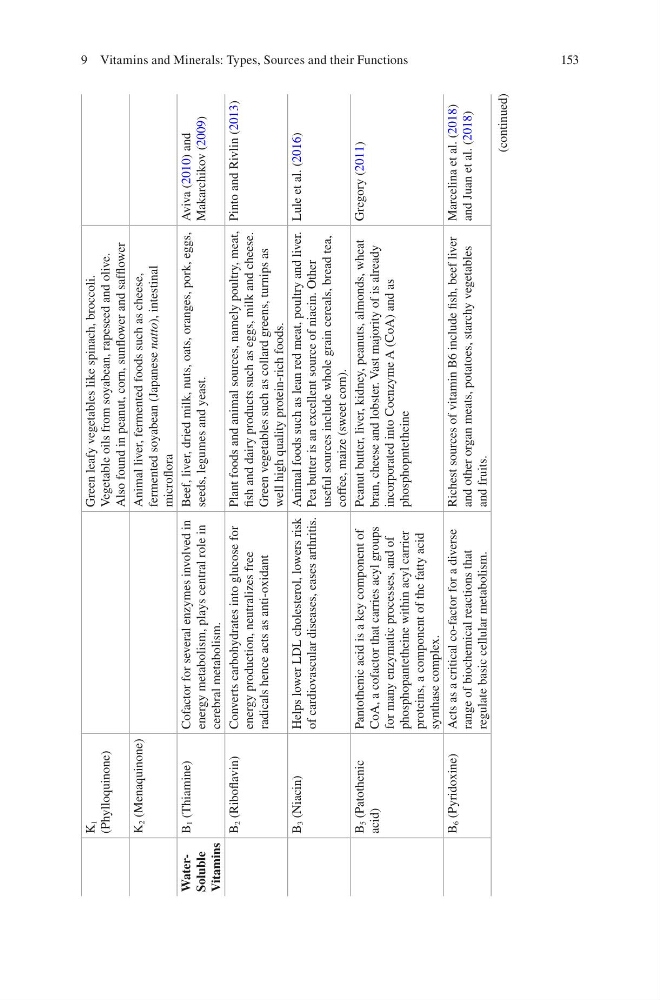
Green leafy vegetables like spinach, broccoli.
Vegetable oils from soyabean, rapeseed and olive.
Also found in peanut, corn, sunflower and safflower
K
2 (Menaquinone)
Animal liver, fermented foods such as cheese,
fermented soyabean (Japanese natto),
intestinal
microflora
WaterSoluble
Vitamins
B
1 (Thiamine)
Cofactor for several enzymes involved in
energy metabolism, plays central role in
cerebral metabolism.
Beef, liver, dried milk, nuts, oats, oranges, pork, eggs,
seeds, legumes and yeast.
Aviva (2010) and
Makarchikov (2009)
B
2 (Riboflavin)
Converts carbohydrates into glucose for
energy production, neutralizes free
radicals hence acts as anti-oxidant
Plant foods and animal sources, namely poultry, meat,
fish and dairy products such as eggs, milk and cheese.
Green vegetables such as collard greens, turnips as
well high quality protein-rich foods.
Pinto and Rivlin (2013)
B
3 (Niacin)
Helps lower LDL cholesterol, lowers risk
of cardiovascular diseases, eases arthritis.
Animal foods such as lean red meat, poultry and liver.
Pea butter is an excellent source of niacin. Other
useful sources include whole grain cereals, bread tea,
coffee, maize (sweet corn).
Lule et al. (2016)
B
5 (Patothenic
acid)
Pantothenic acid is a key component of
CoA, a cofactor that carries acyl groups
for many enzymatic processes, and of
phosphopantetheine within acyl carrier
proteins, a component of the fatty acid
synthase complex.
Peanut butter, liver, kidney, peanuts, almonds, wheat
bran, cheese and lobster. Vast majority of is already
incorporated into Coenzyme A (CoA) and as
phosphopntetheine
Gregory (2011)
B
6 (Pyridoxine)
Acts as a critical co-factor for a diverse
range of biochemical reactions that
regulate basic cellular metabolism.
Richest sources of vitamin B6 include fish, beef liver
and other organ meats, potatoes, starchy vegetables
and fruits.
Marcelina et al. (2018)
and Juan et al. (2018)
(continued)
9 Vitamins and Minerals: Types, Sources and their Functions