

5.2.1 Valorization of Biomass into Fuels and High Value Added
Products
Biomass constitutes largest resource of carbohydrates and lignin. Every year
2 Â 10
11 tonnes of biomass is generated worldwide (Appels and Dewil 2012).
Among the biomass, the estimated global production of lignocellulosic biomass is
about 181.5 billion tonnes per year (Narron et al. 2016). Due to increasing energy
demand, environmental, geo-political factors of fossil fuels utilization, biomass as a
renewable alternative was considered for production of different types of biofuels.
Biomass can be divided into four types based on the origin.
• Biomass exclusively produced for fuel purposes. For example, sugar beet, corn,
sugarcane, etc.
• Lignocellulosic biomass includes all agro-residues rich in carbohydrate for biofuel production.
• Organic fraction of municipal soil wastes rich in fuel properties
• Crop residues that include residues after harvest of crop (Fig. 5.3).
BIOWASTES
Animal waste
Food waste
Mixed waste
Biomass waste
Industrial waste
Activated sludge
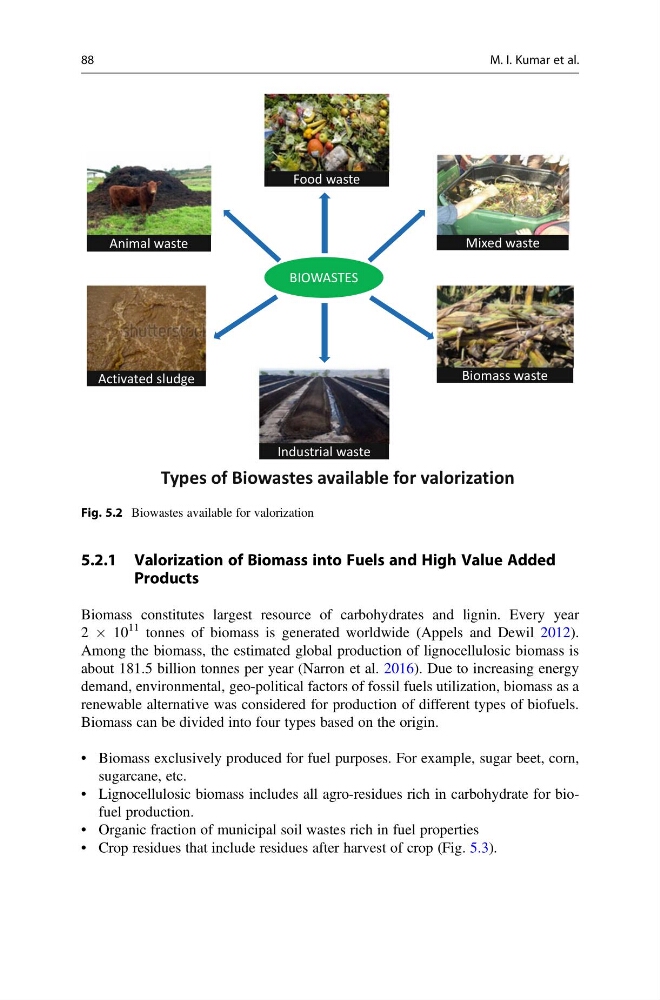
Types of Biowastes available for valorization
Fig. 5.2 Biowastes available for valorization
88
M. I. Kumar et al.
Products
Biomass constitutes largest resource of carbohydrates and lignin. Every year
2 Â 10
11 tonnes of biomass is generated worldwide (Appels and Dewil 2012).
Among the biomass, the estimated global production of lignocellulosic biomass is
about 181.5 billion tonnes per year (Narron et al. 2016). Due to increasing energy
demand, environmental, geo-political factors of fossil fuels utilization, biomass as a
renewable alternative was considered for production of different types of biofuels.
Biomass can be divided into four types based on the origin.
• Biomass exclusively produced for fuel purposes. For example, sugar beet, corn,
sugarcane, etc.
• Lignocellulosic biomass includes all agro-residues rich in carbohydrate for biofuel production.
• Organic fraction of municipal soil wastes rich in fuel properties
• Crop residues that include residues after harvest of crop (Fig. 5.3).
BIOWASTES
Animal waste
Food waste
Mixed waste
Biomass waste
Industrial waste
Activated sludge
Types of Biowastes available for valorization
Fig. 5.2 Biowastes available for valorization
88
M. I. Kumar et al.