

4.4.5 Recovery
The lower concentration of biobutanol in ABE fermentation is mainly because of
inhibition of biobutanol towards the microbes, low biobutanol titer, sluggish fermentation. Integration of in situ recovery could help to increase the recovery of
biobutanol from the fermentation process. Several in situ recovery techniques are
suggested such as pervaporation (Li et al. 2014), gas stripping (Qureshi and
Blaschek 2001), liquid–liquid extraction (Yen and Wang 2013), and adsorption
(Luyben 2008). The low energy input and less capital investment for facilities
could be another specialties of this techniques compared to other techniques (Xue
et al. 2014). The best recovery technique in terms of high biobutanol recovery, costeffectiveness, and capability to upscale into large scale processing is preferred.
Besides in situ recovery enhances the overall fermentation process and is able to
prolong the microbial growth and productivity. Separation of biobutanol from the
production process should not remove other biobutanol precursor such as butyric
acid, enzyme and others glucose, and media. Gas stripping has shown as a suitable
candidate for the biobutanol recovery since only volatile compound was stripped out
without interfering the fermentation process itself. In other words, the gas stripping
is preferred as it selectively separates volatile substances and do not harm the cell,
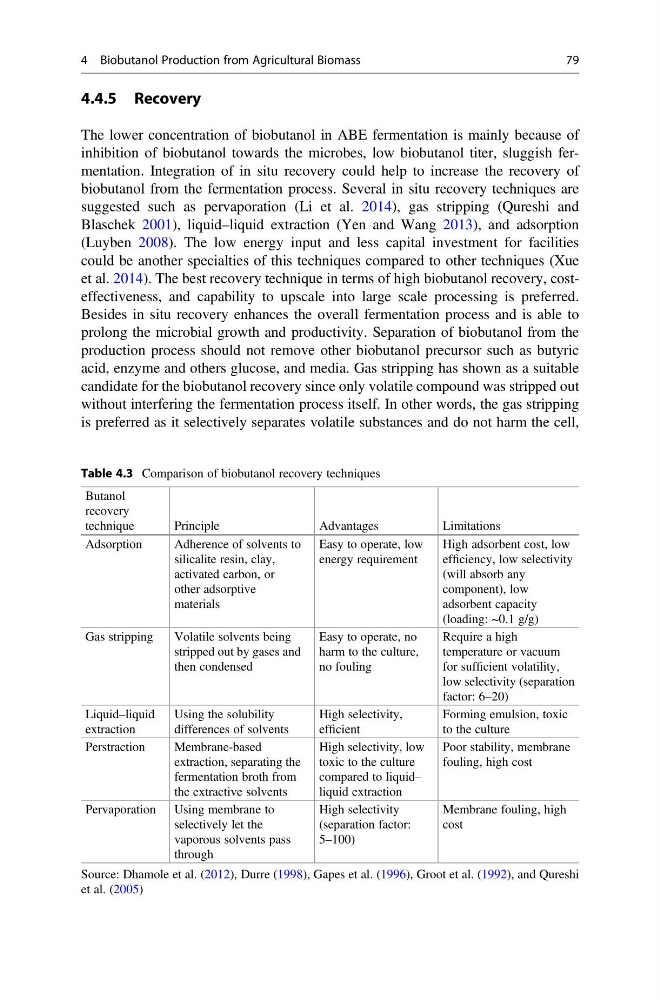
Table 4.3 Comparison of biobutanol recovery techniques
Butanol
recovery
technique
Principle
Advantages
Limitations
Adsorption
Adherence of solvents to
silicalite resin, clay,
activated carbon, or
other adsorptive
materials
Easy to operate, low
energy requirement
High adsorbent cost, low
efficiency, low selectivity
(will absorb any
component), low
adsorbent capacity
(loading: ~0.1 g/g)
Gas stripping
Volatile solvents being
stripped out by gases and
then condensed
Easy to operate, no
harm to the culture,
no fouling
Require a high
temperature or vacuum
for sufficient volatility,
low selectivity (separation
factor: 6–20)
Liquid–liquid
extraction
Using the solubility
differences of solvents
High selectivity,
efficient
Forming emulsion, toxic
to the culture
Perstraction
Membrane-based
extraction, separating the
fermentation broth from
the extractive solvents
High selectivity, low
toxic to the culture
compared to liquid–
liquid extraction
Poor stability, membrane
fouling, high cost
Pervaporation Using membrane to
selectively let the
vaporous solvents pass
through
High selectivity
(separation factor:
5–100)
Membrane fouling, high
cost
Source: Dhamole et al. (2012), Durre (1998), Gapes et al. (1996), Groot et al. (1992), and Qureshi
et al. (2005)
4 Biobutanol Production from Agricultural Biomass
79
The lower concentration of biobutanol in ABE fermentation is mainly because of
inhibition of biobutanol towards the microbes, low biobutanol titer, sluggish fermentation. Integration of in situ recovery could help to increase the recovery of
biobutanol from the fermentation process. Several in situ recovery techniques are
suggested such as pervaporation (Li et al. 2014), gas stripping (Qureshi and
Blaschek 2001), liquid–liquid extraction (Yen and Wang 2013), and adsorption
(Luyben 2008). The low energy input and less capital investment for facilities
could be another specialties of this techniques compared to other techniques (Xue
et al. 2014). The best recovery technique in terms of high biobutanol recovery, costeffectiveness, and capability to upscale into large scale processing is preferred.
Besides in situ recovery enhances the overall fermentation process and is able to
prolong the microbial growth and productivity. Separation of biobutanol from the
production process should not remove other biobutanol precursor such as butyric
acid, enzyme and others glucose, and media. Gas stripping has shown as a suitable
candidate for the biobutanol recovery since only volatile compound was stripped out
without interfering the fermentation process itself. In other words, the gas stripping
is preferred as it selectively separates volatile substances and do not harm the cell,
Table 4.3 Comparison of biobutanol recovery techniques
Butanol
recovery
technique
Principle
Advantages
Limitations
Adsorption
Adherence of solvents to
silicalite resin, clay,
activated carbon, or
other adsorptive
materials
Easy to operate, low
energy requirement
High adsorbent cost, low
efficiency, low selectivity
(will absorb any
component), low
adsorbent capacity
(loading: ~0.1 g/g)
Gas stripping
Volatile solvents being
stripped out by gases and
then condensed
Easy to operate, no
harm to the culture,
no fouling
Require a high
temperature or vacuum
for sufficient volatility,
low selectivity (separation
factor: 6–20)
Liquid–liquid
extraction
Using the solubility
differences of solvents
High selectivity,
efficient
Forming emulsion, toxic
to the culture
Perstraction
Membrane-based
extraction, separating the
fermentation broth from
the extractive solvents
High selectivity, low
toxic to the culture
compared to liquid–
liquid extraction
Poor stability, membrane
fouling, high cost
Pervaporation Using membrane to
selectively let the
vaporous solvents pass
through
High selectivity
(separation factor:
5–100)
Membrane fouling, high
cost
Source: Dhamole et al. (2012), Durre (1998), Gapes et al. (1996), Groot et al. (1992), and Qureshi
et al. (2005)
4 Biobutanol Production from Agricultural Biomass
79