

biofuels that use lignocellulosic biomass substrate (Morone and Pandey 2014).
Previously, the sources of carbon for ABE fermentation are sugarcane, corn, and
cassava which has competing demands. Currently, researchers are interested to
utilize agricultural lignocellulosic biomass as a substrate for the biofuel production
including bioethanol and biobutanol.
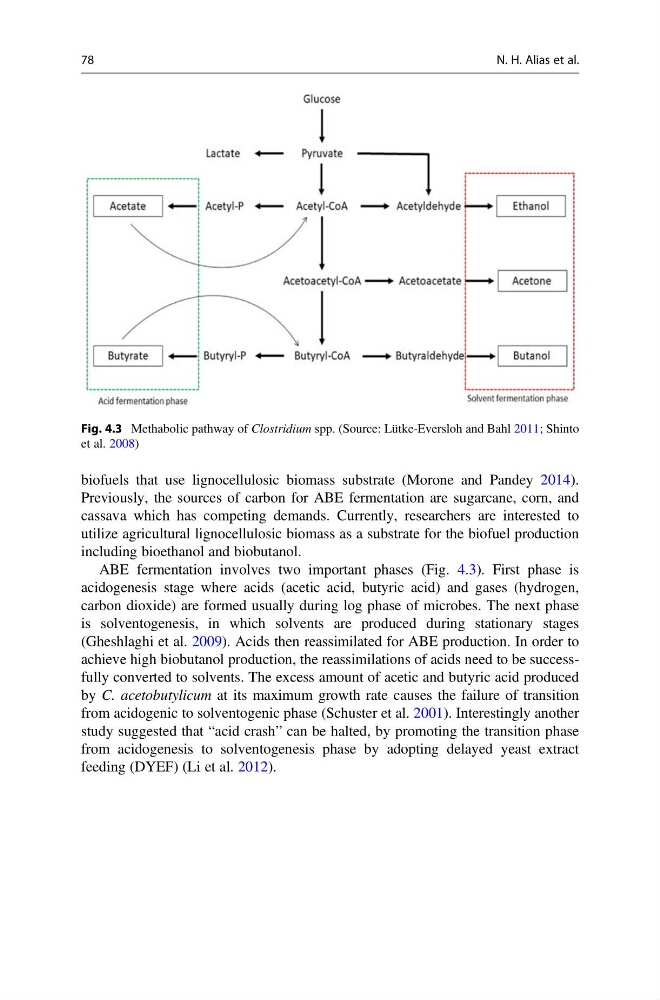
ABE fermentation involves two important phases (Fig. 4.3). First phase is
acidogenesis stage where acids (acetic acid, butyric acid) and gases (hydrogen,
carbon dioxide) are formed usually during log phase of microbes. The next phase
is solventogenesis, in which solvents are produced during stationary stages
(Gheshlaghi et al. 2009). Acids then reassimilated for ABE production. In order to
achieve high biobutanol production, the reassimilations of acids need to be successfully converted to solvents. The excess amount of acetic and butyric acid produced
by C. acetobutylicum at its maximum growth rate causes the failure of transition
from acidogenic to solventogenic phase (Schuster et al. 2001). Interestingly another
study suggested that “acid crash” can be halted, by promoting the transition phase
from acidogenesis to solventogenesis phase by adopting delayed yeast extract
feeding (DYEF) (Li et al. 2012).
Fig. 4.3 Methabolic pathway of Clostridium spp. (Source: Lütke-Eversloh and Bahl 2011; Shinto
et al. 2008)
78
N. H. Alias et al.
Previously, the sources of carbon for ABE fermentation are sugarcane, corn, and
cassava which has competing demands. Currently, researchers are interested to
utilize agricultural lignocellulosic biomass as a substrate for the biofuel production
including bioethanol and biobutanol.
ABE fermentation involves two important phases (Fig. 4.3). First phase is
acidogenesis stage where acids (acetic acid, butyric acid) and gases (hydrogen,
carbon dioxide) are formed usually during log phase of microbes. The next phase
is solventogenesis, in which solvents are produced during stationary stages
(Gheshlaghi et al. 2009). Acids then reassimilated for ABE production. In order to
achieve high biobutanol production, the reassimilations of acids need to be successfully converted to solvents. The excess amount of acetic and butyric acid produced
by C. acetobutylicum at its maximum growth rate causes the failure of transition
from acidogenic to solventogenic phase (Schuster et al. 2001). Interestingly another
study suggested that “acid crash” can be halted, by promoting the transition phase
from acidogenesis to solventogenesis phase by adopting delayed yeast extract
feeding (DYEF) (Li et al. 2012).
Fig. 4.3 Methabolic pathway of Clostridium spp. (Source: Lütke-Eversloh and Bahl 2011; Shinto
et al. 2008)
78
N. H. Alias et al.