

3.7.2 Potential for the Use of Organic Fertilizers, Herbicides,
and Pesticides
Until 2016, 9% of total fertilizers, herbicides, and pesticides used in Ecuador were of
organic origin. Taking this percentage as a basis, it is important to review the impact
of the expansion of the production of organic inputs for agriculture and the displacement of products of chemical origin and fossil materials. The limitations of organic
products in terms of waste generation and product yields per hectare should be taken
into account.
3.7.3 Estimating Biomass-Based Manufacturing and Energy
Development
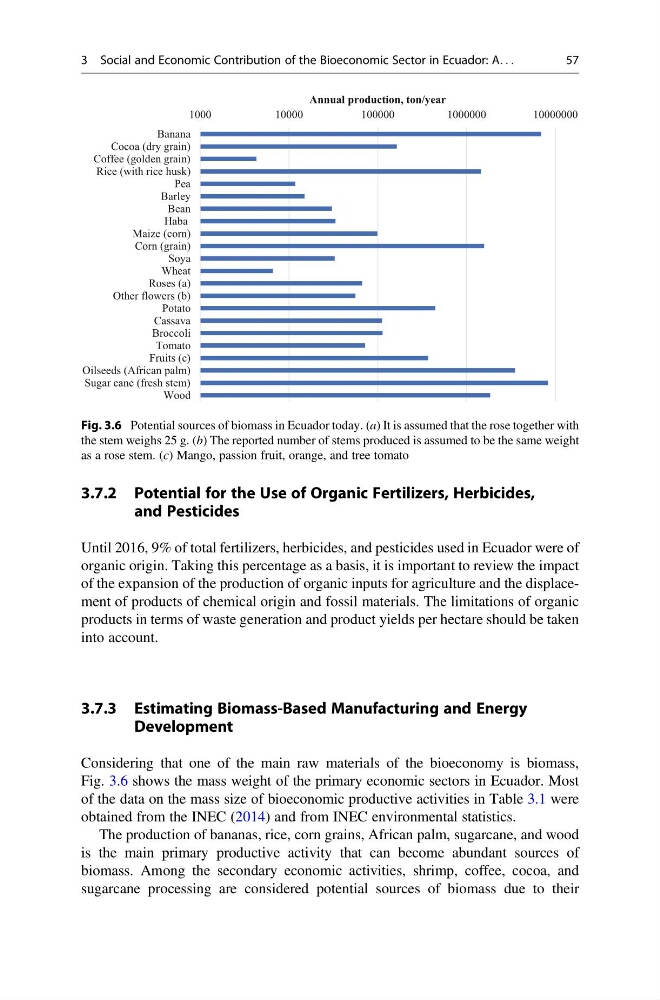
Considering that one of the main raw materials of the bioeconomy is biomass,
Fig. 3.6 shows the mass weight of the primary economic sectors in Ecuador. Most
of the data on the mass size of bioeconomic productive activities in Table 3.1 were
obtained from the INEC (2014) and from INEC environmental statistics.
The production of bananas, rice, corn grains, African palm, sugarcane, and wood
is the main primary productive activity that can become abundant sources of
biomass. Among the secondary economic activities, shrimp, coffee, cocoa, and
sugarcane processing are considered potential sources of biomass due to their
1000
10000
100000
1000000
10000000
Banana
Cocoa (dry grain)
Coffee (golden grain)
Rice (with rice husk)
Pea
Barley
Bean
Haba
Maize (corn)
Corn (grain)
Soya
Wheat
Roses (a)
Other flowers (b)
Potato
Cassava
Broccoli
Tomato
Fruits (c)
Oilseeds (African palm)
Sugar cane (fresh stem)
Wood
Annual production, ton/year
Fig. 3.6 Potential sources of biomass in Ecuador today. (a) It is assumed that the rose together with
the stem weighs 25 g. (b) The reported number of stems produced is assumed to be the same weight
as a rose stem. (c) Mango, passion fruit, orange, and tree tomato
3 Social and Economic Contribution of the Bioeconomic Sector in Ecuador: A. . .
57
and Pesticides
Until 2016, 9% of total fertilizers, herbicides, and pesticides used in Ecuador were of
organic origin. Taking this percentage as a basis, it is important to review the impact
of the expansion of the production of organic inputs for agriculture and the displacement of products of chemical origin and fossil materials. The limitations of organic
products in terms of waste generation and product yields per hectare should be taken
into account.
3.7.3 Estimating Biomass-Based Manufacturing and Energy
Development
Considering that one of the main raw materials of the bioeconomy is biomass,
Fig. 3.6 shows the mass weight of the primary economic sectors in Ecuador. Most
of the data on the mass size of bioeconomic productive activities in Table 3.1 were
obtained from the INEC (2014) and from INEC environmental statistics.
The production of bananas, rice, corn grains, African palm, sugarcane, and wood
is the main primary productive activity that can become abundant sources of
biomass. Among the secondary economic activities, shrimp, coffee, cocoa, and
sugarcane processing are considered potential sources of biomass due to their
1000
10000
100000
1000000
10000000
Banana
Cocoa (dry grain)
Coffee (golden grain)
Rice (with rice husk)
Pea
Barley
Bean
Haba
Maize (corn)
Corn (grain)
Soya
Wheat
Roses (a)
Other flowers (b)
Potato
Cassava
Broccoli
Tomato
Fruits (c)
Oilseeds (African palm)
Sugar cane (fresh stem)
Wood
Annual production, ton/year
Fig. 3.6 Potential sources of biomass in Ecuador today. (a) It is assumed that the rose together with
the stem weighs 25 g. (b) The reported number of stems produced is assumed to be the same weight
as a rose stem. (c) Mango, passion fruit, orange, and tree tomato
3 Social and Economic Contribution of the Bioeconomic Sector in Ecuador: A. . .
57