

3.6.1 Labour and Salary
As mentioned earlier, the labour and salary aspects allow us to quantify how many
workers are related to the bioeconomic processes, as well as the remuneration
involved in this type of activities. Such an analysis allows researchers to assess the
quality of work and to propose possible alternatives for the improvement of these
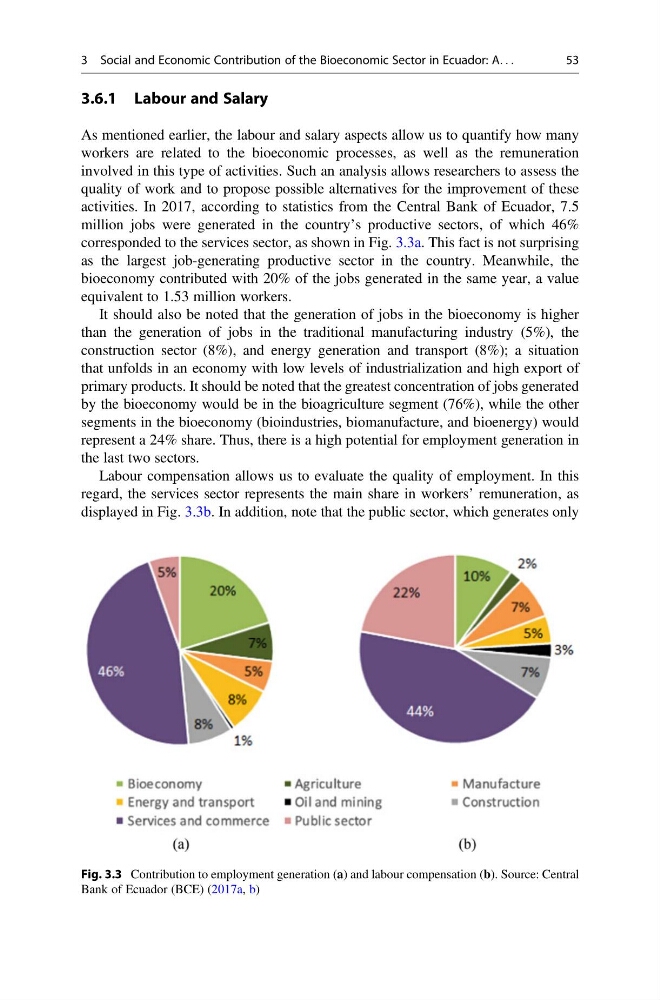
activities. In 2017, according to statistics from the Central Bank of Ecuador, 7.5
million jobs were generated in the country’s productive sectors, of which 46%
corresponded to the services sector, as shown in Fig. 3.3a. This fact is not surprising
as the largest job-generating productive sector in the country. Meanwhile, the
bioeconomy contributed with 20% of the jobs generated in the same year, a value
equivalent to 1.53 million workers.
It should also be noted that the generation of jobs in the bioeconomy is higher
than the generation of jobs in the traditional manufacturing industry (5%), the
construction sector (8%), and energy generation and transport (8%); a situation
that unfolds in an economy with low levels of industrialization and high export of
primary products. It should be noted that the greatest concentration of jobs generated
by the bioeconomy would be in the bioagriculture segment (76%), while the other
segments in the bioeconomy (bioindustries, biomanufacture, and bioenergy) would
represent a 24% share. Thus, there is a high potential for employment generation in
the last two sectors.
Labour compensation allows us to evaluate the quality of employment. In this
regard, the services sector represents the main share in workers’ remuneration, as
displayed in Fig. 3.3b. In addition, note that the public sector, which generates only
Fig. 3.3 Contribution to employment generation (a) and labour compensation (b). Source: Central
Bank of Ecuador (BCE) (2017a, b)
3 Social and Economic Contribution of the Bioeconomic Sector in Ecuador: A. . .
53
As mentioned earlier, the labour and salary aspects allow us to quantify how many
workers are related to the bioeconomic processes, as well as the remuneration
involved in this type of activities. Such an analysis allows researchers to assess the
quality of work and to propose possible alternatives for the improvement of these
activities. In 2017, according to statistics from the Central Bank of Ecuador, 7.5
million jobs were generated in the country’s productive sectors, of which 46%
corresponded to the services sector, as shown in Fig. 3.3a. This fact is not surprising
as the largest job-generating productive sector in the country. Meanwhile, the
bioeconomy contributed with 20% of the jobs generated in the same year, a value
equivalent to 1.53 million workers.
It should also be noted that the generation of jobs in the bioeconomy is higher
than the generation of jobs in the traditional manufacturing industry (5%), the
construction sector (8%), and energy generation and transport (8%); a situation
that unfolds in an economy with low levels of industrialization and high export of
primary products. It should be noted that the greatest concentration of jobs generated
by the bioeconomy would be in the bioagriculture segment (76%), while the other
segments in the bioeconomy (bioindustries, biomanufacture, and bioenergy) would
represent a 24% share. Thus, there is a high potential for employment generation in
the last two sectors.
Labour compensation allows us to evaluate the quality of employment. In this
regard, the services sector represents the main share in workers’ remuneration, as
displayed in Fig. 3.3b. In addition, note that the public sector, which generates only
Fig. 3.3 Contribution to employment generation (a) and labour compensation (b). Source: Central
Bank of Ecuador (BCE) (2017a, b)
3 Social and Economic Contribution of the Bioeconomic Sector in Ecuador: A. . .
53