

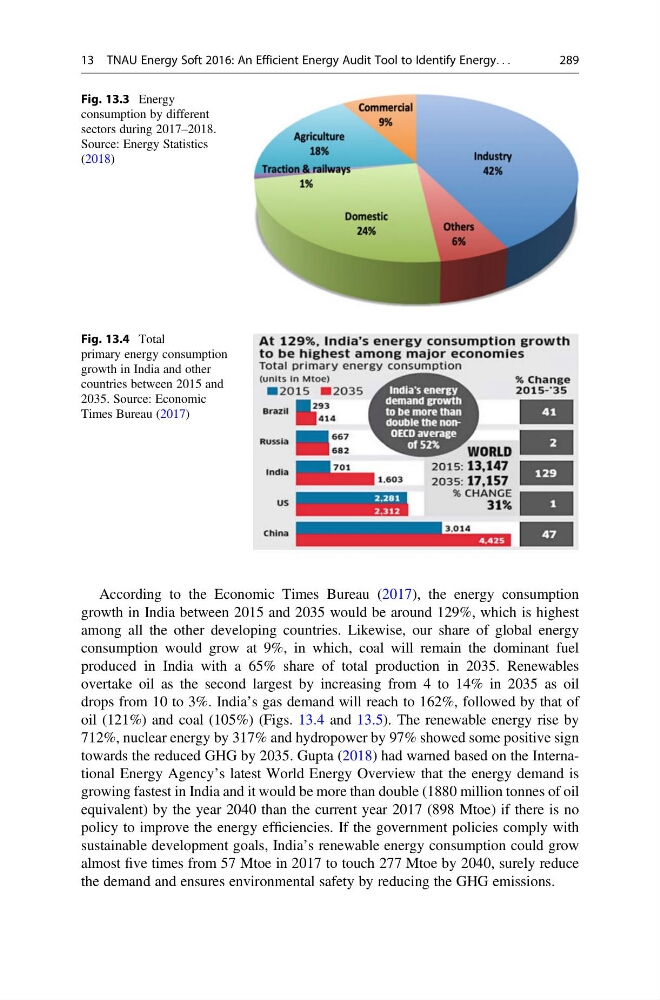
According to the Economic Times Bureau (2017), the energy consumption
growth in India between 2015 and 2035 would be around 129%, which is highest
among all the other developing countries. Likewise, our share of global energy
consumption would grow at 9%, in which, coal will remain the dominant fuel
produced in India with a 65% share of total production in 2035. Renewables
overtake oil as the second largest by increasing from 4 to 14% in 2035 as oil
drops from 10 to 3%. India’s gas demand will reach to 162%, followed by that of
oil (121%) and coal (105%) (Figs. 13.4 and 13.5). The renewable energy rise by
712%, nuclear energy by 317% and hydropower by 97% showed some positive sign
towards the reduced GHG by 2035. Gupta (2018) had warned based on the International Energy Agency’s latest World Energy Overview that the energy demand is
growing fastest in India and it would be more than double (1880 million tonnes of oil
equivalent) by the year 2040 than the current year 2017 (898 Mtoe) if there is no
policy to improve the energy efficiencies. If the government policies comply with
sustainable development goals, India’s renewable energy consumption could grow
almost five times from 57 Mtoe in 2017 to touch 277 Mtoe by 2040, surely reduce
the demand and ensures environmental safety by reducing the GHG emissions.
Fig. 13.3 Energy
consumption by different
sectors during 2017–2018.
Source: Energy Statistics
(2018)
Fig. 13.4 Total
primary energy consumption
growth in India and other
countries between 2015 and
2035. Source: Economic
Times Bureau (2017)
13 TNAU Energy Soft 2016: An Efficient Energy Audit Tool to Identify Energy. . .
289
growth in India between 2015 and 2035 would be around 129%, which is highest
among all the other developing countries. Likewise, our share of global energy
consumption would grow at 9%, in which, coal will remain the dominant fuel
produced in India with a 65% share of total production in 2035. Renewables
overtake oil as the second largest by increasing from 4 to 14% in 2035 as oil
drops from 10 to 3%. India’s gas demand will reach to 162%, followed by that of
oil (121%) and coal (105%) (Figs. 13.4 and 13.5). The renewable energy rise by
712%, nuclear energy by 317% and hydropower by 97% showed some positive sign
towards the reduced GHG by 2035. Gupta (2018) had warned based on the International Energy Agency’s latest World Energy Overview that the energy demand is
growing fastest in India and it would be more than double (1880 million tonnes of oil
equivalent) by the year 2040 than the current year 2017 (898 Mtoe) if there is no
policy to improve the energy efficiencies. If the government policies comply with
sustainable development goals, India’s renewable energy consumption could grow
almost five times from 57 Mtoe in 2017 to touch 277 Mtoe by 2040, surely reduce
the demand and ensures environmental safety by reducing the GHG emissions.
Fig. 13.3 Energy
consumption by different
sectors during 2017–2018.
Source: Energy Statistics
(2018)
Fig. 13.4 Total
primary energy consumption
growth in India and other
countries between 2015 and
2035. Source: Economic
Times Bureau (2017)
13 TNAU Energy Soft 2016: An Efficient Energy Audit Tool to Identify Energy. . .
289