

13.3 Influence of Agricultural Technologies on Climate Change
Factors
Agriculture crops and forest trees are the important sinks of atmospheric CO 2 in the
terrestrial ecosystem, though it contributes equally to climate change through GHC
emissions. Also, the climate change impact on agriculture reflects directly on food
security and indirectly on the standard of living of farmers. The study by Cline
(2007) alarmed that the primary agricultural production sector would greatly suffer
from projected climate change and the Indian region would get a decline in food
production of 15–25% in southern parts and 25–50% in northern parts of India by
2080. A lot of interventions are being made globally in different sectors to contain
greenhouse gas emissions by reducing the use of energy, in particular non-renewable
fossil fuel. At present, agricultural researchers are aiming for sustainability in
productivity and economic development without affecting environmental safety.
The following studies are clearly indicating how the alternate technologies reduce
the GHG emissions and Global Warming Potential (GWP) of Agricultural systems.
A study conducted in collaboration of International Maize and Wheat Improvement Center (CIMMYT), the University of Aberdeen and the Indian Council of
Agricultural Research (ICAR), with support from the CGIAR Research Program on
Climate Change, Agriculture, and Food Security (CCAFS) inferred that 18% of
GHG emissions from Indian agriculture could be reduced through the adoption of
mitigation measures such as efficient use of fertilizer (17.5 MtCO 2 e per year), zero
tillage (17 MtCO 2 e per year) and better water management (12 MtCo2e per year) in
rice farming (Sapkota et al. 2019). The study also estimated that by 2030, GHG
emissions from the agricultural sector in India would be 515 MtCO 2 e per year, with a
technical mitigation potential of 85.5 MtCO 2 e per year through adoption of various
mitigation practices.
The cultivated soils are the major sources of methane and nitrous oxide, both
having significant global warming potential. The GWP ranged from 240 kg CO 2 eq.
per ha in pulses to 3700 kg CO 2 eq. per ha in continuously flooded rice. Agriculture
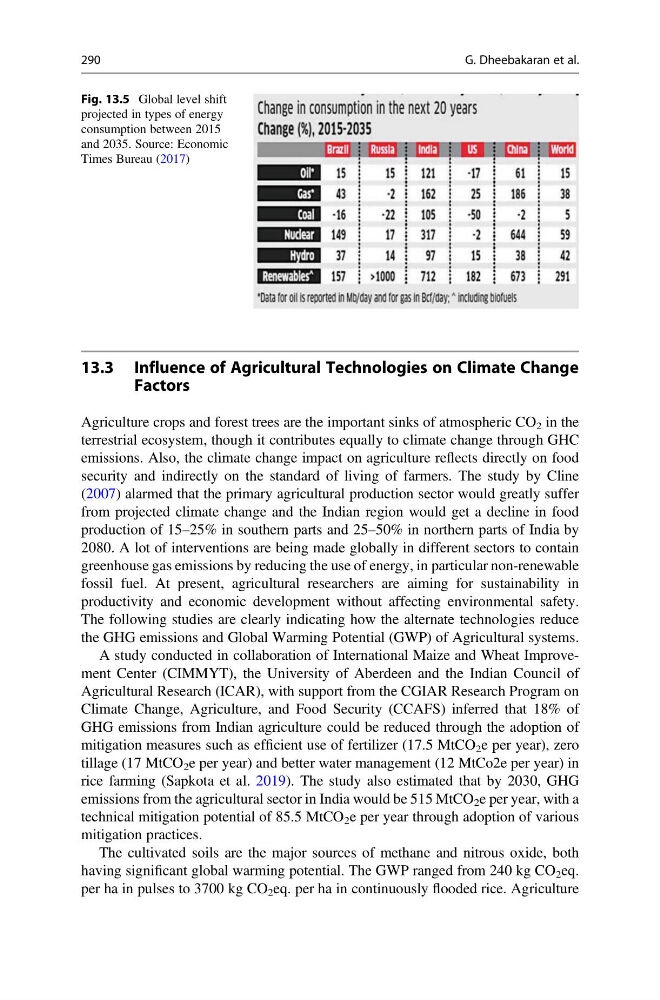
Fig. 13.5 Global level shift
projected in types of energy
consumption between 2015
and 2035. Source: Economic
Times Bureau (2017)
290
G. Dheebakaran et al.
Factors
Agriculture crops and forest trees are the important sinks of atmospheric CO 2 in the
terrestrial ecosystem, though it contributes equally to climate change through GHC
emissions. Also, the climate change impact on agriculture reflects directly on food
security and indirectly on the standard of living of farmers. The study by Cline
(2007) alarmed that the primary agricultural production sector would greatly suffer
from projected climate change and the Indian region would get a decline in food
production of 15–25% in southern parts and 25–50% in northern parts of India by
2080. A lot of interventions are being made globally in different sectors to contain
greenhouse gas emissions by reducing the use of energy, in particular non-renewable
fossil fuel. At present, agricultural researchers are aiming for sustainability in
productivity and economic development without affecting environmental safety.
The following studies are clearly indicating how the alternate technologies reduce
the GHG emissions and Global Warming Potential (GWP) of Agricultural systems.
A study conducted in collaboration of International Maize and Wheat Improvement Center (CIMMYT), the University of Aberdeen and the Indian Council of
Agricultural Research (ICAR), with support from the CGIAR Research Program on
Climate Change, Agriculture, and Food Security (CCAFS) inferred that 18% of
GHG emissions from Indian agriculture could be reduced through the adoption of
mitigation measures such as efficient use of fertilizer (17.5 MtCO 2 e per year), zero
tillage (17 MtCO 2 e per year) and better water management (12 MtCo2e per year) in
rice farming (Sapkota et al. 2019). The study also estimated that by 2030, GHG
emissions from the agricultural sector in India would be 515 MtCO 2 e per year, with a
technical mitigation potential of 85.5 MtCO 2 e per year through adoption of various
mitigation practices.
The cultivated soils are the major sources of methane and nitrous oxide, both
having significant global warming potential. The GWP ranged from 240 kg CO 2 eq.
per ha in pulses to 3700 kg CO 2 eq. per ha in continuously flooded rice. Agriculture
Fig. 13.5 Global level shift
projected in types of energy
consumption between 2015
and 2035. Source: Economic
Times Bureau (2017)
290
G. Dheebakaran et al.