

ingredient(s) is part of the formulation designed to control the target pest. The
function of inert ingredients is to enhance application and effectiveness of the active
ingredient(s). A pesticide formulation is nothing but a combination of active and
inactive ingredients. The organism used in the biopesticides formulation must revive
from their dormant state to be active during application and post-application phase
(Boyetchko et al. 1999). Biopesticides are divided into two categories based on
formulations.
• Dry (dust powders, granules, seed dressers, wettable powders and wettable
dispersible powder)
• Liquid (Emulsion, suspension, emulsifiable concentrate, ultra-low volume
liquids)
11.12.1 Dry Powders
Dry formulation is used for direct application as dustable powders in which only
10 % of active ingredients are mixed with a finely ground mineral powder such as
clay or talc. The inactive ingredients act as UV protectants and they increase the
adsorption of biopesticides. The active ingredient in granule formulation ranges
from the 2–20% which is coated or absorbed into granules made up of silica, starch,
clay, groundnut plant residues, etc. These formulations are applied near to soil.
When sufficient soil moisture is attained, it releases its active component. It can
control insects, weeds and nematodes. In India, Bt var. israelensis Serotype H-14,
Strain VCRC B-17 is available in the form of slow-release granules. Seed dressing/
coating formulations are also available in powder form. They are mixed with seed
before planting. Wettable powders (WP) are finely ground powders obtained by
mixing active ingredients with dispersing agents, surfactants, melting agents, etc.
and can be applied after mixing with water. Wettable powders have good storage,
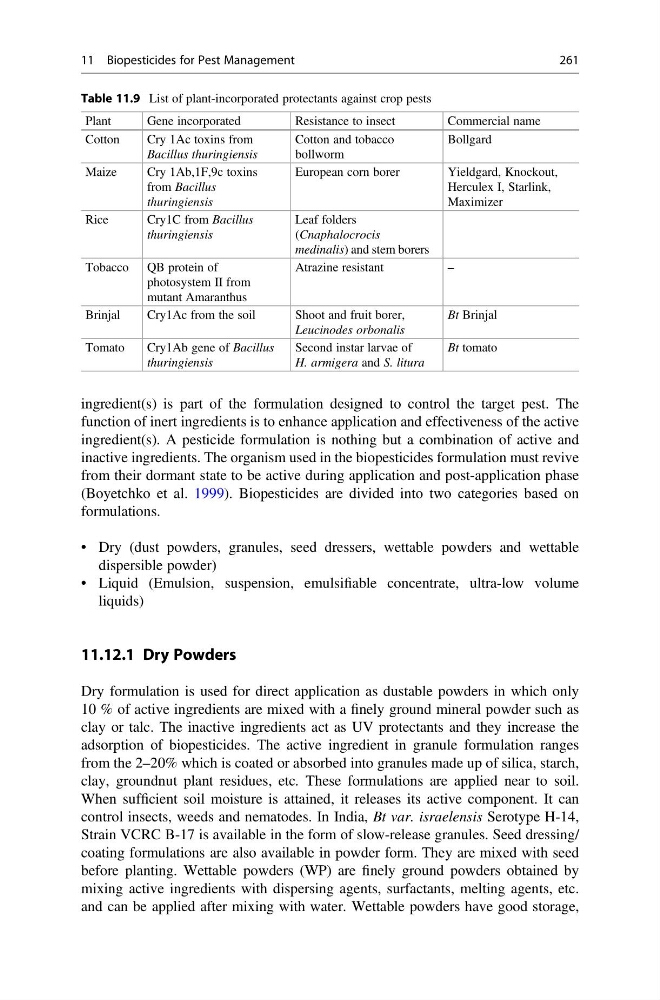
Table 11.9 List of plant-incorporated protectants against crop pests
Plant
Gene incorporated
Resistance to insect
Commercial name
Cotton
Cry 1Ac toxins from
Bacillus thuringiensis
Cotton and tobacco
bollworm
Bollgard
Maize
Cry 1Ab,1F,9c toxins
from Bacillus
thuringiensis
European corn borer
Yieldgard, Knockout,
Herculex I, Starlink,
Maximizer
Rice
Cry1C from Bacillus
thuringiensis
Leaf folders
(Cnaphalocrocis
medinalis) and stem borers
Tobacco QB protein of
photosystem II from
mutant Amaranthus
Atrazine resistant
–
Brinjal
Cry1Ac from the soil
Shoot and fruit borer,
Leucinodes orbonalis
Bt Brinjal
Tomato
Cry1Ab gene of Bacillus
thuringiensis
Second instar larvae of
H. armigera and S. litura
Bt tomato
11 Biopesticides for Pest Management
261
function of inert ingredients is to enhance application and effectiveness of the active
ingredient(s). A pesticide formulation is nothing but a combination of active and
inactive ingredients. The organism used in the biopesticides formulation must revive
from their dormant state to be active during application and post-application phase
(Boyetchko et al. 1999). Biopesticides are divided into two categories based on
formulations.
• Dry (dust powders, granules, seed dressers, wettable powders and wettable
dispersible powder)
• Liquid (Emulsion, suspension, emulsifiable concentrate, ultra-low volume
liquids)
11.12.1 Dry Powders
Dry formulation is used for direct application as dustable powders in which only
10 % of active ingredients are mixed with a finely ground mineral powder such as
clay or talc. The inactive ingredients act as UV protectants and they increase the
adsorption of biopesticides. The active ingredient in granule formulation ranges
from the 2–20% which is coated or absorbed into granules made up of silica, starch,
clay, groundnut plant residues, etc. These formulations are applied near to soil.
When sufficient soil moisture is attained, it releases its active component. It can
control insects, weeds and nematodes. In India, Bt var. israelensis Serotype H-14,
Strain VCRC B-17 is available in the form of slow-release granules. Seed dressing/
coating formulations are also available in powder form. They are mixed with seed
before planting. Wettable powders (WP) are finely ground powders obtained by
mixing active ingredients with dispersing agents, surfactants, melting agents, etc.
and can be applied after mixing with water. Wettable powders have good storage,
Table 11.9 List of plant-incorporated protectants against crop pests
Plant
Gene incorporated
Resistance to insect
Commercial name
Cotton
Cry 1Ac toxins from
Bacillus thuringiensis
Cotton and tobacco
bollworm
Bollgard
Maize
Cry 1Ab,1F,9c toxins
from Bacillus
thuringiensis
European corn borer
Yieldgard, Knockout,
Herculex I, Starlink,
Maximizer
Rice
Cry1C from Bacillus
thuringiensis
Leaf folders
(Cnaphalocrocis
medinalis) and stem borers
Tobacco QB protein of
photosystem II from
mutant Amaranthus
Atrazine resistant
–
Brinjal
Cry1Ac from the soil
Shoot and fruit borer,
Leucinodes orbonalis
Bt Brinjal
Tomato
Cry1Ab gene of Bacillus
thuringiensis
Second instar larvae of
H. armigera and S. litura
Bt tomato
11 Biopesticides for Pest Management
261