

11.11 Plant-Incorporated Protectants
Plants with the toxin-producing genes to fight against the pest are called plantincorporated protectants or genetically modified or genetically engineered plants.
These PIPs help the plants to resist bacteria, viruses or fungi. When PIPs are used
against target insect, it is known as insect-resistant crops. Some of the examples for
PIPs are soybean, brinjal, cotton, corn, potato and tomato. Transgenic plants are
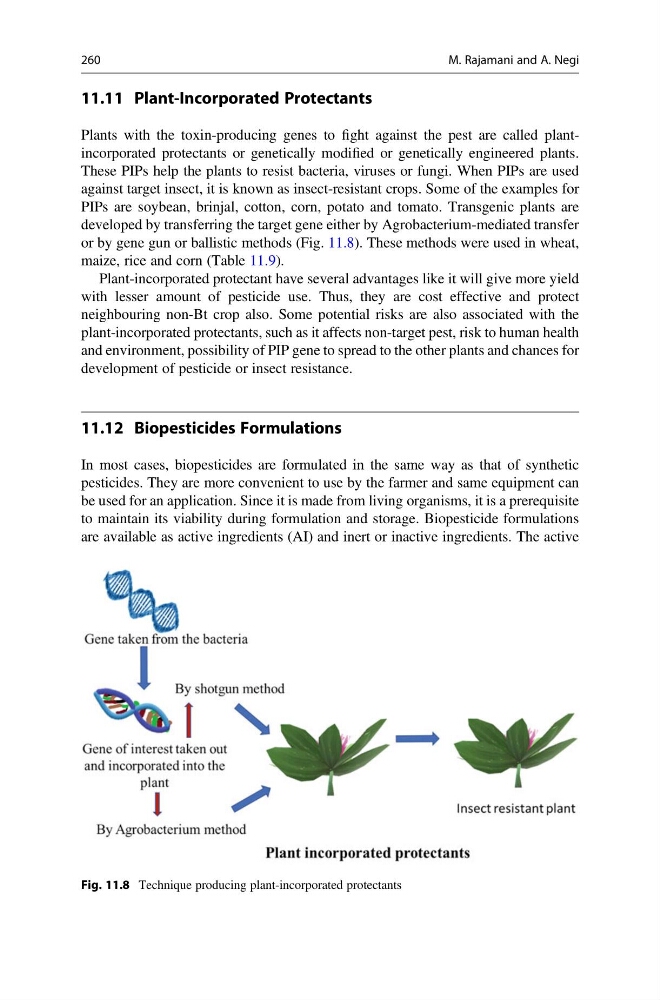
developed by transferring the target gene either by Agrobacterium-mediated transfer
or by gene gun or ballistic methods (Fig. 11.8). These methods were used in wheat,
maize, rice and corn (Table 11.9).
Plant-incorporated protectant have several advantages like it will give more yield
with lesser amount of pesticide use. Thus, they are cost effective and protect
neighbouring non-Bt crop also. Some potential risks are also associated with the
plant-incorporated protectants, such as it affects non-target pest, risk to human health
and environment, possibility of PIP gene to spread to the other plants and chances for
development of pesticide or insect resistance.
11.12 Biopesticides Formulations
In most cases, biopesticides are formulated in the same way as that of synthetic
pesticides. They are more convenient to use by the farmer and same equipment can
be used for an application. Since it is made from living organisms, it is a prerequisite
to maintain its viability during formulation and storage. Biopesticide formulations
are available as active ingredients (AI) and inert or inactive ingredients. The active
Fig. 11.8 Technique producing plant-incorporated protectants
260
M. Rajamani and A. Negi
Plants with the toxin-producing genes to fight against the pest are called plantincorporated protectants or genetically modified or genetically engineered plants.
These PIPs help the plants to resist bacteria, viruses or fungi. When PIPs are used
against target insect, it is known as insect-resistant crops. Some of the examples for
PIPs are soybean, brinjal, cotton, corn, potato and tomato. Transgenic plants are
developed by transferring the target gene either by Agrobacterium-mediated transfer
or by gene gun or ballistic methods (Fig. 11.8). These methods were used in wheat,
maize, rice and corn (Table 11.9).
Plant-incorporated protectant have several advantages like it will give more yield
with lesser amount of pesticide use. Thus, they are cost effective and protect
neighbouring non-Bt crop also. Some potential risks are also associated with the
plant-incorporated protectants, such as it affects non-target pest, risk to human health
and environment, possibility of PIP gene to spread to the other plants and chances for
development of pesticide or insect resistance.
11.12 Biopesticides Formulations
In most cases, biopesticides are formulated in the same way as that of synthetic
pesticides. They are more convenient to use by the farmer and same equipment can
be used for an application. Since it is made from living organisms, it is a prerequisite
to maintain its viability during formulation and storage. Biopesticide formulations
are available as active ingredients (AI) and inert or inactive ingredients. The active
Fig. 11.8 Technique producing plant-incorporated protectants
260
M. Rajamani and A. Negi