

17 million cattle has potential to produce biogas of 545,600 m
3 /day. Biogas plants in
addition to producing biogas, provide sludge, which can be used as a value-added
product (Pertiwiningrum et al. 2016, 2019; Stefaniuk and Oleszczuk 2015). Biogas
sludge also can be combined with eggshells to grow oyster mushroom (Saputra et al.
2010; Pertiwiningrum et al. 2017, 2018).
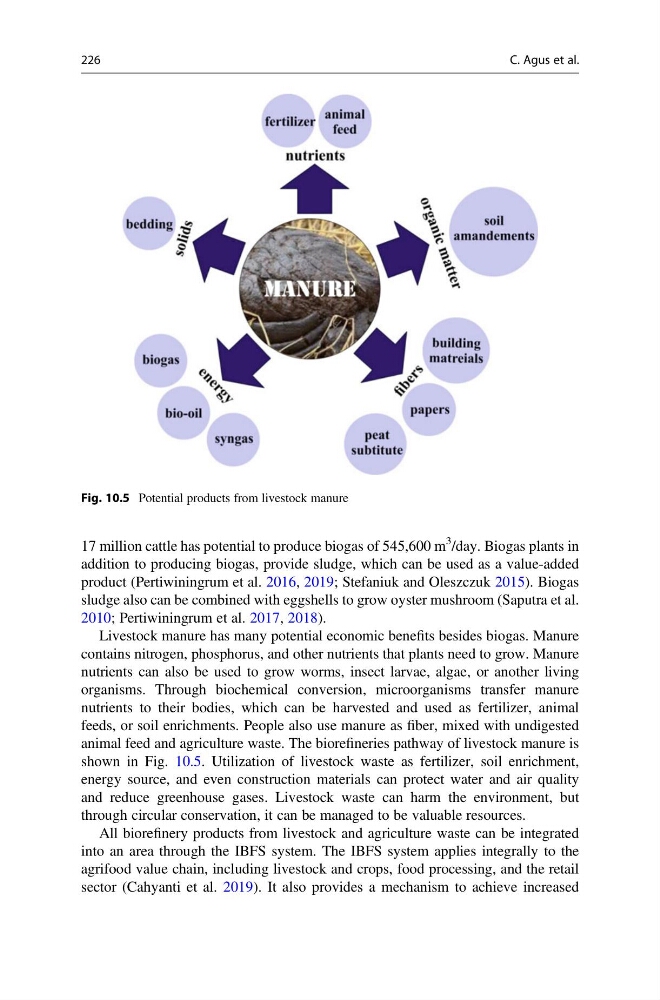
Livestock manure has many potential economic benefits besides biogas. Manure
contains nitrogen, phosphorus, and other nutrients that plants need to grow. Manure
nutrients can also be used to grow worms, insect larvae, algae, or another living
organisms. Through biochemical conversion, microorganisms transfer manure
nutrients to their bodies, which can be harvested and used as fertilizer, animal
feeds, or soil enrichments. People also use manure as fiber, mixed with undigested
animal feed and agriculture waste. The biorefineries pathway of livestock manure is
shown in Fig. 10.5. Utilization of livestock waste as fertilizer, soil enrichment,
energy source, and even construction materials can protect water and air quality
and reduce greenhouse gases. Livestock waste can harm the environment, but
through circular conservation, it can be managed to be valuable resources.
All biorefinery products from livestock and agriculture waste can be integrated
into an area through the IBFS system. The IBFS system applies integrally to the
agrifood value chain, including livestock and crops, food processing, and the retail
sector (Cahyanti et al. 2019). It also provides a mechanism to achieve increased
Fig. 10.5 Potential products from livestock manure
226
C. Agus et al.
3 /day. Biogas plants in
addition to producing biogas, provide sludge, which can be used as a value-added
product (Pertiwiningrum et al. 2016, 2019; Stefaniuk and Oleszczuk 2015). Biogas
sludge also can be combined with eggshells to grow oyster mushroom (Saputra et al.
2010; Pertiwiningrum et al. 2017, 2018).
Livestock manure has many potential economic benefits besides biogas. Manure
contains nitrogen, phosphorus, and other nutrients that plants need to grow. Manure
nutrients can also be used to grow worms, insect larvae, algae, or another living
organisms. Through biochemical conversion, microorganisms transfer manure
nutrients to their bodies, which can be harvested and used as fertilizer, animal
feeds, or soil enrichments. People also use manure as fiber, mixed with undigested
animal feed and agriculture waste. The biorefineries pathway of livestock manure is
shown in Fig. 10.5. Utilization of livestock waste as fertilizer, soil enrichment,
energy source, and even construction materials can protect water and air quality
and reduce greenhouse gases. Livestock waste can harm the environment, but
through circular conservation, it can be managed to be valuable resources.
All biorefinery products from livestock and agriculture waste can be integrated
into an area through the IBFS system. The IBFS system applies integrally to the
agrifood value chain, including livestock and crops, food processing, and the retail
sector (Cahyanti et al. 2019). It also provides a mechanism to achieve increased
Fig. 10.5 Potential products from livestock manure
226
C. Agus et al.