

waste and by-products so that economic value is added. Adoption of IBFS increases
resource efficiency through use and reuse of resources and improvement in feedback
loops. Implementation of IBFS and circular economy will make our business more
economical and sustainable in the long term.
Implementation of IBFS and circular economy in agriculture and livestock
farming is possible. Many agriculture and livestock waste are ideal raw materials
for biological processes to create new products or existing products. Technologies
that facilitate these processes are composting, anaerobic digestion, open-pond
bioreactors, pyrolysis, and chemical extraction. These technologies have been spread
and implemented in the agriculture and livestock sectors previously, but the integration of these technologies in an integrated area is rare. Biorefinery is also an
important option in waste management. The biorefinery is a facility for processing
bio-based feedstocks into valuable products addressing the needs of a diverse market
like fuels, plastics, or other commodities (Murthy 2019). Biowastes can be treated
through direct combustion, thermochemical conversion, biochemical conversion,
and non-value-added treatment (Yu et al. 2018). The most common method is the
first three types, waste to energy (WTE). Waste to energy is a transformation of
biodegradable waste to energy by direct combustion, thermochemical conversion, or
biochemical conversion. One of them is anaerobic digestion technology that
produces biogas. Biogas becomes one of the products in IBFS and circular economy
applications in biowaste management by biochemical conversion technology. The
biochemical process involves microorganisms to convert biomass into environmentally friendly products. Today, biogas has been established all over the world and
utilized to produce energy and heat in rural areas. If we assume that every cattle
produces 0.32 m
3 /day biogas (Bond and Templeton 2011), then Indonesia with
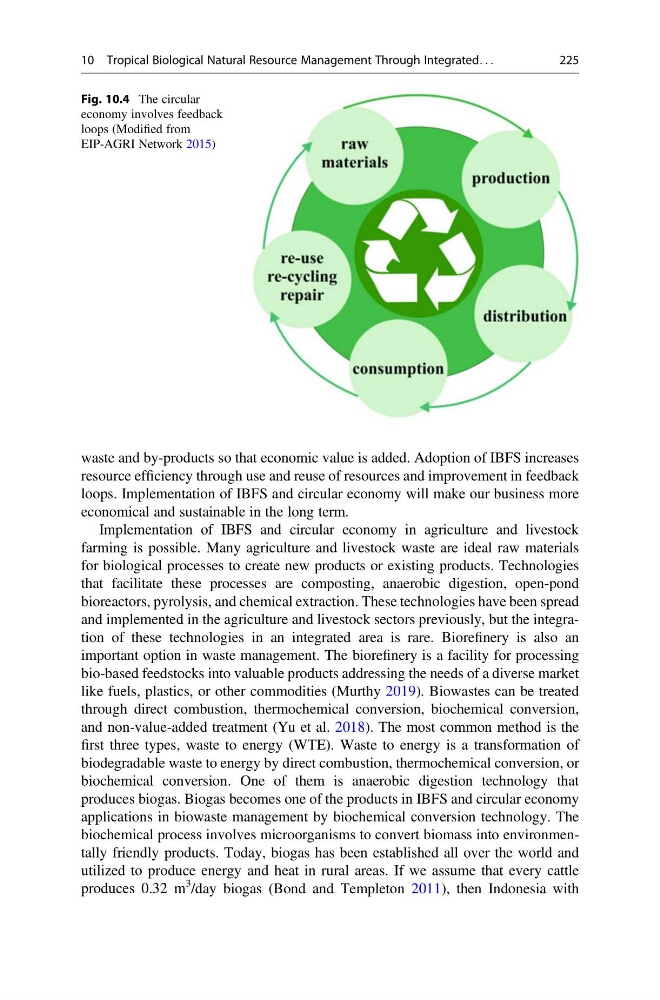
Fig. 10.4 The circular
economy involves feedback
loops (Modified from
EIP-AGRI Network 2015)
10 Tropical Biological Natural Resource Management Through Integrated. . .
225
resource efficiency through use and reuse of resources and improvement in feedback
loops. Implementation of IBFS and circular economy will make our business more
economical and sustainable in the long term.
Implementation of IBFS and circular economy in agriculture and livestock
farming is possible. Many agriculture and livestock waste are ideal raw materials
for biological processes to create new products or existing products. Technologies
that facilitate these processes are composting, anaerobic digestion, open-pond
bioreactors, pyrolysis, and chemical extraction. These technologies have been spread
and implemented in the agriculture and livestock sectors previously, but the integration of these technologies in an integrated area is rare. Biorefinery is also an
important option in waste management. The biorefinery is a facility for processing
bio-based feedstocks into valuable products addressing the needs of a diverse market
like fuels, plastics, or other commodities (Murthy 2019). Biowastes can be treated
through direct combustion, thermochemical conversion, biochemical conversion,
and non-value-added treatment (Yu et al. 2018). The most common method is the
first three types, waste to energy (WTE). Waste to energy is a transformation of
biodegradable waste to energy by direct combustion, thermochemical conversion, or
biochemical conversion. One of them is anaerobic digestion technology that
produces biogas. Biogas becomes one of the products in IBFS and circular economy
applications in biowaste management by biochemical conversion technology. The
biochemical process involves microorganisms to convert biomass into environmentally friendly products. Today, biogas has been established all over the world and
utilized to produce energy and heat in rural areas. If we assume that every cattle
produces 0.32 m
3 /day biogas (Bond and Templeton 2011), then Indonesia with
Fig. 10.4 The circular
economy involves feedback
loops (Modified from
EIP-AGRI Network 2015)
10 Tropical Biological Natural Resource Management Through Integrated. . .
225