

recycling and valorization of agricultural or livestock waste by maximizing the use
of byproducts by creating new sustainable value chains (Toop et al. 2017). One
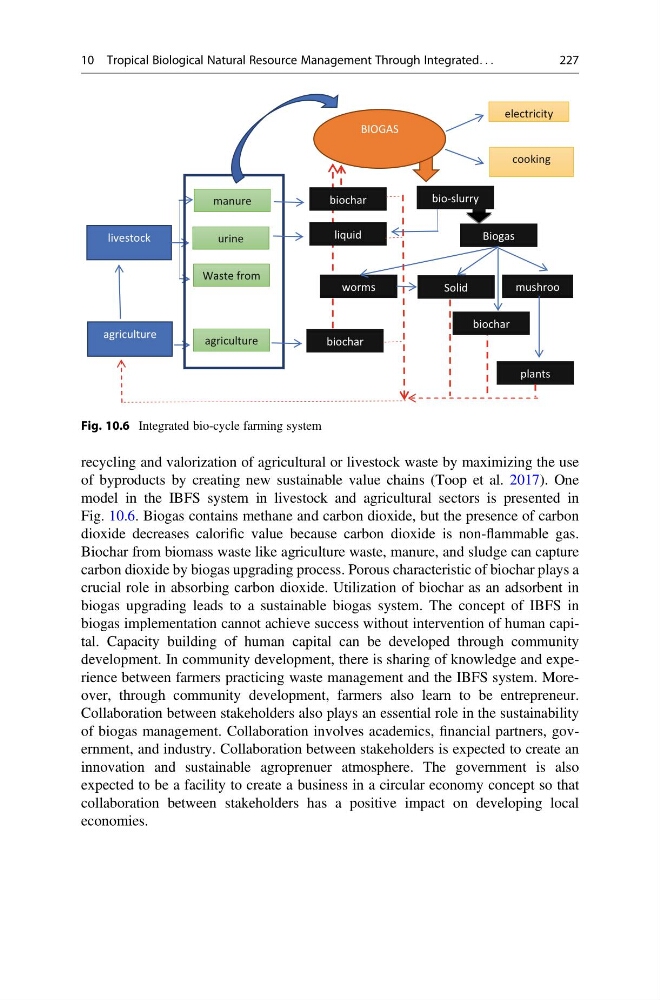
model in the IBFS system in livestock and agricultural sectors is presented in
Fig. 10.6. Biogas contains methane and carbon dioxide, but the presence of carbon
dioxide decreases calorific value because carbon dioxide is non-flammable gas.
Biochar from biomass waste like agriculture waste, manure, and sludge can capture
carbon dioxide by biogas upgrading process. Porous characteristic of biochar plays a
crucial role in absorbing carbon dioxide. Utilization of biochar as an adsorbent in
biogas upgrading leads to a sustainable biogas system. The concept of IBFS in
biogas implementation cannot achieve success without intervention of human capital. Capacity building of human capital can be developed through community
development. In community development, there is sharing of knowledge and experience between farmers practicing waste management and the IBFS system. Moreover, through community development, farmers also learn to be entrepreneur.
Collaboration between stakeholders also plays an essential role in the sustainability
of biogas management. Collaboration involves academics, financial partners, government, and industry. Collaboration between stakeholders is expected to create an
innovation and sustainable agroprenuer atmosphere. The government is also
expected to be a facility to create a business in a circular economy concept so that
collaboration between stakeholders has a positive impact on developing local
economies.
livestock
agriculture
manure
urine
Waste from
agriculture
BIOGAS
electricity
cooking
biochar
biochar
liquid
bio-slurry
Biogas
Solid
mushroo
biochar
plants
worms
Fig. 10.6 Integrated bio-cycle farming system
10 Tropical Biological Natural Resource Management Through Integrated. . .
227
of byproducts by creating new sustainable value chains (Toop et al. 2017). One
model in the IBFS system in livestock and agricultural sectors is presented in
Fig. 10.6. Biogas contains methane and carbon dioxide, but the presence of carbon
dioxide decreases calorific value because carbon dioxide is non-flammable gas.
Biochar from biomass waste like agriculture waste, manure, and sludge can capture
carbon dioxide by biogas upgrading process. Porous characteristic of biochar plays a
crucial role in absorbing carbon dioxide. Utilization of biochar as an adsorbent in
biogas upgrading leads to a sustainable biogas system. The concept of IBFS in
biogas implementation cannot achieve success without intervention of human capital. Capacity building of human capital can be developed through community
development. In community development, there is sharing of knowledge and experience between farmers practicing waste management and the IBFS system. Moreover, through community development, farmers also learn to be entrepreneur.
Collaboration between stakeholders also plays an essential role in the sustainability
of biogas management. Collaboration involves academics, financial partners, government, and industry. Collaboration between stakeholders is expected to create an
innovation and sustainable agroprenuer atmosphere. The government is also
expected to be a facility to create a business in a circular economy concept so that
collaboration between stakeholders has a positive impact on developing local
economies.
livestock
agriculture
manure
urine
Waste from
agriculture
BIOGAS
electricity
cooking
biochar
biochar
liquid
bio-slurry
Biogas
Solid
mushroo
biochar
plants
worms
Fig. 10.6 Integrated bio-cycle farming system
10 Tropical Biological Natural Resource Management Through Integrated. . .
227