

6.5.3 Valorization of Lignin
The lignin is an essential component in the lignocellulosic biomass feedstocks,
which acts as a shield to prevent microbial degradation and protect the cellulose.
Lignin is a highly branched structure; aromatic polymer and helps in tight intact with
holocellulose. Several biomass pretreatment methods are used to remove this component to tap the cellulose and hemicellulose. Lignin monomers and dimers, including phenols, alkylphenols, aromatic aldehydes, aromatic acids, etc. can be derived
from lignin using different conversion processes. Furthermore, the heating value of
lignin is higher than other components present in the biomass. The effective utilization of lignin (both soluble and insoluble) to produce different value-added
chemicals are presented in Table 6.3.
6.6
Challenges in Commercialization
The biomass supply chain involves supplying of wastes/residues from the biomass
production area to energy conversion facilities (Mafakheri and Nasiri 2014). Generally, the agro-residues are of low bulk density in nature. In other words, these
feedstocks occupy more space as compared with the same weight of high-density
biomass materials. Due to this physical property, either we use more vehicles or
more trips of a transport vehicle for conveying the residues from agricultural fields to
the biorefinery industry area. This approach would increase the overall transport cost
as well as more human resources will be required for loading and unloading the
feedstocks.
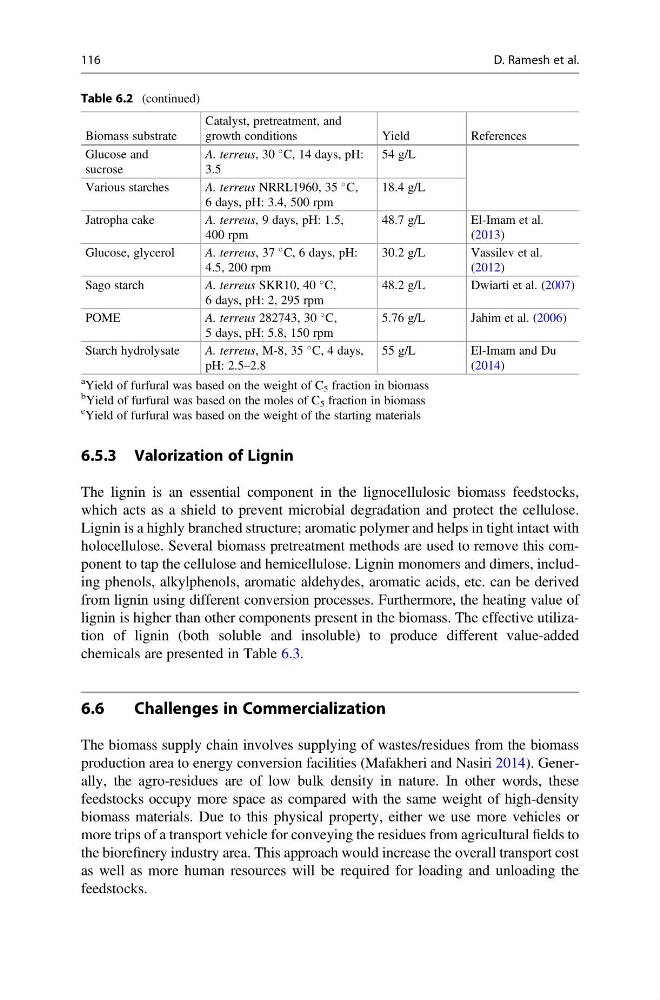
Table 6.2 (continued)
Biomass substrate
Catalyst, pretreatment, and
growth conditions
Yield
References
Glucose and
sucrose
A. terreus, 30
C, 14 days, pH:
3.5
54 g/L
Various starches
A. terreus NRRL1960, 35
C,
6 days, pH: 3.4, 500 rpm
18.4 g/L
Jatropha cake
A. terreus, 9 days, pH: 1.5,
400 rpm
48.7 g/L
El-Imam et al.
(2013)
Glucose, glycerol
A. terreus, 37
C, 6 days, pH:
4.5, 200 rpm
30.2 g/L
Vassilev et al.
(2012)
Sago starch
A. terreus SKR10, 40
C,
6 days, pH: 2, 295 rpm
48.2 g/L
Dwiarti et al. (2007)
POME
A. terreus 282743, 30
C,
5 days, pH: 5.8, 150 rpm
5.76 g/L
Jahim et al. (2006)
Starch hydrolysate
A. terreus, M-8, 35
C, 4 days,
pH: 2.5–2.8
55 g/L
El-Imam and Du
(2014)
a Yield of furfural was based on the weight of C 5 fraction in biomass
b
Yield of furfural was based on the moles of C 5 fraction in biomass
c Yield of furfural was based on the weight of the starting materials
116
D. Ramesh et al.
The lignin is an essential component in the lignocellulosic biomass feedstocks,
which acts as a shield to prevent microbial degradation and protect the cellulose.
Lignin is a highly branched structure; aromatic polymer and helps in tight intact with
holocellulose. Several biomass pretreatment methods are used to remove this component to tap the cellulose and hemicellulose. Lignin monomers and dimers, including phenols, alkylphenols, aromatic aldehydes, aromatic acids, etc. can be derived
from lignin using different conversion processes. Furthermore, the heating value of
lignin is higher than other components present in the biomass. The effective utilization of lignin (both soluble and insoluble) to produce different value-added
chemicals are presented in Table 6.3.
6.6
Challenges in Commercialization
The biomass supply chain involves supplying of wastes/residues from the biomass
production area to energy conversion facilities (Mafakheri and Nasiri 2014). Generally, the agro-residues are of low bulk density in nature. In other words, these
feedstocks occupy more space as compared with the same weight of high-density
biomass materials. Due to this physical property, either we use more vehicles or
more trips of a transport vehicle for conveying the residues from agricultural fields to
the biorefinery industry area. This approach would increase the overall transport cost
as well as more human resources will be required for loading and unloading the
feedstocks.
Table 6.2 (continued)
Biomass substrate
Catalyst, pretreatment, and
growth conditions
Yield
References
Glucose and
sucrose
A. terreus, 30
C, 14 days, pH:
3.5
54 g/L
Various starches
A. terreus NRRL1960, 35
C,
6 days, pH: 3.4, 500 rpm
18.4 g/L
Jatropha cake
A. terreus, 9 days, pH: 1.5,
400 rpm
48.7 g/L
El-Imam et al.
(2013)
Glucose, glycerol
A. terreus, 37
C, 6 days, pH:
4.5, 200 rpm
30.2 g/L
Vassilev et al.
(2012)
Sago starch
A. terreus SKR10, 40
C,
6 days, pH: 2, 295 rpm
48.2 g/L
Dwiarti et al. (2007)
POME
A. terreus 282743, 30
C,
5 days, pH: 5.8, 150 rpm
5.76 g/L
Jahim et al. (2006)
Starch hydrolysate
A. terreus, M-8, 35
C, 4 days,
pH: 2.5–2.8
55 g/L
El-Imam and Du
(2014)
a Yield of furfural was based on the weight of C 5 fraction in biomass
b
Yield of furfural was based on the moles of C 5 fraction in biomass
c Yield of furfural was based on the weight of the starting materials
116
D. Ramesh et al.