

Environmental Sensibility and Human Values as Factors for Forming …
249
Table 2 Final clusters from the non-hierarchical analysis
Factor
Cluster centroids for the three clusters
Cluster 1
35.28%
Cluster 2
31.61%
Cluster 3
33.11%
F1: Self-enhancement
0.10359
0.48821
–
–
–
–
–
0.82181
F2: Self-transcendence
0.24250
1.08638
0.56322
F3: Conservatism
0.61543
0.76279
0.91455
Factor
Tourist clusters based on environmental sensibility
Cluster 1
Eco-careless
Cluster 2
Eco-careful
Cluster 3
Eco-sensible
F Value
F1: Self-enhancement
2.83
(2) (3)
1.34
(1)
1.60
(1)
1573.480
F2: Self-transcendence
1.96
(2)
3.26
(1) (3)
2.29
(2)
2642.339
F3: Conservatism
2.15
(2) (3)
2.69
(1) (3)
3.71
(1) (2)
489.552
How important to care for nature
and environment? (mean value)
3.98
2.18
2.53
Note (1,2,3) The mean of the cluster is significantly different from the mean of other clusters on each factor
based on post hoc Tukey’s honestly significant difference (HSD) test
a Highlighted mean values indicate higher values than means values of the other groups and the total
b The mean difference is significant (p<0.05)
64.72%), indicating that this particular value was an important asset in defining
clusters.
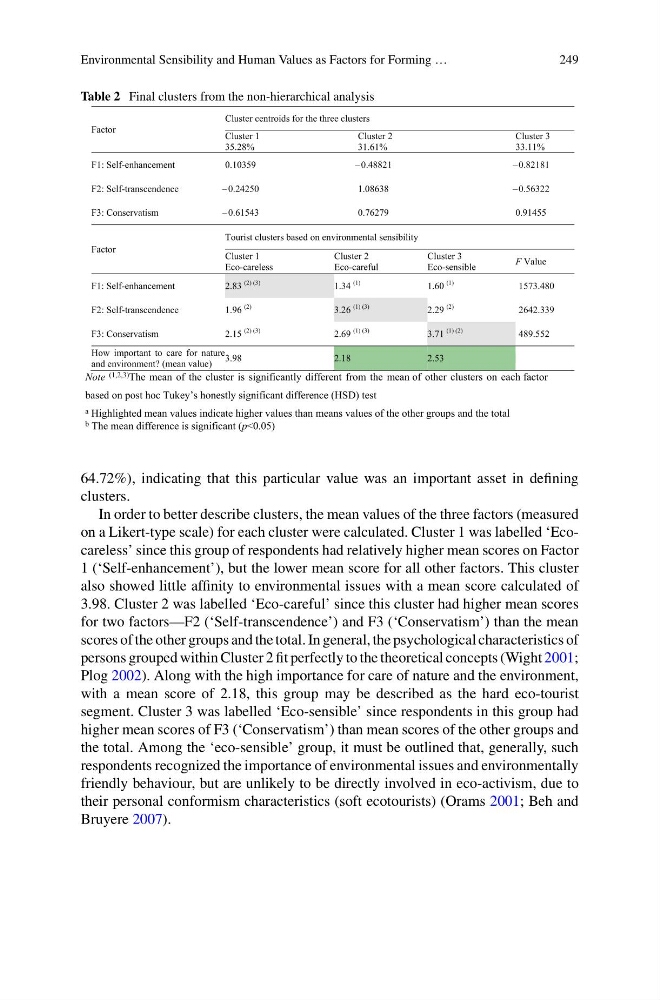
In order to better describe clusters, the mean values of the three factors (measured
on a Likert-type scale) for each cluster were calculated. Cluster 1 was labelled ‘Ecocareless’ since this group of respondents had relatively higher mean scores on Factor
1 (‘Self-enhancement’), but the lower mean score for all other factors. This cluster
also showed little affinity to environmental issues with a mean score calculated of
3.98. Cluster 2 was labelled ‘Eco-careful’ since this cluster had higher mean scores
for two factors—F2 (‘Self-transcendence’) and F3 (‘Conservatism’) than the mean
scores of the other groups and the total. In general, the psychological characteristics of
persons grouped within Cluster 2 fit perfectly to the theoretical concepts (Wight 2001;
Plog 2002). Along with the high importance for care of nature and the environment,
with a mean score of 2.18, this group may be described as the hard eco-tourist
segment. Cluster 3 was labelled ‘Eco-sensible’ since respondents in this group had
higher mean scores of F3 (‘Conservatism’) than mean scores of the other groups and
the total. Among the ‘eco-sensible’ group, it must be outlined that, generally, such
respondents recognized the importance of environmental issues and environmentally
friendly behaviour, but are unlikely to be directly involved in eco-activism, due to
their personal conformism characteristics (soft ecotourists) (Orams 2001; Beh and
Bruyere 2007).
249
Table 2 Final clusters from the non-hierarchical analysis
Factor
Cluster centroids for the three clusters
Cluster 1
35.28%
Cluster 2
31.61%
Cluster 3
33.11%
F1: Self-enhancement
0.10359
0.48821
–
–
–
–
–
0.82181
F2: Self-transcendence
0.24250
1.08638
0.56322
F3: Conservatism
0.61543
0.76279
0.91455
Factor
Tourist clusters based on environmental sensibility
Cluster 1
Eco-careless
Cluster 2
Eco-careful
Cluster 3
Eco-sensible
F Value
F1: Self-enhancement
2.83
(2) (3)
1.34
(1)
1.60
(1)
1573.480
F2: Self-transcendence
1.96
(2)
3.26
(1) (3)
2.29
(2)
2642.339
F3: Conservatism
2.15
(2) (3)
2.69
(1) (3)
3.71
(1) (2)
489.552
How important to care for nature
and environment? (mean value)
3.98
2.18
2.53
Note (1,2,3) The mean of the cluster is significantly different from the mean of other clusters on each factor
based on post hoc Tukey’s honestly significant difference (HSD) test
a Highlighted mean values indicate higher values than means values of the other groups and the total
b The mean difference is significant (p<0.05)
64.72%), indicating that this particular value was an important asset in defining
clusters.
In order to better describe clusters, the mean values of the three factors (measured
on a Likert-type scale) for each cluster were calculated. Cluster 1 was labelled ‘Ecocareless’ since this group of respondents had relatively higher mean scores on Factor
1 (‘Self-enhancement’), but the lower mean score for all other factors. This cluster
also showed little affinity to environmental issues with a mean score calculated of
3.98. Cluster 2 was labelled ‘Eco-careful’ since this cluster had higher mean scores
for two factors—F2 (‘Self-transcendence’) and F3 (‘Conservatism’) than the mean
scores of the other groups and the total. In general, the psychological characteristics of
persons grouped within Cluster 2 fit perfectly to the theoretical concepts (Wight 2001;
Plog 2002). Along with the high importance for care of nature and the environment,
with a mean score of 2.18, this group may be described as the hard eco-tourist
segment. Cluster 3 was labelled ‘Eco-sensible’ since respondents in this group had
higher mean scores of F3 (‘Conservatism’) than mean scores of the other groups and
the total. Among the ‘eco-sensible’ group, it must be outlined that, generally, such
respondents recognized the importance of environmental issues and environmentally
friendly behaviour, but are unlikely to be directly involved in eco-activism, due to
their personal conformism characteristics (soft ecotourists) (Orams 2001; Beh and
Bruyere 2007).