

250
A. Terzi´ c and D. Demirovi´ c Bajrami
7 Socio-Demographic Characteristics
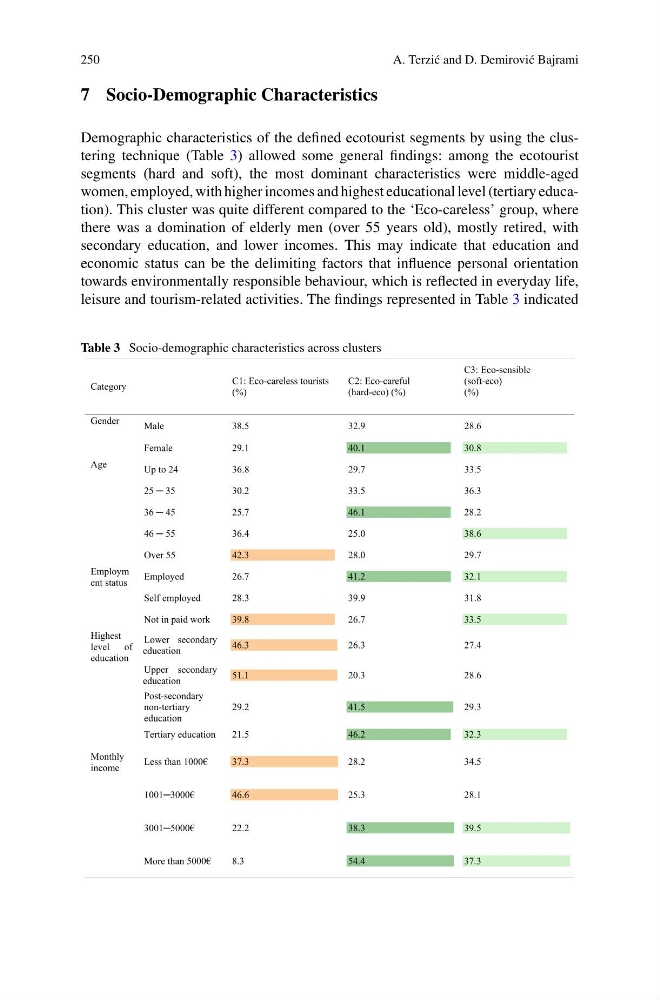
Demographic characteristics of the defined ecotourist segments by using the clustering technique (Table 3) allowed some general findings: among the ecotourist
segments (hard and soft), the most dominant characteristics were middle-aged
women, employed, with higher incomes and highest educational level (tertiary education). This cluster was quite different compared to the ‘Eco-careless’ group, where
there was a domination of elderly men (over 55 years old), mostly retired, with
secondary education, and lower incomes. This may indicate that education and
economic status can be the delimiting factors that influence personal orientation
towards environmentally responsible behaviour, which is reflected in everyday life,
leisure and tourism-related activities. The findings represented in Table 3 indicated
Table 3 Socio-demographic characteristics across clusters
Category
C1: Eco-careless tourists
(%)
C2: Eco-careful
(hard-eco) (%)
C3: Eco-sensible
(soft-eco)
(%)
Gender
Male
38.5
32.9
28.6
Female
29.1
40.1
30.8
Age
Up to 24
36.8
29.7
33.5
25 ─ 35
30.2
33.5
36.3
36 ─ 45
25.7
46.1
28.2
46 ─ 55
36.4
25.0
38.6
Over 55
42.3
28.0
29.7
Employm
ent status
Employed
26.7
41.2
32.1
Self employed
28.3
39.9
31.8
Not in paid work
39.8
26.7
33.5
Highest
level
of
education
Lower secondary
education
46.3
26.3
27.4
Upper secondary
education
51.1
20.3
28.6
Post-secondary
non-tertiary
education
29.2
41.5
29.3
Tertiary education
21.5
46.2
32.3
Monthly
income
Less than 1000€
37.3
28.2
34.5
1001─3000€
46.6
25.3
28.1
3001─5000€
22.2
38.3
39.5
More than 5000€
8.3
54.4
37.3
A. Terzi´ c and D. Demirovi´ c Bajrami
7 Socio-Demographic Characteristics
Demographic characteristics of the defined ecotourist segments by using the clustering technique (Table 3) allowed some general findings: among the ecotourist
segments (hard and soft), the most dominant characteristics were middle-aged
women, employed, with higher incomes and highest educational level (tertiary education). This cluster was quite different compared to the ‘Eco-careless’ group, where
there was a domination of elderly men (over 55 years old), mostly retired, with
secondary education, and lower incomes. This may indicate that education and
economic status can be the delimiting factors that influence personal orientation
towards environmentally responsible behaviour, which is reflected in everyday life,
leisure and tourism-related activities. The findings represented in Table 3 indicated
Table 3 Socio-demographic characteristics across clusters
Category
C1: Eco-careless tourists
(%)
C2: Eco-careful
(hard-eco) (%)
C3: Eco-sensible
(soft-eco)
(%)
Gender
Male
38.5
32.9
28.6
Female
29.1
40.1
30.8
Age
Up to 24
36.8
29.7
33.5
25 ─ 35
30.2
33.5
36.3
36 ─ 45
25.7
46.1
28.2
46 ─ 55
36.4
25.0
38.6
Over 55
42.3
28.0
29.7
Employm
ent status
Employed
26.7
41.2
32.1
Self employed
28.3
39.9
31.8
Not in paid work
39.8
26.7
33.5
Highest
level
of
education
Lower secondary
education
46.3
26.3
27.4
Upper secondary
education
51.1
20.3
28.6
Post-secondary
non-tertiary
education
29.2
41.5
29.3
Tertiary education
21.5
46.2
32.3
Monthly
income
Less than 1000€
37.3
28.2
34.5
1001─3000€
46.6
25.3
28.1
3001─5000€
22.2
38.3
39.5
More than 5000€
8.3
54.4
37.3