

248
A. Terzi´ c and D. Demirovi´ c Bajrami
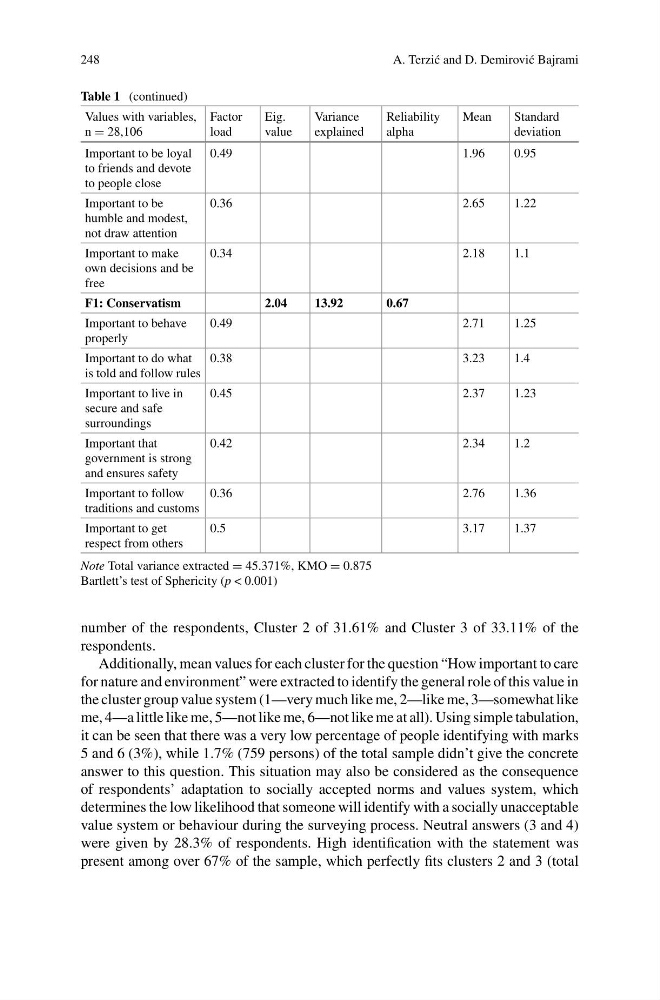
Table 1 (continued)
Values with variables,
n = 28,106
Factor
load
Eig.
value
Variance
explained
Reliability
alpha
Mean
Standard
deviation
Important to be loyal
to friends and devote
to people close
0.49
1.96
0.95
Important to be
humble and modest,
not draw attention
0.36
2.65
1.22
Important to make
own decisions and be
free
0.34
2.18
1.1
F1: Conservatism
2.04
13.92
0.67
Important to behave
properly
0.49
2.71
1.25
Important to do what
is told and follow rules
0.38
3.23
1.4
Important to live in
secure and safe
surroundings
0.45
2.37
1.23
Important that
government is strong
and ensures safety
0.42
2.34
1.2
Important to follow
traditions and customs
0.36
2.76
1.36
Important to get
respect from others
0.5
3.17
1.37
Note Total variance extracted = 45.371%, KMO = 0.875
Bartlett’s test of Sphericity (p < 0.001)
number of the respondents, Cluster 2 of 31.61% and Cluster 3 of 33.11% of the
respondents.
Additionally, mean values for each cluster for the question “How important to care
for nature and environment” were extracted to identify the general role of this value in
the cluster group value system (1—very much like me, 2—like me, 3—somewhat like
me, 4—a little like me, 5—not like me, 6—not like me at all). Using simple tabulation,
it can be seen that there was a very low percentage of people identifying with marks
5 and 6 (3%), while 1.7% (759 persons) of the total sample didn’t give the concrete
answer to this question. This situation may also be considered as the consequence
of respondents’ adaptation to socially accepted norms and values system, which
determines the low likelihood that someone will identify with a socially unacceptable
value system or behaviour during the surveying process. Neutral answers (3 and 4)
were given by 28.3% of respondents. High identification with the statement was
present among over 67% of the sample, which perfectly fits clusters 2 and 3 (total
A. Terzi´ c and D. Demirovi´ c Bajrami
Table 1 (continued)
Values with variables,
n = 28,106
Factor
load
Eig.
value
Variance
explained
Reliability
alpha
Mean
Standard
deviation
Important to be loyal
to friends and devote
to people close
0.49
1.96
0.95
Important to be
humble and modest,
not draw attention
0.36
2.65
1.22
Important to make
own decisions and be
free
0.34
2.18
1.1
F1: Conservatism
2.04
13.92
0.67
Important to behave
properly
0.49
2.71
1.25
Important to do what
is told and follow rules
0.38
3.23
1.4
Important to live in
secure and safe
surroundings
0.45
2.37
1.23
Important that
government is strong
and ensures safety
0.42
2.34
1.2
Important to follow
traditions and customs
0.36
2.76
1.36
Important to get
respect from others
0.5
3.17
1.37
Note Total variance extracted = 45.371%, KMO = 0.875
Bartlett’s test of Sphericity (p < 0.001)
number of the respondents, Cluster 2 of 31.61% and Cluster 3 of 33.11% of the
respondents.
Additionally, mean values for each cluster for the question “How important to care
for nature and environment” were extracted to identify the general role of this value in
the cluster group value system (1—very much like me, 2—like me, 3—somewhat like
me, 4—a little like me, 5—not like me, 6—not like me at all). Using simple tabulation,
it can be seen that there was a very low percentage of people identifying with marks
5 and 6 (3%), while 1.7% (759 persons) of the total sample didn’t give the concrete
answer to this question. This situation may also be considered as the consequence
of respondents’ adaptation to socially accepted norms and values system, which
determines the low likelihood that someone will identify with a socially unacceptable
value system or behaviour during the surveying process. Neutral answers (3 and 4)
were given by 28.3% of respondents. High identification with the statement was
present among over 67% of the sample, which perfectly fits clusters 2 and 3 (total