

166
L. Singh
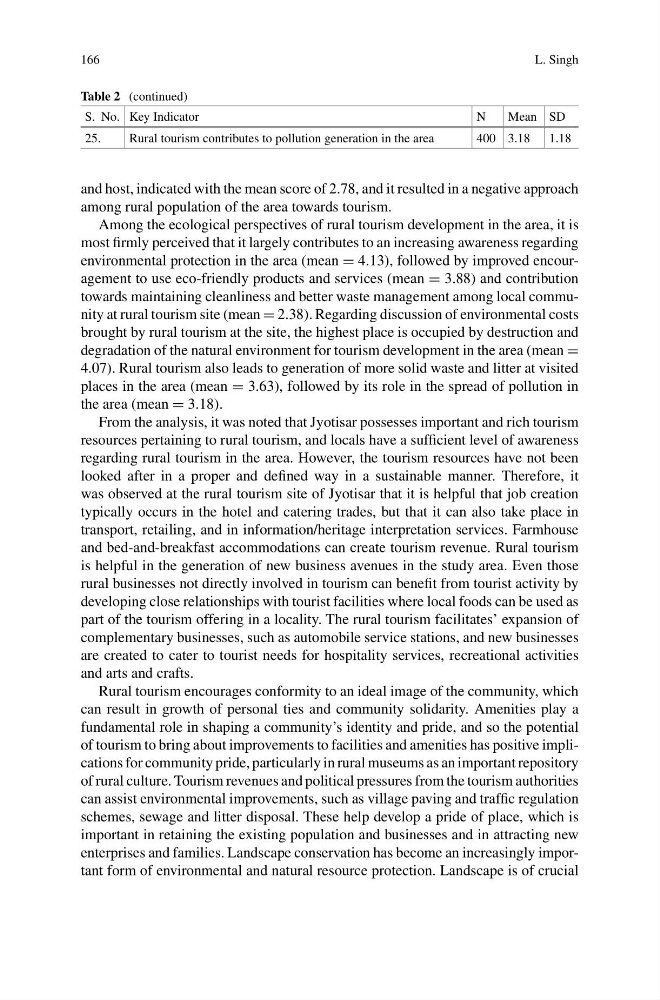
Table 2 (continued)
S. No. Key Indicator
N
Mean SD
25.
Rural tourism contributes to pollution generation in the area
400 3.18 1.18
and host, indicated with the mean score of 2.78, and it resulted in a negative approach
among rural population of the area towards tourism.
Among the ecological perspectives of rural tourism development in the area, it is
most firmly perceived that it largely contributes to an increasing awareness regarding
environmental protection in the area (mean = 4.13), followed by improved encouragement to use eco-friendly products and services (mean = 3.88) and contribution
towards maintaining cleanliness and better waste management among local community at rural tourism site (mean = 2.38). Regarding discussion of environmental costs
brought by rural tourism at the site, the highest place is occupied by destruction and
degradation of the natural environment for tourism development in the area (mean =
4.07). Rural tourism also leads to generation of more solid waste and litter at visited
places in the area (mean = 3.63), followed by its role in the spread of pollution in
the area (mean = 3.18).
From the analysis, it was noted that Jyotisar possesses important and rich tourism
resources pertaining to rural tourism, and locals have a sufficient level of awareness
regarding rural tourism in the area. However, the tourism resources have not been
looked after in a proper and defined way in a sustainable manner. Therefore, it
was observed at the rural tourism site of Jyotisar that it is helpful that job creation
typically occurs in the hotel and catering trades, but that it can also take place in
transport, retailing, and in information/heritage interpretation services. Farmhouse
and bed-and-breakfast accommodations can create tourism revenue. Rural tourism
is helpful in the generation of new business avenues in the study area. Even those
rural businesses not directly involved in tourism can benefit from tourist activity by
developing close relationships with tourist facilities where local foods can be used as
part of the tourism offering in a locality. The rural tourism facilitates’ expansion of
complementary businesses, such as automobile service stations, and new businesses
are created to cater to tourist needs for hospitality services, recreational activities
and arts and crafts.
Rural tourism encourages conformity to an ideal image of the community, which
can result in growth of personal ties and community solidarity. Amenities play a
fundamental role in shaping a community’s identity and pride, and so the potential
of tourism to bring about improvements to facilities and amenities has positive implications for community pride, particularly in rural museums as an important repository
of rural culture. Tourism revenues and political pressures from the tourism authorities
can assist environmental improvements, such as village paving and traffic regulation
schemes, sewage and litter disposal. These help develop a pride of place, which is
important in retaining the existing population and businesses and in attracting new
enterprises and families. Landscape conservation has become an increasingly important form of environmental and natural resource protection. Landscape is of crucial
L. Singh
Table 2 (continued)
S. No. Key Indicator
N
Mean SD
25.
Rural tourism contributes to pollution generation in the area
400 3.18 1.18
and host, indicated with the mean score of 2.78, and it resulted in a negative approach
among rural population of the area towards tourism.
Among the ecological perspectives of rural tourism development in the area, it is
most firmly perceived that it largely contributes to an increasing awareness regarding
environmental protection in the area (mean = 4.13), followed by improved encouragement to use eco-friendly products and services (mean = 3.88) and contribution
towards maintaining cleanliness and better waste management among local community at rural tourism site (mean = 2.38). Regarding discussion of environmental costs
brought by rural tourism at the site, the highest place is occupied by destruction and
degradation of the natural environment for tourism development in the area (mean =
4.07). Rural tourism also leads to generation of more solid waste and litter at visited
places in the area (mean = 3.63), followed by its role in the spread of pollution in
the area (mean = 3.18).
From the analysis, it was noted that Jyotisar possesses important and rich tourism
resources pertaining to rural tourism, and locals have a sufficient level of awareness
regarding rural tourism in the area. However, the tourism resources have not been
looked after in a proper and defined way in a sustainable manner. Therefore, it
was observed at the rural tourism site of Jyotisar that it is helpful that job creation
typically occurs in the hotel and catering trades, but that it can also take place in
transport, retailing, and in information/heritage interpretation services. Farmhouse
and bed-and-breakfast accommodations can create tourism revenue. Rural tourism
is helpful in the generation of new business avenues in the study area. Even those
rural businesses not directly involved in tourism can benefit from tourist activity by
developing close relationships with tourist facilities where local foods can be used as
part of the tourism offering in a locality. The rural tourism facilitates’ expansion of
complementary businesses, such as automobile service stations, and new businesses
are created to cater to tourist needs for hospitality services, recreational activities
and arts and crafts.
Rural tourism encourages conformity to an ideal image of the community, which
can result in growth of personal ties and community solidarity. Amenities play a
fundamental role in shaping a community’s identity and pride, and so the potential
of tourism to bring about improvements to facilities and amenities has positive implications for community pride, particularly in rural museums as an important repository
of rural culture. Tourism revenues and political pressures from the tourism authorities
can assist environmental improvements, such as village paving and traffic regulation
schemes, sewage and litter disposal. These help develop a pride of place, which is
important in retaining the existing population and businesses and in attracting new
enterprises and families. Landscape conservation has become an increasingly important form of environmental and natural resource protection. Landscape is of crucial