

grown in these areas is very inferior compared to a temperate zone, and infestations
of disease and pests are also greater.
Decline in moisture and increasingly frequent droughts may raise atmospheric
temperature in temperate zones. Winter temperatures and rainfall in the form of snow
are required for apple plant dormancy, and there is a chilling requirement for bud
break to ensure the flowering (Jindal et al. 2000). So, delay in cold has effects on
chilling requirements in December–January. However, extremely low temperature
also affects plant growth and fruits by chilling injury, resulting in poor yields.
Summer temperatures higher than 26
C and lower than 15
C at the blooming
period reduce the apple crop. The increases in atmospheric temperature at different
hill elevations ultimately affect the quality of the fruits, increase infestations of
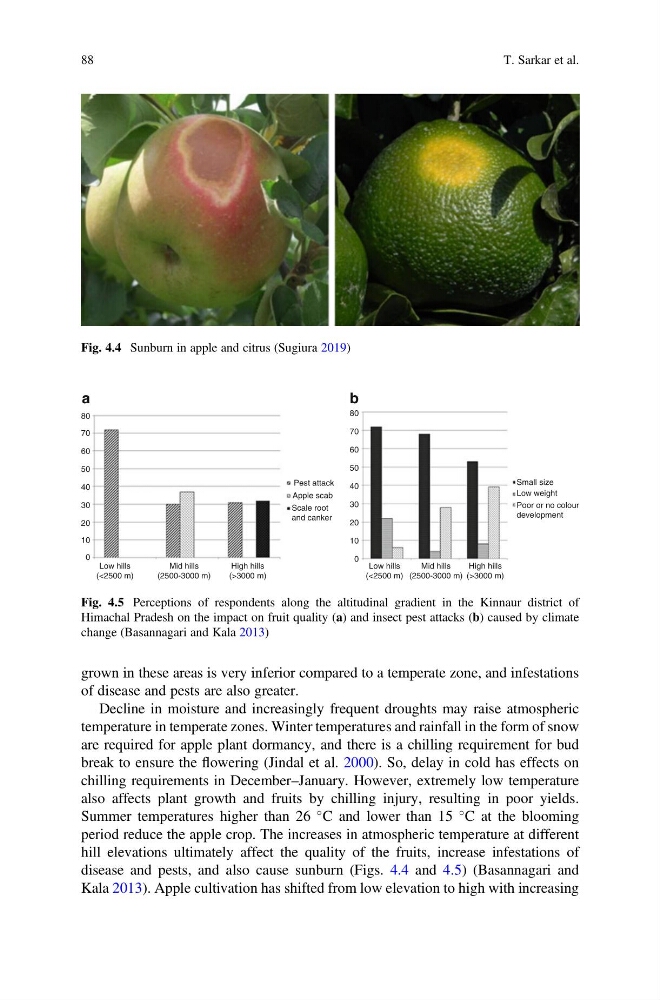
disease and pests, and also cause sunburn (Figs. 4.4 and 4.5) (Basannagari and
Kala 2013). Apple cultivation has shifted from low elevation to high with increasing
80
a
b
70
60
50
40
30
20
10
0
Low hills
(<2500 m)
Mid hills
(2500-3000 m)
High hills
(>3000 m)
80
70
60
50
40
30
20
10
0
Low hills
(<2500 m)
Mid hills
(2500-3000 m)
High hills
(>3000 m)
Pest attack
Small size
Low weight
Poor or no colour
development
Apple scab
Scale root
and canker
Fig. 4.5 Perceptions of respondents along the altitudinal gradient in the Kinnaur district of
Himachal Pradesh on the impact on fruit quality (a) and insect pest attacks (b) caused by climate
change (Basannagari and Kala 2013)
Fig. 4.4 Sunburn in apple and citrus (Sugiura 2019)
88
T. Sarkar et al.
of disease and pests are also greater.
Decline in moisture and increasingly frequent droughts may raise atmospheric
temperature in temperate zones. Winter temperatures and rainfall in the form of snow
are required for apple plant dormancy, and there is a chilling requirement for bud
break to ensure the flowering (Jindal et al. 2000). So, delay in cold has effects on
chilling requirements in December–January. However, extremely low temperature
also affects plant growth and fruits by chilling injury, resulting in poor yields.
Summer temperatures higher than 26
C and lower than 15
C at the blooming
period reduce the apple crop. The increases in atmospheric temperature at different
hill elevations ultimately affect the quality of the fruits, increase infestations of
disease and pests, and also cause sunburn (Figs. 4.4 and 4.5) (Basannagari and
Kala 2013). Apple cultivation has shifted from low elevation to high with increasing
80
a
b
70
60
50
40
30
20
10
0
Low hills
(<2500 m)
Mid hills
(2500-3000 m)
High hills
(>3000 m)
80
70
60
50
40
30
20
10
0
Low hills
(<2500 m)
Mid hills
(2500-3000 m)
High hills
(>3000 m)
Pest attack
Small size
Low weight
Poor or no colour
development
Apple scab
Scale root
and canker
Fig. 4.5 Perceptions of respondents along the altitudinal gradient in the Kinnaur district of
Himachal Pradesh on the impact on fruit quality (a) and insect pest attacks (b) caused by climate
change (Basannagari and Kala 2013)
Fig. 4.4 Sunburn in apple and citrus (Sugiura 2019)
88
T. Sarkar et al.