

parts of the country, namely, Rajasthan, Madhya Pradesh, Maharastra, Karnataka,
Andhra Pradesh, and Bihar, being more likely vulnerable in terms of extreme events
(Mall et al. 2006). Therefore, understanding the regional scenario is a prerequisite for
assessing the impacts of changing climate.
Climate Change: Regional Scenario
The Krishna, an eastward draining interstate river basin, is one of the fastest
developing regions and ranked as the second-largest river in peninsular India. The
basin covers parts of four South Indian states: Karnataka, Andhra Pradesh,
Telangana, and Maharashtra. The Krishna basin is divided into 12 subbasins as
per the National Water Development Agency of India (NWDA) report (2017–2018).
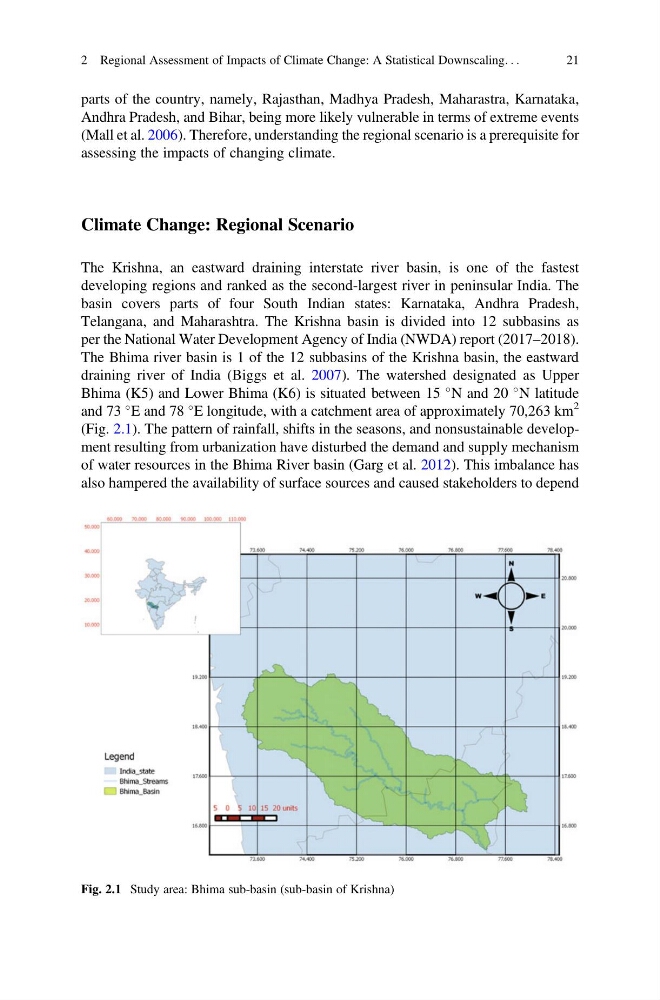
The Bhima river basin is 1 of the 12 subbasins of the Krishna basin, the eastward
draining river of India (Biggs et al. 2007). The watershed designated as Upper
Bhima (K5) and Lower Bhima (K6) is situated between 15
N and 20
N latitude
and 73
E and 78
E longitude, with a catchment area of approximately 70,263 km
2
(Fig. 2.1). The pattern of rainfall, shifts in the seasons, and nonsustainable development resulting from urbanization have disturbed the demand and supply mechanism
of water resources in the Bhima River basin (Garg et al. 2012). This imbalance has
also hampered the availability of surface sources and caused stakeholders to depend
Fig. 2.1 Study area: Bhima sub-basin (sub-basin of Krishna)
2 Regional Assessment of Impacts of Climate Change: A Statistical Downscaling. . .
21
Andhra Pradesh, and Bihar, being more likely vulnerable in terms of extreme events
(Mall et al. 2006). Therefore, understanding the regional scenario is a prerequisite for
assessing the impacts of changing climate.
Climate Change: Regional Scenario
The Krishna, an eastward draining interstate river basin, is one of the fastest
developing regions and ranked as the second-largest river in peninsular India. The
basin covers parts of four South Indian states: Karnataka, Andhra Pradesh,
Telangana, and Maharashtra. The Krishna basin is divided into 12 subbasins as
per the National Water Development Agency of India (NWDA) report (2017–2018).
The Bhima river basin is 1 of the 12 subbasins of the Krishna basin, the eastward
draining river of India (Biggs et al. 2007). The watershed designated as Upper
Bhima (K5) and Lower Bhima (K6) is situated between 15
N and 20
N latitude
and 73
E and 78
E longitude, with a catchment area of approximately 70,263 km
2
(Fig. 2.1). The pattern of rainfall, shifts in the seasons, and nonsustainable development resulting from urbanization have disturbed the demand and supply mechanism
of water resources in the Bhima River basin (Garg et al. 2012). This imbalance has
also hampered the availability of surface sources and caused stakeholders to depend
Fig. 2.1 Study area: Bhima sub-basin (sub-basin of Krishna)
2 Regional Assessment of Impacts of Climate Change: A Statistical Downscaling. . .
21