

geological province requires shifting for a particular form of strategy to escape
continuing to pursue full LCAs of alternative system setups. Furthermore, in light
of the growth of the EGS industry, the emergence of a simpler and easier approach
than LCA to calculate the GHG emissions may be beneficial for decision makers. A
meta-LCA method has tried to globally recognize energy ways forwards (i.e., a
collection of processes rather than a single one) in an attempt to settle the efforts of
individual-detailed LCAs and has already been frequently implemented in the
context of energy in recent years (Warner et al. 2010). The meta-LCA concentrates
on an intercomparison of research study: the studies conducted are connected to a
particular context (e.g., same life expectancy, same parameters of characterization).
One component at a time is assessed for the heterogeneity developed by a single
variable, and its relevant information on environmental sustainability is computed.
There are two different options: a reduced variety of emission estimates (particularly
in relation to a centralized analysis of individual LCAs in research) and, in some
situations, meta-models (Lenzen 2008), which enable the research to assess environmental impacts using a linear regression model. However, the results depend
primarily on the validity of literature data in both scenarios, and therefore cannot
account for the insufficient evidence or relevant case studies published.
The procedure for producing parameterized simulations representing life cycle
emissions of GHGs per electricity produced for the EGS system is characterized by
the following steps (Padey et al. 2013):
1. Objective description and degree of statistical inference model
2. Proposed technique structure and EGS GHG transfer profile production using
Monte Carlo simulations
3. Classification of critical elements via a global sensitivity evaluation, by generalized decay of variability (Sobol indices)
4. Description of generalized model, based on defined key components
5. Comparative analysis of the generalized model results with research and assessment of its reproducibility
To protect a standard EGS system with the comparison model, a large range of
possible EGS plants have to be compensated. Any EGS power station will calculate
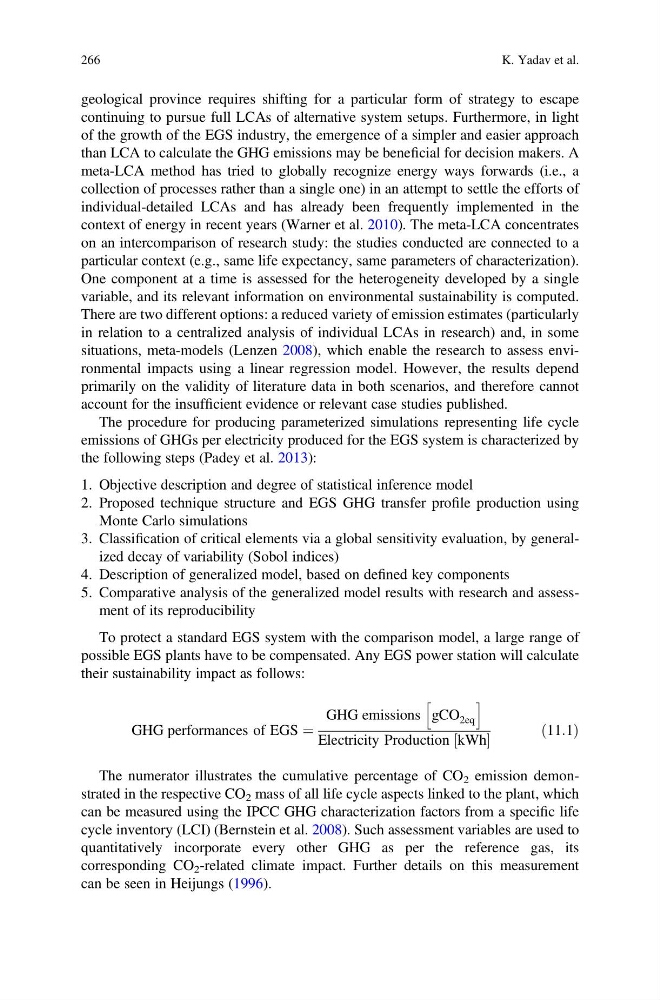
their sustainability impact as follows:
GHG performances of EGS ¼
GHG emissions gCO 2eq
h
i
Electricity Production kWh
½
ð11:1Þ
The numerator illustrates the cumulative percentage of CO 2 emission demonstrated in the respective CO 2 mass of all life cycle aspects linked to the plant, which
can be measured using the IPCC GHG characterization factors from a specific life
cycle inventory (LCI) (Bernstein et al. 2008). Such assessment variables are used to
quantitatively incorporate every other GHG as per the reference gas, its
corresponding CO 2 -related climate impact. Further details on this measurement
can be seen in Heijungs (1996).
266
K. Yadav et al.
continuing to pursue full LCAs of alternative system setups. Furthermore, in light
of the growth of the EGS industry, the emergence of a simpler and easier approach
than LCA to calculate the GHG emissions may be beneficial for decision makers. A
meta-LCA method has tried to globally recognize energy ways forwards (i.e., a
collection of processes rather than a single one) in an attempt to settle the efforts of
individual-detailed LCAs and has already been frequently implemented in the
context of energy in recent years (Warner et al. 2010). The meta-LCA concentrates
on an intercomparison of research study: the studies conducted are connected to a
particular context (e.g., same life expectancy, same parameters of characterization).
One component at a time is assessed for the heterogeneity developed by a single
variable, and its relevant information on environmental sustainability is computed.
There are two different options: a reduced variety of emission estimates (particularly
in relation to a centralized analysis of individual LCAs in research) and, in some
situations, meta-models (Lenzen 2008), which enable the research to assess environmental impacts using a linear regression model. However, the results depend
primarily on the validity of literature data in both scenarios, and therefore cannot
account for the insufficient evidence or relevant case studies published.
The procedure for producing parameterized simulations representing life cycle
emissions of GHGs per electricity produced for the EGS system is characterized by
the following steps (Padey et al. 2013):
1. Objective description and degree of statistical inference model
2. Proposed technique structure and EGS GHG transfer profile production using
Monte Carlo simulations
3. Classification of critical elements via a global sensitivity evaluation, by generalized decay of variability (Sobol indices)
4. Description of generalized model, based on defined key components
5. Comparative analysis of the generalized model results with research and assessment of its reproducibility
To protect a standard EGS system with the comparison model, a large range of
possible EGS plants have to be compensated. Any EGS power station will calculate
their sustainability impact as follows:
GHG performances of EGS ¼
GHG emissions gCO 2eq
h
i
Electricity Production kWh
½
ð11:1Þ
The numerator illustrates the cumulative percentage of CO 2 emission demonstrated in the respective CO 2 mass of all life cycle aspects linked to the plant, which
can be measured using the IPCC GHG characterization factors from a specific life
cycle inventory (LCI) (Bernstein et al. 2008). Such assessment variables are used to
quantitatively incorporate every other GHG as per the reference gas, its
corresponding CO 2 -related climate impact. Further details on this measurement
can be seen in Heijungs (1996).
266
K. Yadav et al.