

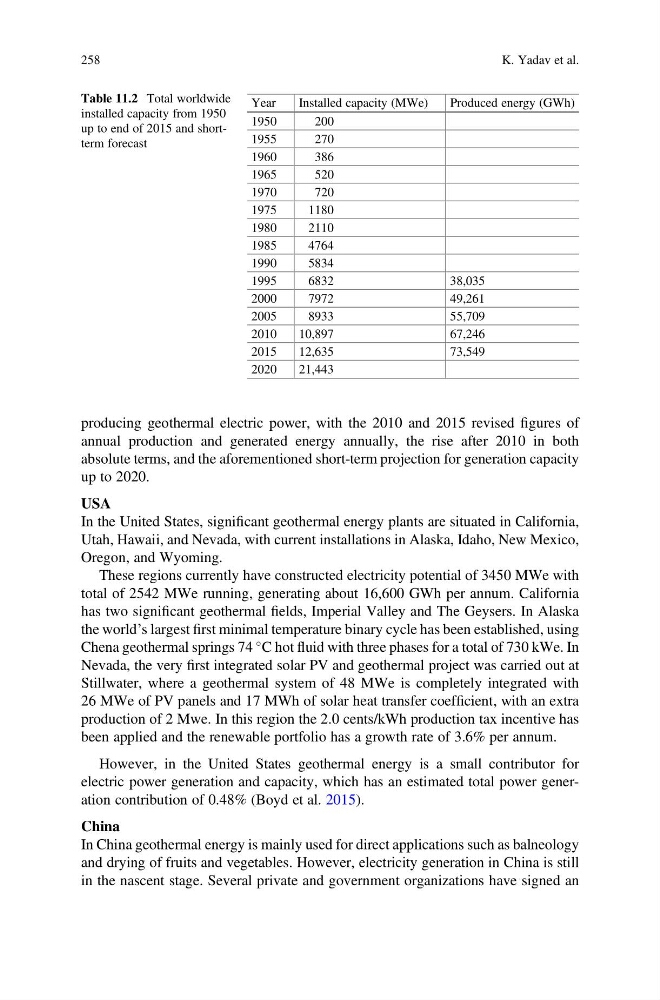
producing geothermal electric power, with the 2010 and 2015 revised figures of
annual production and generated energy annually, the rise after 2010 in both
absolute terms, and the aforementioned short-term projection for generation capacity
up to 2020.
USA
In the United States, significant geothermal energy plants are situated in California,
Utah, Hawaii, and Nevada, with current installations in Alaska, Idaho, New Mexico,
Oregon, and Wyoming.
These regions currently have constructed electricity potential of 3450 MWe with
total of 2542 MWe running, generating about 16,600 GWh per annum. California
has two significant geothermal fields, Imperial Valley and The Geysers. In Alaska
the world’s largest first minimal temperature binary cycle has been established, using
Chena geothermal springs 74
C hot fluid with three phases for a total of 730 kWe. In
Nevada, the very first integrated solar PV and geothermal project was carried out at
Stillwater, where a geothermal system of 48 MWe is completely integrated with
26 MWe of PV panels and 17 MWh of solar heat transfer coefficient, with an extra
production of 2 Mwe. In this region the 2.0 cents/kWh production tax incentive has
been applied and the renewable portfolio has a growth rate of 3.6% per annum.
However, in the United States geothermal energy is a small contributor for
electric power generation and capacity, which has an estimated total power generation contribution of 0.48% (Boyd et al. 2015).
China
In China geothermal energy is mainly used for direct applications such as balneology
and drying of fruits and vegetables. However, electricity generation in China is still
in the nascent stage. Several private and government organizations have signed an
Table 11.2 Total worldwide
installed capacity from 1950
up to end of 2015 and shortterm forecast
Year
Installed capacity (MWe)
Produced energy (GWh)
1950
200
1955
270
1960
386
1965
520
1970
720
1975
1180
1980
2110
1985
4764
1990
5834
1995
6832
38,035
2000
7972
49,261
2005
8933
55,709
2010
10,897
67,246
2015
12,635
73,549
2020
21,443
258
K. Yadav et al.
annual production and generated energy annually, the rise after 2010 in both
absolute terms, and the aforementioned short-term projection for generation capacity
up to 2020.
USA
In the United States, significant geothermal energy plants are situated in California,
Utah, Hawaii, and Nevada, with current installations in Alaska, Idaho, New Mexico,
Oregon, and Wyoming.
These regions currently have constructed electricity potential of 3450 MWe with
total of 2542 MWe running, generating about 16,600 GWh per annum. California
has two significant geothermal fields, Imperial Valley and The Geysers. In Alaska
the world’s largest first minimal temperature binary cycle has been established, using
Chena geothermal springs 74
C hot fluid with three phases for a total of 730 kWe. In
Nevada, the very first integrated solar PV and geothermal project was carried out at
Stillwater, where a geothermal system of 48 MWe is completely integrated with
26 MWe of PV panels and 17 MWh of solar heat transfer coefficient, with an extra
production of 2 Mwe. In this region the 2.0 cents/kWh production tax incentive has
been applied and the renewable portfolio has a growth rate of 3.6% per annum.
However, in the United States geothermal energy is a small contributor for
electric power generation and capacity, which has an estimated total power generation contribution of 0.48% (Boyd et al. 2015).
China
In China geothermal energy is mainly used for direct applications such as balneology
and drying of fruits and vegetables. However, electricity generation in China is still
in the nascent stage. Several private and government organizations have signed an
Table 11.2 Total worldwide
installed capacity from 1950
up to end of 2015 and shortterm forecast
Year
Installed capacity (MWe)
Produced energy (GWh)
1950
200
1955
270
1960
386
1965
520
1970
720
1975
1180
1980
2110
1985
4764
1990
5834
1995
6832
38,035
2000
7972
49,261
2005
8933
55,709
2010
10,897
67,246
2015
12,635
73,549
2020
21,443
258
K. Yadav et al.