

of BOD indicate that people of this area use a sanitary system and not open
defecation. Fecal coliform bacteria indicate the likely presence of water-borne
pathogenic (disease-causing) bacteria or viruses, including Escherichia coli, which
are present in the intestinal tracts of all warm-blooded animals, including humans.
Fecal coliform levels are measured in fecal colonies (FC) per 100 ml. Fecal coliform
levels in freshwater should not exceed an average count of 100 colonies. A fecal
coliform level less than 50 ml MPN/100 is optimal. For marine waters, fecal
coliform levels should not exceed 14 MPN/100. The health standard for drinking
water is 0 MPN/100, for swimming 200 MPN/100, and for partial body contact
(boating) 1000 MPN/100. A maximum fecal coliform of 100 MPN/100 ml as found
in a semi-disturbed catchment is safe for plant use but in the disturbed catchment
value of 800 MPN/100 ml indicated anthropogenic activities. Soil of the undisturbed
catchment has a favorable amount of nitrogen for plant growth whereas a disturbed
catchment has slightly more. Therefore, mixing of soil from undisturbed, disturbed,
and semidisturbed catchments is needed to get a homogeneous nitrogen concentration in the soil. The soil at the disturbed catchment has a little more nitrogen than
required for plants and semidisturbed catchments have a favorable amount of
nitrogen for plant growth. Therefore, these two soils also need to be mixed properly
(Table 9.4).
Net impacts on water quality depend on prior land use and crop management,
current forest management practices, soil type, local hydrology, and climate. In
general, conversions to forestland have the potential to reduce erosion and subsequent sedimentation, as well as reduce levels of dissolved nutrients and pesticides in
surface runoff and groundwater. These improvements in water quality are a function
of the lesser amounts of runoff and leaching as well as a lower concentration of
potential pollutants that are expected to result from the conversion of forestland.
Water draining from undisturbed forested watersheds is generally of the highest
quality, particularly with regard to beneficial uses including drinking water, aquatic
habit for native species, and contact recreation. Our results show consistent patterns
of relatively high water quality draining forested catchments, undisturbed in comparison to other land uses such as agriculture or urbanization (disturbed or
semidisturbed catchment). Recognition of the relative role of forests for providing
water supplies of the highest quality has been one of the driving factors for
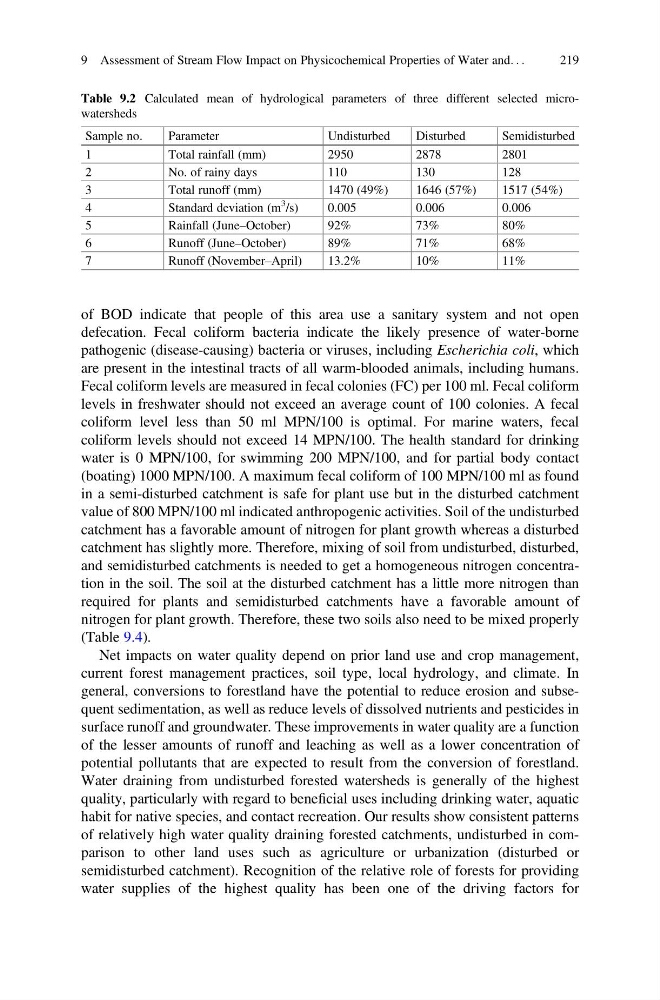
Table 9.2 Calculated mean of hydrological parameters of three different selected microwatersheds
Sample no.
Parameter
Undisturbed
Disturbed
Semidisturbed
1
Total rainfall (mm)
2950
2878
2801
2
No. of rainy days
110
130
128
3
Total runoff (mm)
1470 (49%)
1646 (57%)
1517 (54%)
4
Standard deviation (m
3
/s)
0.005
0.006
0.006
5
Rainfall (June–October)
92%
73%
80%
6
Runoff (June–October)
89%
71%
68%
7
Runoff (November–April)
13.2%
10%
11%
9 Assessment of Stream Flow Impact on Physicochemical Properties of Water and. . .
219
defecation. Fecal coliform bacteria indicate the likely presence of water-borne
pathogenic (disease-causing) bacteria or viruses, including Escherichia coli, which
are present in the intestinal tracts of all warm-blooded animals, including humans.
Fecal coliform levels are measured in fecal colonies (FC) per 100 ml. Fecal coliform
levels in freshwater should not exceed an average count of 100 colonies. A fecal
coliform level less than 50 ml MPN/100 is optimal. For marine waters, fecal
coliform levels should not exceed 14 MPN/100. The health standard for drinking
water is 0 MPN/100, for swimming 200 MPN/100, and for partial body contact
(boating) 1000 MPN/100. A maximum fecal coliform of 100 MPN/100 ml as found
in a semi-disturbed catchment is safe for plant use but in the disturbed catchment
value of 800 MPN/100 ml indicated anthropogenic activities. Soil of the undisturbed
catchment has a favorable amount of nitrogen for plant growth whereas a disturbed
catchment has slightly more. Therefore, mixing of soil from undisturbed, disturbed,
and semidisturbed catchments is needed to get a homogeneous nitrogen concentration in the soil. The soil at the disturbed catchment has a little more nitrogen than
required for plants and semidisturbed catchments have a favorable amount of
nitrogen for plant growth. Therefore, these two soils also need to be mixed properly
(Table 9.4).
Net impacts on water quality depend on prior land use and crop management,
current forest management practices, soil type, local hydrology, and climate. In
general, conversions to forestland have the potential to reduce erosion and subsequent sedimentation, as well as reduce levels of dissolved nutrients and pesticides in
surface runoff and groundwater. These improvements in water quality are a function
of the lesser amounts of runoff and leaching as well as a lower concentration of
potential pollutants that are expected to result from the conversion of forestland.
Water draining from undisturbed forested watersheds is generally of the highest
quality, particularly with regard to beneficial uses including drinking water, aquatic
habit for native species, and contact recreation. Our results show consistent patterns
of relatively high water quality draining forested catchments, undisturbed in comparison to other land uses such as agriculture or urbanization (disturbed or
semidisturbed catchment). Recognition of the relative role of forests for providing
water supplies of the highest quality has been one of the driving factors for
Table 9.2 Calculated mean of hydrological parameters of three different selected microwatersheds
Sample no.
Parameter
Undisturbed
Disturbed
Semidisturbed
1
Total rainfall (mm)
2950
2878
2801
2
No. of rainy days
110
130
128
3
Total runoff (mm)
1470 (49%)
1646 (57%)
1517 (54%)
4
Standard deviation (m
3
/s)
0.005
0.006
0.006
5
Rainfall (June–October)
92%
73%
80%
6
Runoff (June–October)
89%
71%
68%
7
Runoff (November–April)
13.2%
10%
11%
9 Assessment of Stream Flow Impact on Physicochemical Properties of Water and. . .
219