

components in river flow in forested catchments compared to the areas where forest
coverage was poor. The following steps were applied to complete the research.
Procedure
• Three micro-watersheds were selected, namely, disturbed, semidisturbed, and
undisturbed, separated at a distance of 12 km. There is no significant variation
in climatic parameters and geological conditions.
• Meteorological observations have been undertaken in three micro-watersheds and
sampling sites to measure rainfall, evaporation, temperature, humidity, and wind
velocity.
• A meteorological observatory consists of dry and wet bulb thermometer, rain
gauge, pan evaporimeter, and anemometer.
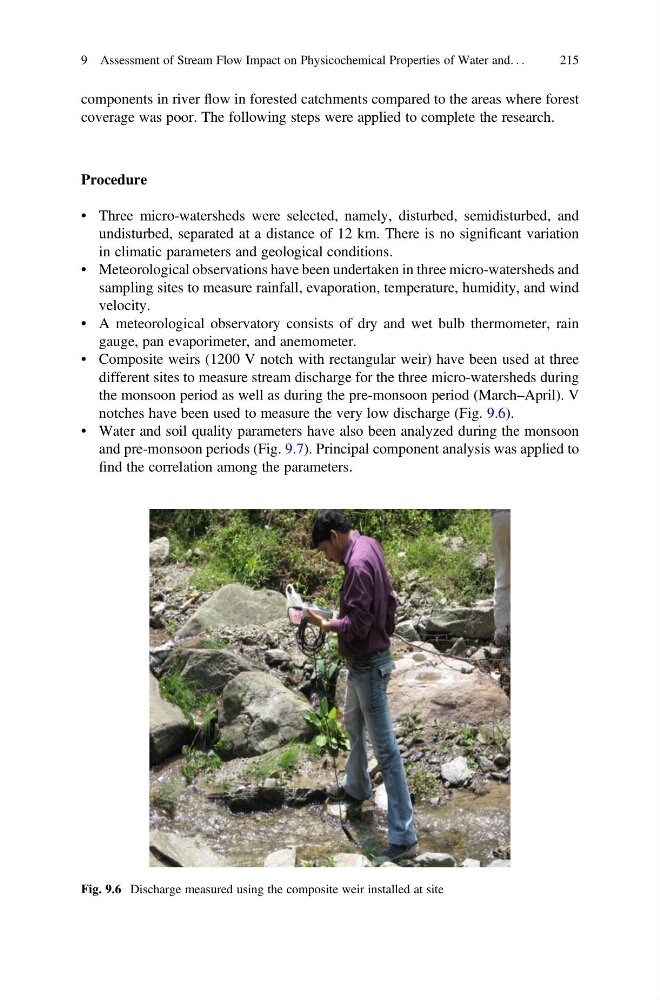
• Composite weirs (1200 V notch with rectangular weir) have been used at three
different sites to measure stream discharge for the three micro-watersheds during
the monsoon period as well as during the pre-monsoon period (March–April). V
notches have been used to measure the very low discharge (Fig. 9.6).
• Water and soil quality parameters have also been analyzed during the monsoon
and pre-monsoon periods (Fig. 9.7). Principal component analysis was applied to
find the correlation among the parameters.
Fig. 9.6 Discharge measured using the composite weir installed at site
9 Assessment of Stream Flow Impact on Physicochemical Properties of Water and. . .
215
coverage was poor. The following steps were applied to complete the research.
Procedure
• Three micro-watersheds were selected, namely, disturbed, semidisturbed, and
undisturbed, separated at a distance of 12 km. There is no significant variation
in climatic parameters and geological conditions.
• Meteorological observations have been undertaken in three micro-watersheds and
sampling sites to measure rainfall, evaporation, temperature, humidity, and wind
velocity.
• A meteorological observatory consists of dry and wet bulb thermometer, rain
gauge, pan evaporimeter, and anemometer.
• Composite weirs (1200 V notch with rectangular weir) have been used at three
different sites to measure stream discharge for the three micro-watersheds during
the monsoon period as well as during the pre-monsoon period (March–April). V
notches have been used to measure the very low discharge (Fig. 9.6).
• Water and soil quality parameters have also been analyzed during the monsoon
and pre-monsoon periods (Fig. 9.7). Principal component analysis was applied to
find the correlation among the parameters.
Fig. 9.6 Discharge measured using the composite weir installed at site
9 Assessment of Stream Flow Impact on Physicochemical Properties of Water and. . .
215