

activities. Most of the respondents (25%) transformed their agricultural fields into
fish ponds for income generation. The other strategies adopted by respondents were
changing the crop calendar (13%), crop diversification (9%), and adapting modern
farm practices (7%). Nearly half the sampled respondents (50%) did not have any
adaptation strategy for fish/shrimp practices, although nearly 13% of the sampled
households increased the embankment height, followed by digging ponds inside fish
farms (12%), using medicine (11%), placing nets around shrimp fields (9%), and
used liming in the fish ponds (5%).
Moreover, analysis of adaptive measures showed that most of the respondents did
not undertake any adaptation measures against the changes in these two economic
activities, although a segregated pattern of adaptive measures was discerned among
the other respondents. It is also important to observe that fishing was the second most
preferred economic activity after agriculture. However, in agriculture very few
respondents adapted modern farm practices to increase agricultural productivity.
Coping Mechanism of the Sampled Households
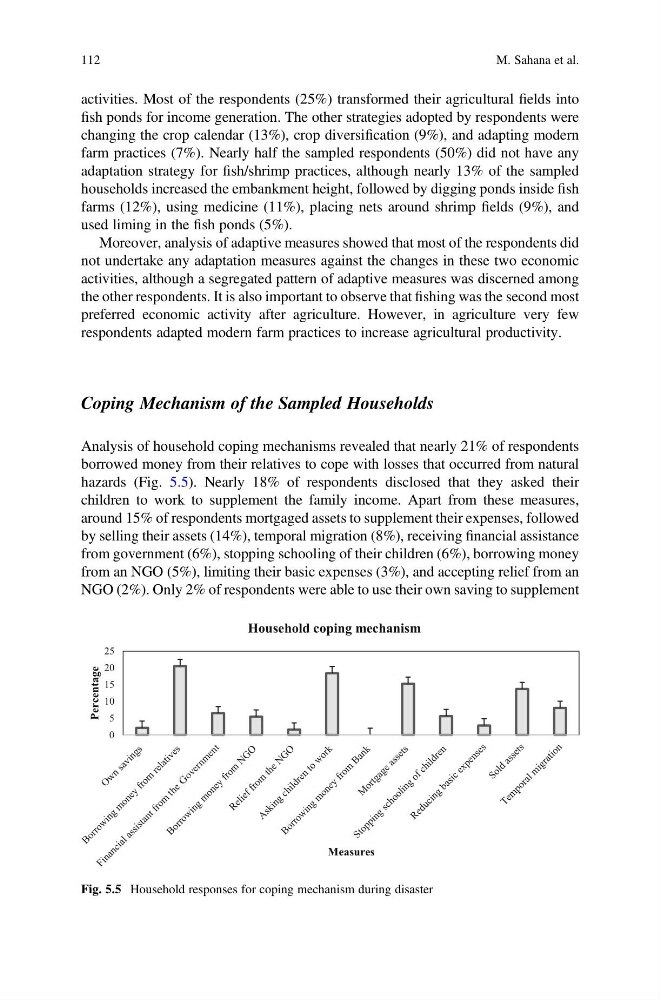
Analysis of household coping mechanisms revealed that nearly 21% of respondents
borrowed money from their relatives to cope with losses that occurred from natural
hazards (Fig. 5.5). Nearly 18% of respondents disclosed that they asked their
children to work to supplement the family income. Apart from these measures,
around 15% of respondents mortgaged assets to supplement their expenses, followed
by selling their assets (14%), temporal migration (8%), receiving financial assistance
from government (6%), stopping schooling of their children (6%), borrowing money
from an NGO (5%), limiting their basic expenses (3%), and accepting relief from an
NGO (2%). Only 2% of respondents were able to use their own saving to supplement
0
5
10
15
20
25
Percentage
Measures
Household coping mechanism
Fig. 5.5 Household responses for coping mechanism during disaster
112
M. Sahana et al.
fish ponds for income generation. The other strategies adopted by respondents were
changing the crop calendar (13%), crop diversification (9%), and adapting modern
farm practices (7%). Nearly half the sampled respondents (50%) did not have any
adaptation strategy for fish/shrimp practices, although nearly 13% of the sampled
households increased the embankment height, followed by digging ponds inside fish
farms (12%), using medicine (11%), placing nets around shrimp fields (9%), and
used liming in the fish ponds (5%).
Moreover, analysis of adaptive measures showed that most of the respondents did
not undertake any adaptation measures against the changes in these two economic
activities, although a segregated pattern of adaptive measures was discerned among
the other respondents. It is also important to observe that fishing was the second most
preferred economic activity after agriculture. However, in agriculture very few
respondents adapted modern farm practices to increase agricultural productivity.
Coping Mechanism of the Sampled Households
Analysis of household coping mechanisms revealed that nearly 21% of respondents
borrowed money from their relatives to cope with losses that occurred from natural
hazards (Fig. 5.5). Nearly 18% of respondents disclosed that they asked their
children to work to supplement the family income. Apart from these measures,
around 15% of respondents mortgaged assets to supplement their expenses, followed
by selling their assets (14%), temporal migration (8%), receiving financial assistance
from government (6%), stopping schooling of their children (6%), borrowing money
from an NGO (5%), limiting their basic expenses (3%), and accepting relief from an
NGO (2%). Only 2% of respondents were able to use their own saving to supplement
0
5
10
15
20
25
Percentage
Measures
Household coping mechanism
Fig. 5.5 Household responses for coping mechanism during disaster
112
M. Sahana et al.