

2.2 Experimental Methods
59
devices, such as the Rotter Impact Machine, define a successful initiation based on
the production of gas products. For other methods, such as in the BAM fall hammer,
a successful initiation is determined by the user, and is generally based on sound
or visual inspection of the sample. It follows that the reported impact sensitivities
that result from different testing methods can vary substantially [78]. Further difficulties in the experimental validation of impact sensitivity stems from sample and
environmental factors [79], which include particle size, crystallinity, purity, temperature, and humidity, amongst others. These factors are not regularly controlled, and
their effects on impact sensitivity are poorly understood. These all contribute to the
extreme variability in reported impact sensitivities for materials.
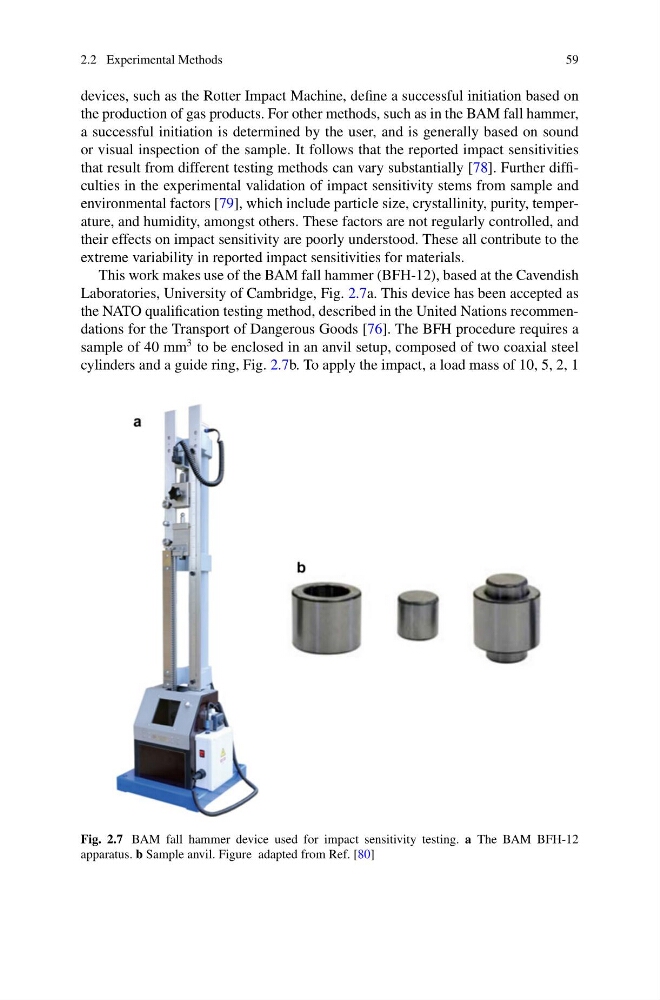
This work makes use of the BAM fall hammer (BFH-12), based at the Cavendish
Laboratories, University of Cambridge, Fig. 2.7a. This device has been accepted as
the NATO qualification testing method, described in the United Nations recommendations for the Transport of Dangerous Goods [76]. The BFH procedure requires a
sample of 40 mm
3 to be enclosed in an anvil setup, composed of two coaxial steel
cylinders and a guide ring, Fig. 2.7b. To apply the impact, a load mass of 10, 5, 2, 1
Fig. 2.7 BAM fall hammer device used for impact sensitivity testing. a The BAM BFH-12
apparatus. b Sample anvil. Figure adapted from Ref. [80]
59
devices, such as the Rotter Impact Machine, define a successful initiation based on
the production of gas products. For other methods, such as in the BAM fall hammer,
a successful initiation is determined by the user, and is generally based on sound
or visual inspection of the sample. It follows that the reported impact sensitivities
that result from different testing methods can vary substantially [78]. Further difficulties in the experimental validation of impact sensitivity stems from sample and
environmental factors [79], which include particle size, crystallinity, purity, temperature, and humidity, amongst others. These factors are not regularly controlled, and
their effects on impact sensitivity are poorly understood. These all contribute to the
extreme variability in reported impact sensitivities for materials.
This work makes use of the BAM fall hammer (BFH-12), based at the Cavendish
Laboratories, University of Cambridge, Fig. 2.7a. This device has been accepted as
the NATO qualification testing method, described in the United Nations recommendations for the Transport of Dangerous Goods [76]. The BFH procedure requires a
sample of 40 mm
3 to be enclosed in an anvil setup, composed of two coaxial steel
cylinders and a guide ring, Fig. 2.7b. To apply the impact, a load mass of 10, 5, 2, 1
Fig. 2.7 BAM fall hammer device used for impact sensitivity testing. a The BAM BFH-12
apparatus. b Sample anvil. Figure adapted from Ref. [80]