

58
2 Experimental and Computational Methods
scattering cross section in both cases requires consideration of coherent and incoherent processes. The former describes the in-phase scattering and results in interference effects. Hence, coherent scattering is required for diffraction and vibrational
spectroscopy of collective motions (e.g. phonon dispersion). The incoherent scattering describes motion of single particles, in which no correlation exists between
different molecules or atoms. These motions are particularly important for studying
internal molecular vibrations. In an INS spectrum, both coherent and incoherent scattering processes are observed, and the dominating scattering mechanism depends
largely on the scattering cross-sections of the atoms involved. Incoherent scattering
dominates in hydrogen-containing compounds.
The absolute intensity of an INS spectrum is difficult to interpret, and so only
the relative spectral intensities are considered. The calculated relative intensity (the
scaled scattering factor, S
∗
( Q, ω i )) of the i
th vibrational mode with momentum
transfer Q and neutron energy loss E tr = ω i is defined as [73]
S
∗
( Q, ω i )
n
m = yσ m
Q ·
i u m
2
n
n!
ex p
⎛
⎝ −
Q ·
i
i u m
2
⎞
⎠
(2.47)
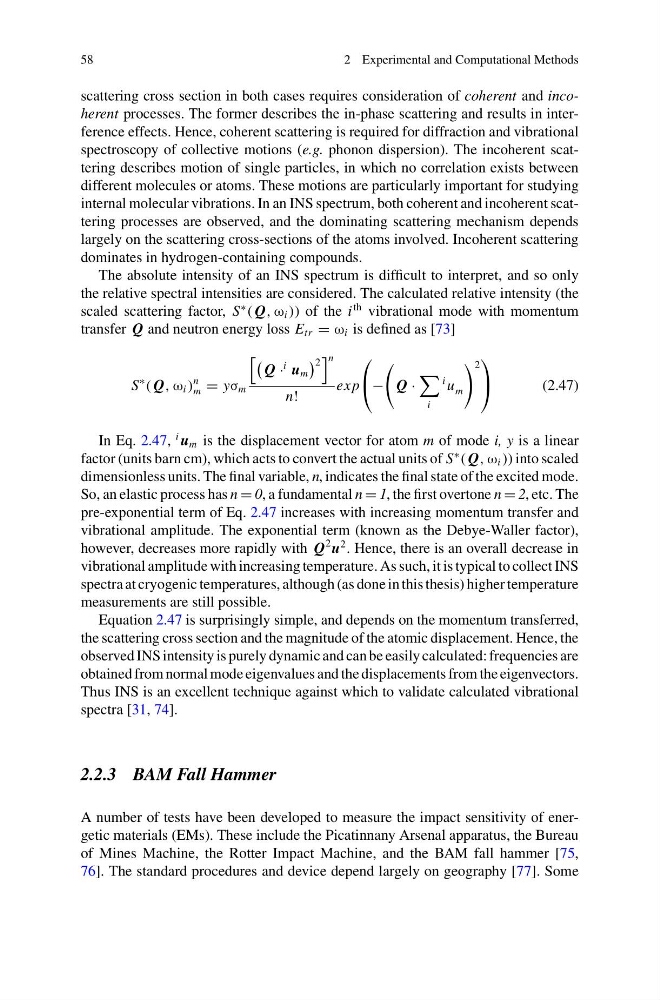
In Eq. 2.47,
i u m is the displacement vector for atom m of mode i, y is a linear
factor (units barn cm), which acts to convert the actual units of S
∗
( Q, ω i )) into scaled
dimensionless units. The final variable, n, indicates the final state of the excited mode.
So, an elastic process has n = 0, a fundamental n = 1, the first overtone n = 2, etc. The
pre-exponential term of Eq. 2.47 increases with increasing momentum transfer and
vibrational amplitude. The exponential term (known as the Debye-Waller factor),
however, decreases more rapidly with Q
2 u
2 . Hence, there is an overall decrease in
vibrational amplitude with increasing temperature. As such, it is typical to collect INS
spectra at cryogenic temperatures, although (as done in this thesis) higher temperature
measurements are still possible.
Equation 2.47 is surprisingly simple, and depends on the momentum transferred,
the scattering cross section and the magnitude of the atomic displacement. Hence, the
observed INS intensity is purely dynamic and can be easily calculated: frequencies are
obtained from normal mode eigenvalues and the displacements from the eigenvectors.
Thus INS is an excellent technique against which to validate calculated vibrational
spectra [31, 74].
2.2.3 BAM Fall Hammer
A number of tests have been developed to measure the impact sensitivity of energetic materials (EMs). These include the Picatinnany Arsenal apparatus, the Bureau
of Mines Machine, the Rotter Impact Machine, and the BAM fall hammer [75,
76]. The standard procedures and device depend largely on geography [77]. Some
2 Experimental and Computational Methods
scattering cross section in both cases requires consideration of coherent and incoherent processes. The former describes the in-phase scattering and results in interference effects. Hence, coherent scattering is required for diffraction and vibrational
spectroscopy of collective motions (e.g. phonon dispersion). The incoherent scattering describes motion of single particles, in which no correlation exists between
different molecules or atoms. These motions are particularly important for studying
internal molecular vibrations. In an INS spectrum, both coherent and incoherent scattering processes are observed, and the dominating scattering mechanism depends
largely on the scattering cross-sections of the atoms involved. Incoherent scattering
dominates in hydrogen-containing compounds.
The absolute intensity of an INS spectrum is difficult to interpret, and so only
the relative spectral intensities are considered. The calculated relative intensity (the
scaled scattering factor, S
∗
( Q, ω i )) of the i
th vibrational mode with momentum
transfer Q and neutron energy loss E tr = ω i is defined as [73]
S
∗
( Q, ω i )
n
m = yσ m
Q ·
i u m
2
n
n!
ex p
⎛
⎝ −
Q ·
i
i u m
2
⎞
⎠
(2.47)
In Eq. 2.47,
i u m is the displacement vector for atom m of mode i, y is a linear
factor (units barn cm), which acts to convert the actual units of S
∗
( Q, ω i )) into scaled
dimensionless units. The final variable, n, indicates the final state of the excited mode.
So, an elastic process has n = 0, a fundamental n = 1, the first overtone n = 2, etc. The
pre-exponential term of Eq. 2.47 increases with increasing momentum transfer and
vibrational amplitude. The exponential term (known as the Debye-Waller factor),
however, decreases more rapidly with Q
2 u
2 . Hence, there is an overall decrease in
vibrational amplitude with increasing temperature. As such, it is typical to collect INS
spectra at cryogenic temperatures, although (as done in this thesis) higher temperature
measurements are still possible.
Equation 2.47 is surprisingly simple, and depends on the momentum transferred,
the scattering cross section and the magnitude of the atomic displacement. Hence, the
observed INS intensity is purely dynamic and can be easily calculated: frequencies are
obtained from normal mode eigenvalues and the displacements from the eigenvectors.
Thus INS is an excellent technique against which to validate calculated vibrational
spectra [31, 74].
2.2.3 BAM Fall Hammer
A number of tests have been developed to measure the impact sensitivity of energetic materials (EMs). These include the Picatinnany Arsenal apparatus, the Bureau
of Mines Machine, the Rotter Impact Machine, and the BAM fall hammer [75,
76]. The standard procedures and device depend largely on geography [77]. Some