

60
2 Experimental and Computational Methods
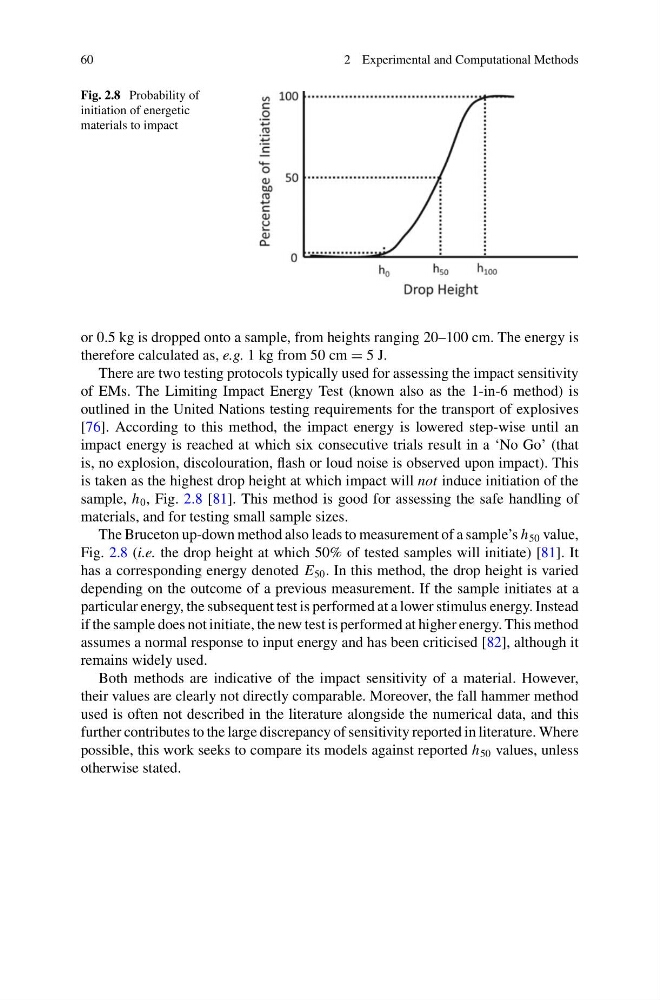
Fig. 2.8 Probability of
initiation of energetic
materials to impact
or 0.5 kg is dropped onto a sample, from heights ranging 20–100 cm. The energy is
therefore calculated as, e.g. 1 kg from 50 cm = 5 J.
There are two testing protocols typically used for assessing the impact sensitivity
of EMs. The Limiting Impact Energy Test (known also as the 1-in-6 method) is
outlined in the United Nations testing requirements for the transport of explosives
[76]. According to this method, the impact energy is lowered step-wise until an
impact energy is reached at which six consecutive trials result in a ‘No Go’ (that
is, no explosion, discolouration, flash or loud noise is observed upon impact). This
is taken as the highest drop height at which impact will not induce initiation of the
sample, h 0 , Fig. 2.8 [81]. This method is good for assessing the safe handling of
materials, and for testing small sample sizes.
The Bruceton up-down method also leads to measurement of a sample’s h 50 value,
Fig. 2.8 (i.e. the drop height at which 50% of tested samples will initiate) [81]. It
has a corresponding energy denoted E 50 . In this method, the drop height is varied
depending on the outcome of a previous measurement. If the sample initiates at a
particular energy, the subsequent test is performed at a lower stimulus energy. Instead
if the sample does not initiate, the new test is performed at higher energy. This method
assumes a normal response to input energy and has been criticised [82], although it
remains widely used.
Both methods are indicative of the impact sensitivity of a material. However,
their values are clearly not directly comparable. Moreover, the fall hammer method
used is often not described in the literature alongside the numerical data, and this
further contributes to the large discrepancy of sensitivity reported in literature. Where
possible, this work seeks to compare its models against reported h 50 values, unless
otherwise stated.
2 Experimental and Computational Methods
Fig. 2.8 Probability of
initiation of energetic
materials to impact
or 0.5 kg is dropped onto a sample, from heights ranging 20–100 cm. The energy is
therefore calculated as, e.g. 1 kg from 50 cm = 5 J.
There are two testing protocols typically used for assessing the impact sensitivity
of EMs. The Limiting Impact Energy Test (known also as the 1-in-6 method) is
outlined in the United Nations testing requirements for the transport of explosives
[76]. According to this method, the impact energy is lowered step-wise until an
impact energy is reached at which six consecutive trials result in a ‘No Go’ (that
is, no explosion, discolouration, flash or loud noise is observed upon impact). This
is taken as the highest drop height at which impact will not induce initiation of the
sample, h 0 , Fig. 2.8 [81]. This method is good for assessing the safe handling of
materials, and for testing small sample sizes.
The Bruceton up-down method also leads to measurement of a sample’s h 50 value,
Fig. 2.8 (i.e. the drop height at which 50% of tested samples will initiate) [81]. It
has a corresponding energy denoted E 50 . In this method, the drop height is varied
depending on the outcome of a previous measurement. If the sample initiates at a
particular energy, the subsequent test is performed at a lower stimulus energy. Instead
if the sample does not initiate, the new test is performed at higher energy. This method
assumes a normal response to input energy and has been criticised [82], although it
remains widely used.
Both methods are indicative of the impact sensitivity of a material. However,
their values are clearly not directly comparable. Moreover, the fall hammer method
used is often not described in the literature alongside the numerical data, and this
further contributes to the large discrepancy of sensitivity reported in literature. Where
possible, this work seeks to compare its models against reported h 50 values, unless
otherwise stated.