

1.3 Prediction and Rationalisation of Energetic Material Sensitivity
17
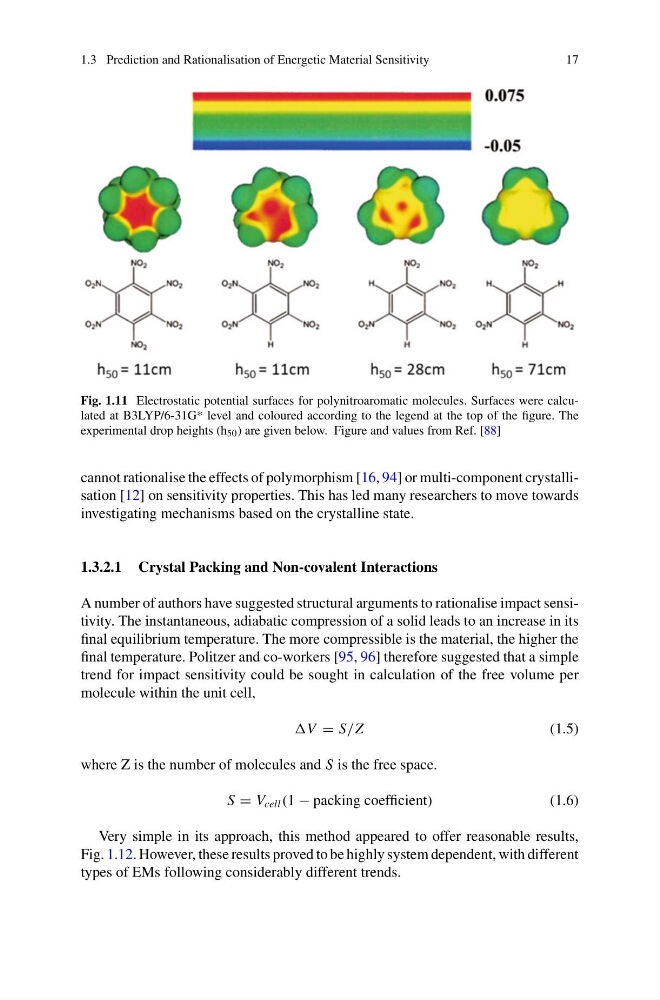
Fig. 1.11 Electrostatic potential surfaces for polynitroaromatic molecules. Surfaces were calculated at B3LYP/6-31G* level and coloured according to the legend at the top of the figure. The
experimental drop heights (h 50 ) are given below. Figure and values from Ref. [88]
cannot rationalise the effects of polymorphism [16, 94] or multi-component crystallisation [12] on sensitivity properties. This has led many researchers to move towards
investigating mechanisms based on the crystalline state.
1.3.2.1 Crystal Packing and Non-covalent Interactions
A number of authors have suggested structural arguments to rationalise impact sensitivity. The instantaneous, adiabatic compression of a solid leads to an increase in its
final equilibrium temperature. The more compressible is the material, the higher the
final temperature. Politzer and co-workers [95, 96] therefore suggested that a simple
trend for impact sensitivity could be sought in calculation of the free volume per
molecule within the unit cell,
V = S/Z
(1.5)
where Z is the number of molecules and S is the free space.
S = V cell (1 − packing coefficient)
(1.6)
Very simple in its approach, this method appeared to offer reasonable results,
Fig. 1.12. However, these results proved to be highly system dependent, with different
types of EMs following considerably different trends.
17
Fig. 1.11 Electrostatic potential surfaces for polynitroaromatic molecules. Surfaces were calculated at B3LYP/6-31G* level and coloured according to the legend at the top of the figure. The
experimental drop heights (h 50 ) are given below. Figure and values from Ref. [88]
cannot rationalise the effects of polymorphism [16, 94] or multi-component crystallisation [12] on sensitivity properties. This has led many researchers to move towards
investigating mechanisms based on the crystalline state.
1.3.2.1 Crystal Packing and Non-covalent Interactions
A number of authors have suggested structural arguments to rationalise impact sensitivity. The instantaneous, adiabatic compression of a solid leads to an increase in its
final equilibrium temperature. The more compressible is the material, the higher the
final temperature. Politzer and co-workers [95, 96] therefore suggested that a simple
trend for impact sensitivity could be sought in calculation of the free volume per
molecule within the unit cell,
V = S/Z
(1.5)
where Z is the number of molecules and S is the free space.
S = V cell (1 − packing coefficient)
(1.6)
Very simple in its approach, this method appeared to offer reasonable results,
Fig. 1.12. However, these results proved to be highly system dependent, with different
types of EMs following considerably different trends.