

16
1 Introduction
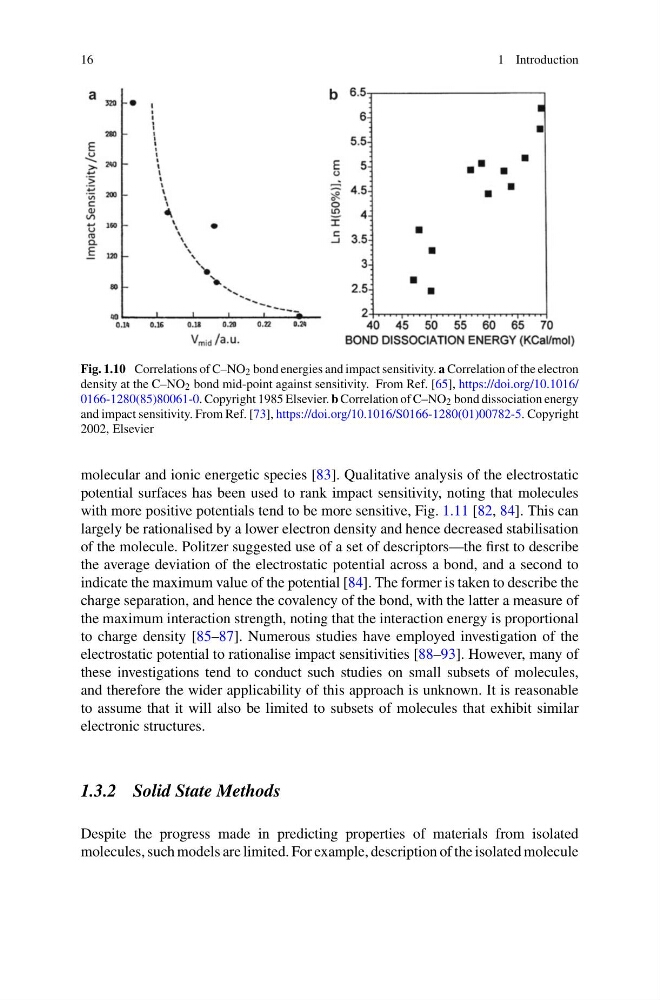
Fig. 1.10 Correlations of C–NO 2 bond energies and impact sensitivity. a Correlation of the electron
density at the C–NO 2 bond mid-point against sensitivity. From Ref. [65], https://doi.org/10.1016/
0166-1280(85)80061-0. Copyright 1985 Elsevier. b Correlation of C–NO 2 bond dissociation energy
and impact sensitivity. From Ref. [73], https://doi.org/10.1016/S0166-1280(01)00782-5. Copyright
2002, Elsevier
molecular and ionic energetic species [83]. Qualitative analysis of the electrostatic
potential surfaces has been used to rank impact sensitivity, noting that molecules
with more positive potentials tend to be more sensitive, Fig. 1.11 [82, 84]. This can
largely be rationalised by a lower electron density and hence decreased stabilisation
of the molecule. Politzer suggested use of a set of descriptors—the first to describe
the average deviation of the electrostatic potential across a bond, and a second to
indicate the maximum value of the potential [84]. The former is taken to describe the
charge separation, and hence the covalency of the bond, with the latter a measure of
the maximum interaction strength, noting that the interaction energy is proportional
to charge density [85–87]. Numerous studies have employed investigation of the
electrostatic potential to rationalise impact sensitivities [88–93]. However, many of
these investigations tend to conduct such studies on small subsets of molecules,
and therefore the wider applicability of this approach is unknown. It is reasonable
to assume that it will also be limited to subsets of molecules that exhibit similar
electronic structures.
1.3.2 Solid State Methods
Despite the progress made in predicting properties of materials from isolated
molecules, such models are limited. For example, description of the isolated molecule
1 Introduction
Fig. 1.10 Correlations of C–NO 2 bond energies and impact sensitivity. a Correlation of the electron
density at the C–NO 2 bond mid-point against sensitivity. From Ref. [65], https://doi.org/10.1016/
0166-1280(85)80061-0. Copyright 1985 Elsevier. b Correlation of C–NO 2 bond dissociation energy
and impact sensitivity. From Ref. [73], https://doi.org/10.1016/S0166-1280(01)00782-5. Copyright
2002, Elsevier
molecular and ionic energetic species [83]. Qualitative analysis of the electrostatic
potential surfaces has been used to rank impact sensitivity, noting that molecules
with more positive potentials tend to be more sensitive, Fig. 1.11 [82, 84]. This can
largely be rationalised by a lower electron density and hence decreased stabilisation
of the molecule. Politzer suggested use of a set of descriptors—the first to describe
the average deviation of the electrostatic potential across a bond, and a second to
indicate the maximum value of the potential [84]. The former is taken to describe the
charge separation, and hence the covalency of the bond, with the latter a measure of
the maximum interaction strength, noting that the interaction energy is proportional
to charge density [85–87]. Numerous studies have employed investigation of the
electrostatic potential to rationalise impact sensitivities [88–93]. However, many of
these investigations tend to conduct such studies on small subsets of molecules,
and therefore the wider applicability of this approach is unknown. It is reasonable
to assume that it will also be limited to subsets of molecules that exhibit similar
electronic structures.
1.3.2 Solid State Methods
Despite the progress made in predicting properties of materials from isolated
molecules, such models are limited. For example, description of the isolated molecule