

1.3 Prediction and Rationalisation of Energetic Material Sensitivity
15
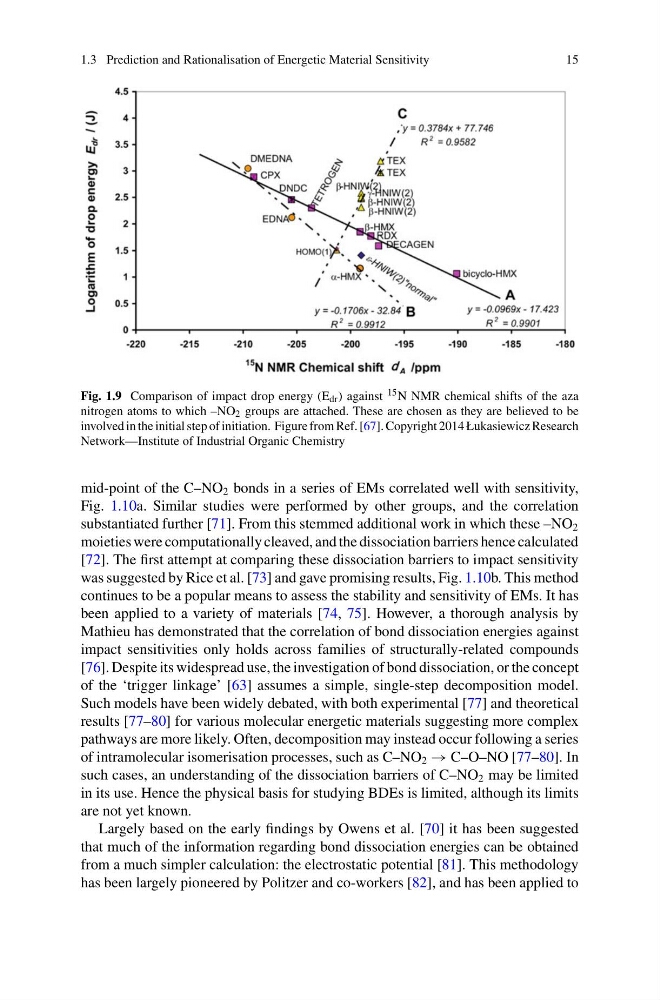
Fig. 1.9 Comparison of impact drop energy (E dr ) against 15 N NMR chemical shifts of the aza
nitrogen atoms to which –NO 2 groups are attached. These are chosen as they are believed to be
involved in the initial step of initiation. Figure from Ref. [67]. Copyright 2014 Łukasiewicz Research
Network—Institute of Industrial Organic Chemistry
mid-point of the C–NO 2 bonds in a series of EMs correlated well with sensitivity,
Fig. 1.10a. Similar studies were performed by other groups, and the correlation
substantiated further [71]. From this stemmed additional work in which these –NO 2
moieties were computationally cleaved, and the dissociation barriers hence calculated
[72]. The first attempt at comparing these dissociation barriers to impact sensitivity
was suggested by Rice et al. [73] and gave promising results, Fig. 1.10b. This method
continues to be a popular means to assess the stability and sensitivity of EMs. It has
been applied to a variety of materials [74, 75]. However, a thorough analysis by
Mathieu has demonstrated that the correlation of bond dissociation energies against
impact sensitivities only holds across families of structurally-related compounds
[76]. Despite its widespread use, the investigation of bond dissociation, or the concept
of the ‘trigger linkage’ [63] assumes a simple, single-step decomposition model.
Such models have been widely debated, with both experimental [77] and theoretical
results [77–80] for various molecular energetic materials suggesting more complex
pathways are more likely. Often, decomposition may instead occur following a series
of intramolecular isomerisation processes, such as C–NO 2 → C–O–NO [77–80]. In
such cases, an understanding of the dissociation barriers of C–NO 2 may be limited
in its use. Hence the physical basis for studying BDEs is limited, although its limits
are not yet known.
Largely based on the early findings by Owens et al. [70] it has been suggested
that much of the information regarding bond dissociation energies can be obtained
from a much simpler calculation: the electrostatic potential [81]. This methodology
has been largely pioneered by Politzer and co-workers [82], and has been applied to
15
Fig. 1.9 Comparison of impact drop energy (E dr ) against 15 N NMR chemical shifts of the aza
nitrogen atoms to which –NO 2 groups are attached. These are chosen as they are believed to be
involved in the initial step of initiation. Figure from Ref. [67]. Copyright 2014 Łukasiewicz Research
Network—Institute of Industrial Organic Chemistry
mid-point of the C–NO 2 bonds in a series of EMs correlated well with sensitivity,
Fig. 1.10a. Similar studies were performed by other groups, and the correlation
substantiated further [71]. From this stemmed additional work in which these –NO 2
moieties were computationally cleaved, and the dissociation barriers hence calculated
[72]. The first attempt at comparing these dissociation barriers to impact sensitivity
was suggested by Rice et al. [73] and gave promising results, Fig. 1.10b. This method
continues to be a popular means to assess the stability and sensitivity of EMs. It has
been applied to a variety of materials [74, 75]. However, a thorough analysis by
Mathieu has demonstrated that the correlation of bond dissociation energies against
impact sensitivities only holds across families of structurally-related compounds
[76]. Despite its widespread use, the investigation of bond dissociation, or the concept
of the ‘trigger linkage’ [63] assumes a simple, single-step decomposition model.
Such models have been widely debated, with both experimental [77] and theoretical
results [77–80] for various molecular energetic materials suggesting more complex
pathways are more likely. Often, decomposition may instead occur following a series
of intramolecular isomerisation processes, such as C–NO 2 → C–O–NO [77–80]. In
such cases, an understanding of the dissociation barriers of C–NO 2 may be limited
in its use. Hence the physical basis for studying BDEs is limited, although its limits
are not yet known.
Largely based on the early findings by Owens et al. [70] it has been suggested
that much of the information regarding bond dissociation energies can be obtained
from a much simpler calculation: the electrostatic potential [81]. This methodology
has been largely pioneered by Politzer and co-workers [82], and has been applied to