

14
1 Introduction
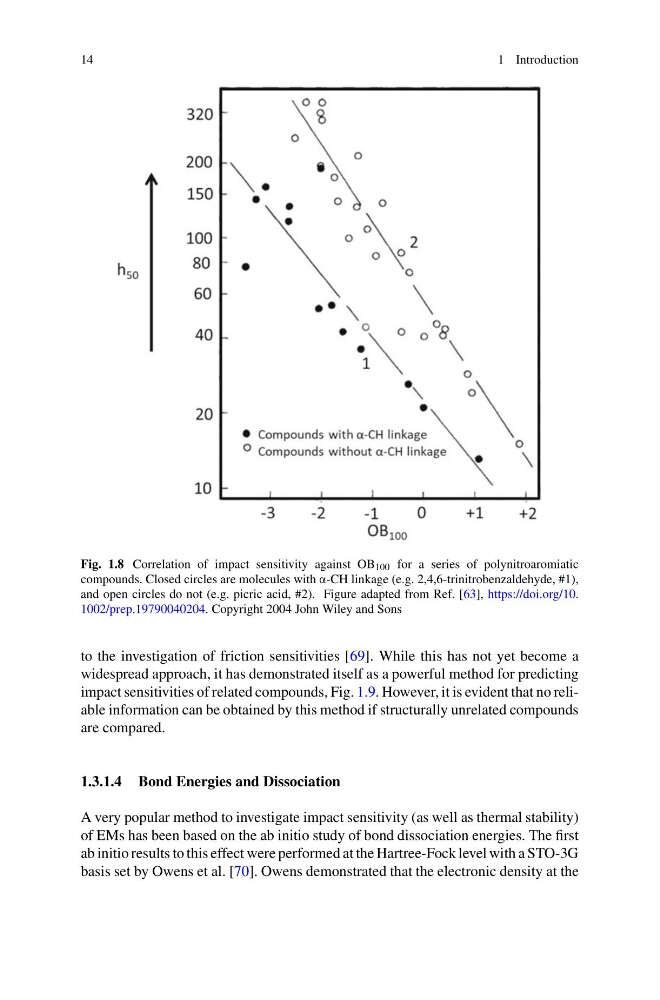
Fig. 1.8 Correlation of impact sensitivity against OB 100 for a series of polynitroaromiatic
compounds. Closed circles are molecules with α-CH linkage (e.g. 2,4,6-trinitrobenzaldehyde, #1),
and open circles do not (e.g. picric acid, #2). Figure adapted from Ref. [63], https://doi.org/10.
1002/prep.19790040204. Copyright 2004 John Wiley and Sons
to the investigation of friction sensitivities [69]. While this has not yet become a
widespread approach, it has demonstrated itself as a powerful method for predicting
impact sensitivities of related compounds, Fig. 1.9. However, it is evident that no reliable information can be obtained by this method if structurally unrelated compounds
are compared.
1.3.1.4 Bond Energies and Dissociation
A very popular method to investigate impact sensitivity (as well as thermal stability)
of EMs has been based on the ab initio study of bond dissociation energies. The first
ab initio results to this effect were performed at the Hartree-Fock level with a STO-3G
basis set by Owens et al. [70]. Owens demonstrated that the electronic density at the
1 Introduction
Fig. 1.8 Correlation of impact sensitivity against OB 100 for a series of polynitroaromiatic
compounds. Closed circles are molecules with α-CH linkage (e.g. 2,4,6-trinitrobenzaldehyde, #1),
and open circles do not (e.g. picric acid, #2). Figure adapted from Ref. [63], https://doi.org/10.
1002/prep.19790040204. Copyright 2004 John Wiley and Sons
to the investigation of friction sensitivities [69]. While this has not yet become a
widespread approach, it has demonstrated itself as a powerful method for predicting
impact sensitivities of related compounds, Fig. 1.9. However, it is evident that no reliable information can be obtained by this method if structurally unrelated compounds
are compared.
1.3.1.4 Bond Energies and Dissociation
A very popular method to investigate impact sensitivity (as well as thermal stability)
of EMs has been based on the ab initio study of bond dissociation energies. The first
ab initio results to this effect were performed at the Hartree-Fock level with a STO-3G
basis set by Owens et al. [70]. Owens demonstrated that the electronic density at the