

18
1 Introduction
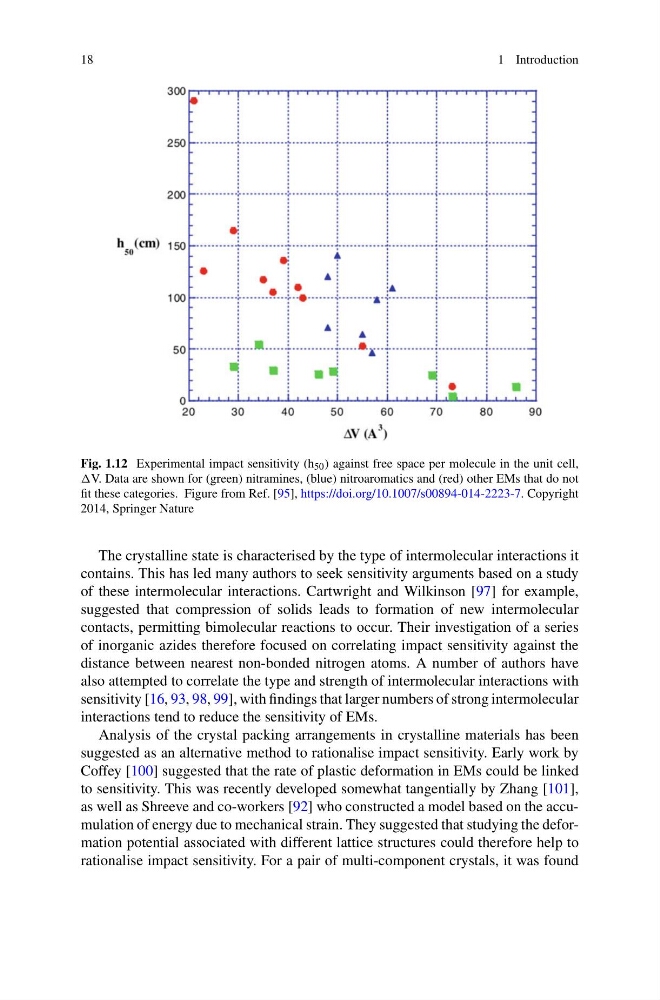
Fig. 1.12 Experimental impact sensitivity (h 50 ) against free space per molecule in the unit cell,
V. Data are shown for (green) nitramines, (blue) nitroaromatics and (red) other EMs that do not
fit these categories. Figure from Ref. [95], https://doi.org/10.1007/s00894-014-2223-7. Copyright
2014, Springer Nature
The crystalline state is characterised by the type of intermolecular interactions it
contains. This has led many authors to seek sensitivity arguments based on a study
of these intermolecular interactions. Cartwright and Wilkinson [97] for example,
suggested that compression of solids leads to formation of new intermolecular
contacts, permitting bimolecular reactions to occur. Their investigation of a series
of inorganic azides therefore focused on correlating impact sensitivity against the
distance between nearest non-bonded nitrogen atoms. A number of authors have
also attempted to correlate the type and strength of intermolecular interactions with
sensitivity [16, 93, 98, 99], with findings that larger numbers of strong intermolecular
interactions tend to reduce the sensitivity of EMs.
Analysis of the crystal packing arrangements in crystalline materials has been
suggested as an alternative method to rationalise impact sensitivity. Early work by
Coffey [100] suggested that the rate of plastic deformation in EMs could be linked
to sensitivity. This was recently developed somewhat tangentially by Zhang [101],
as well as Shreeve and co-workers [92] who constructed a model based on the accumulation of energy due to mechanical strain. They suggested that studying the deformation potential associated with different lattice structures could therefore help to
rationalise impact sensitivity. For a pair of multi-component crystals, it was found
1 Introduction
Fig. 1.12 Experimental impact sensitivity (h 50 ) against free space per molecule in the unit cell,
V. Data are shown for (green) nitramines, (blue) nitroaromatics and (red) other EMs that do not
fit these categories. Figure from Ref. [95], https://doi.org/10.1007/s00894-014-2223-7. Copyright
2014, Springer Nature
The crystalline state is characterised by the type of intermolecular interactions it
contains. This has led many authors to seek sensitivity arguments based on a study
of these intermolecular interactions. Cartwright and Wilkinson [97] for example,
suggested that compression of solids leads to formation of new intermolecular
contacts, permitting bimolecular reactions to occur. Their investigation of a series
of inorganic azides therefore focused on correlating impact sensitivity against the
distance between nearest non-bonded nitrogen atoms. A number of authors have
also attempted to correlate the type and strength of intermolecular interactions with
sensitivity [16, 93, 98, 99], with findings that larger numbers of strong intermolecular
interactions tend to reduce the sensitivity of EMs.
Analysis of the crystal packing arrangements in crystalline materials has been
suggested as an alternative method to rationalise impact sensitivity. Early work by
Coffey [100] suggested that the rate of plastic deformation in EMs could be linked
to sensitivity. This was recently developed somewhat tangentially by Zhang [101],
as well as Shreeve and co-workers [92] who constructed a model based on the accumulation of energy due to mechanical strain. They suggested that studying the deformation potential associated with different lattice structures could therefore help to
rationalise impact sensitivity. For a pair of multi-component crystals, it was found