

8
1 Introduction
proposed [25, 26] for the formation of hot-spots, but the mechanism by which they
occur depends critically on the nature of the material. Some hot-spots (critical hotspots) will lead to self-propagating initiation of an EM, while others (non-critical hotspots) will lead to local heating, without initiation of the material. Hence, within the
hot-spot theory for EM initiation, understanding the corresponding hot-spot mechanism is crucial. Field [26] studied the initiation events by high-speed photography,
and concluded that there are only a few mechanisms that are responsible for critical hot-spot formation as a result of mechanical perturbation. In solids, these are
adiabatic gas heating, friction, adiabatic shear and viscoplastic work [26].
Within an explosive composition, gases trapped within defects (on the order of
0.1–10 μm) are adiabatically compressed from an initial pressure, P i , to some final
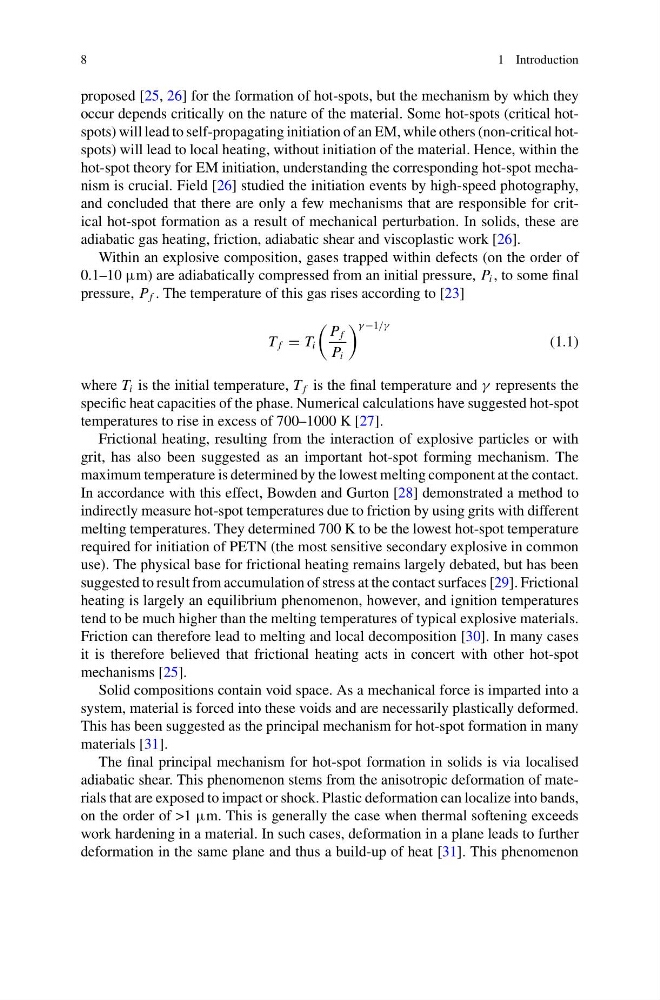
pressure, P f . The temperature of this gas rises according to [23]
T f = T i
P f
P i
γ −1/γ
(1.1)
where T i is the initial temperature, T f is the final temperature and γ represents the
specific heat capacities of the phase. Numerical calculations have suggested hot-spot
temperatures to rise in excess of 700–1000 K [27].
Frictional heating, resulting from the interaction of explosive particles or with
grit, has also been suggested as an important hot-spot forming mechanism. The
maximum temperature is determined by the lowest melting component at the contact.
In accordance with this effect, Bowden and Gurton [28] demonstrated a method to
indirectly measure hot-spot temperatures due to friction by using grits with different
melting temperatures. They determined 700 K to be the lowest hot-spot temperature
required for initiation of PETN (the most sensitive secondary explosive in common
use). The physical base for frictional heating remains largely debated, but has been
suggested to result from accumulation of stress at the contact surfaces [29]. Frictional
heating is largely an equilibrium phenomenon, however, and ignition temperatures
tend to be much higher than the melting temperatures of typical explosive materials.
Friction can therefore lead to melting and local decomposition [30]. In many cases
it is therefore believed that frictional heating acts in concert with other hot-spot
mechanisms [25].
Solid compositions contain void space. As a mechanical force is imparted into a
system, material is forced into these voids and are necessarily plastically deformed.
This has been suggested as the principal mechanism for hot-spot formation in many
materials [31].
The final principal mechanism for hot-spot formation in solids is via localised
adiabatic shear. This phenomenon stems from the anisotropic deformation of materials that are exposed to impact or shock. Plastic deformation can localize into bands,
on the order of >1 μm. This is generally the case when thermal softening exceeds
work hardening in a material. In such cases, deformation in a plane leads to further
deformation in the same plane and thus a build-up of heat [31]. This phenomenon
1 Introduction
proposed [25, 26] for the formation of hot-spots, but the mechanism by which they
occur depends critically on the nature of the material. Some hot-spots (critical hotspots) will lead to self-propagating initiation of an EM, while others (non-critical hotspots) will lead to local heating, without initiation of the material. Hence, within the
hot-spot theory for EM initiation, understanding the corresponding hot-spot mechanism is crucial. Field [26] studied the initiation events by high-speed photography,
and concluded that there are only a few mechanisms that are responsible for critical hot-spot formation as a result of mechanical perturbation. In solids, these are
adiabatic gas heating, friction, adiabatic shear and viscoplastic work [26].
Within an explosive composition, gases trapped within defects (on the order of
0.1–10 μm) are adiabatically compressed from an initial pressure, P i , to some final
pressure, P f . The temperature of this gas rises according to [23]
T f = T i
P f
P i
γ −1/γ
(1.1)
where T i is the initial temperature, T f is the final temperature and γ represents the
specific heat capacities of the phase. Numerical calculations have suggested hot-spot
temperatures to rise in excess of 700–1000 K [27].
Frictional heating, resulting from the interaction of explosive particles or with
grit, has also been suggested as an important hot-spot forming mechanism. The
maximum temperature is determined by the lowest melting component at the contact.
In accordance with this effect, Bowden and Gurton [28] demonstrated a method to
indirectly measure hot-spot temperatures due to friction by using grits with different
melting temperatures. They determined 700 K to be the lowest hot-spot temperature
required for initiation of PETN (the most sensitive secondary explosive in common
use). The physical base for frictional heating remains largely debated, but has been
suggested to result from accumulation of stress at the contact surfaces [29]. Frictional
heating is largely an equilibrium phenomenon, however, and ignition temperatures
tend to be much higher than the melting temperatures of typical explosive materials.
Friction can therefore lead to melting and local decomposition [30]. In many cases
it is therefore believed that frictional heating acts in concert with other hot-spot
mechanisms [25].
Solid compositions contain void space. As a mechanical force is imparted into a
system, material is forced into these voids and are necessarily plastically deformed.
This has been suggested as the principal mechanism for hot-spot formation in many
materials [31].
The final principal mechanism for hot-spot formation in solids is via localised
adiabatic shear. This phenomenon stems from the anisotropic deformation of materials that are exposed to impact or shock. Plastic deformation can localize into bands,
on the order of >1 μm. This is generally the case when thermal softening exceeds
work hardening in a material. In such cases, deformation in a plane leads to further
deformation in the same plane and thus a build-up of heat [31]. This phenomenon