

1.2 Initiation of Energetic Materials
7
1.2 Initiation of Energetic Materials
1.2.1 Hot Spot Models
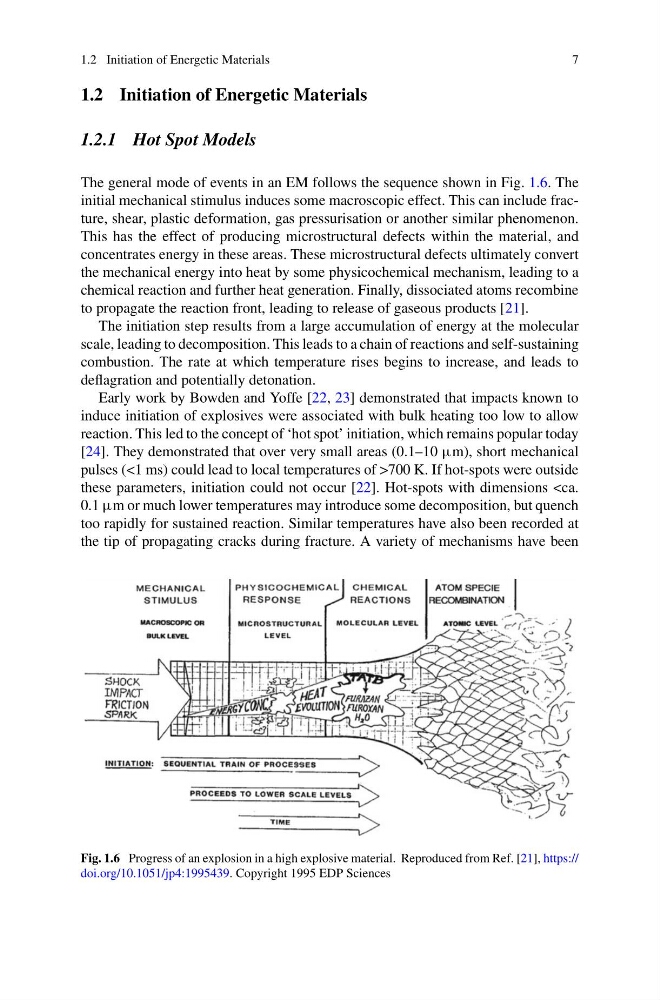
The general mode of events in an EM follows the sequence shown in Fig. 1.6. The
initial mechanical stimulus induces some macroscopic effect. This can include fracture, shear, plastic deformation, gas pressurisation or another similar phenomenon.
This has the effect of producing microstructural defects within the material, and
concentrates energy in these areas. These microstructural defects ultimately convert
the mechanical energy into heat by some physicochemical mechanism, leading to a
chemical reaction and further heat generation. Finally, dissociated atoms recombine
to propagate the reaction front, leading to release of gaseous products [21].
The initiation step results from a large accumulation of energy at the molecular
scale, leading to decomposition. This leads to a chain of reactions and self-sustaining
combustion. The rate at which temperature rises begins to increase, and leads to
deflagration and potentially detonation.
Early work by Bowden and Yoffe [22, 23] demonstrated that impacts known to
induce initiation of explosives were associated with bulk heating too low to allow
reaction. This led to the concept of ‘hot spot’ initiation, which remains popular today
[24]. They demonstrated that over very small areas (0.1–10 μm), short mechanical
pulses (<1 ms) could lead to local temperatures of >700 K. If hot-spots were outside
these parameters, initiation could not occur [22]. Hot-spots with dimensions
too rapidly for sustained reaction. Similar temperatures have also been recorded at
the tip of propagating cracks during fracture. A variety of mechanisms have been
Fig. 1.6 Progress of an explosion in a high explosive material. Reproduced from Ref. [21], https://
doi.org/10.1051/jp4:1995439. Copyright 1995 EDP Sciences
7
1.2 Initiation of Energetic Materials
1.2.1 Hot Spot Models
The general mode of events in an EM follows the sequence shown in Fig. 1.6. The
initial mechanical stimulus induces some macroscopic effect. This can include fracture, shear, plastic deformation, gas pressurisation or another similar phenomenon.
This has the effect of producing microstructural defects within the material, and
concentrates energy in these areas. These microstructural defects ultimately convert
the mechanical energy into heat by some physicochemical mechanism, leading to a
chemical reaction and further heat generation. Finally, dissociated atoms recombine
to propagate the reaction front, leading to release of gaseous products [21].
The initiation step results from a large accumulation of energy at the molecular
scale, leading to decomposition. This leads to a chain of reactions and self-sustaining
combustion. The rate at which temperature rises begins to increase, and leads to
deflagration and potentially detonation.
Early work by Bowden and Yoffe [22, 23] demonstrated that impacts known to
induce initiation of explosives were associated with bulk heating too low to allow
reaction. This led to the concept of ‘hot spot’ initiation, which remains popular today
[24]. They demonstrated that over very small areas (0.1–10 μm), short mechanical
pulses (<1 ms) could lead to local temperatures of >700 K. If hot-spots were outside
these parameters, initiation could not occur [22]. Hot-spots with dimensions
too rapidly for sustained reaction. Similar temperatures have also been recorded at
the tip of propagating cracks during fracture. A variety of mechanisms have been
Fig. 1.6 Progress of an explosion in a high explosive material. Reproduced from Ref. [21], https://
doi.org/10.1051/jp4:1995439. Copyright 1995 EDP Sciences