

1.2 Initiation of Energetic Materials
9
was first described by Recht for metals [32], but was subsequently observed in inorganic explosives by Winter and Field [33] and later in organic explosives, PETN and
HMX [26].
A microscopic hot-spot model has also been suggested. This model is based on
the concept of dislocation pile-ups [29]. Upon mechanical stimulation, the contact
layer undergoes immense plastic deformation and generation of extended defects
(dislocations) that extend into the bulk [29]. At any temperature T > 0 K these
defects rapidly migrate through the sample and collide (generally at existing defects),
leading to local accumulations of energy within a crystallite. However, these pileups occur over length scales of 10 s of nanometres [34]. Hence this mechanism
does not produce sufficiently large hot-spots, and the accumulated energy quickly
dissipates to the surrounding bulk. Hence dislocation pile-ups have been suggested
as a non-critical hot-spot phenomenon.
1.2.2 Vibrational Up-Pumping
While the hot-spot mechanisms describe the generation of large amounts of energy
in localised areas, they do not go so far as to describe localisation of this energy into
a molecular response. An additional model, dubbed vibrational up-pumping was
therefore proposed by Coffey and Toton [35] in an attempt to describe the processes
occurring immediately behind a shock front. This model was subsequently developed
by Dlott and Fayer [36].
The process of vibrational cooling was well established both experimentally
and theoretically through the late 20th century [37]. This phenomenon describes
the mechanism by which excess molecular vibrational energy relaxes within a
crystal. However, when mechanical energy is inserted instead into the low frequency
vibrational modes, the reverse process is observed.
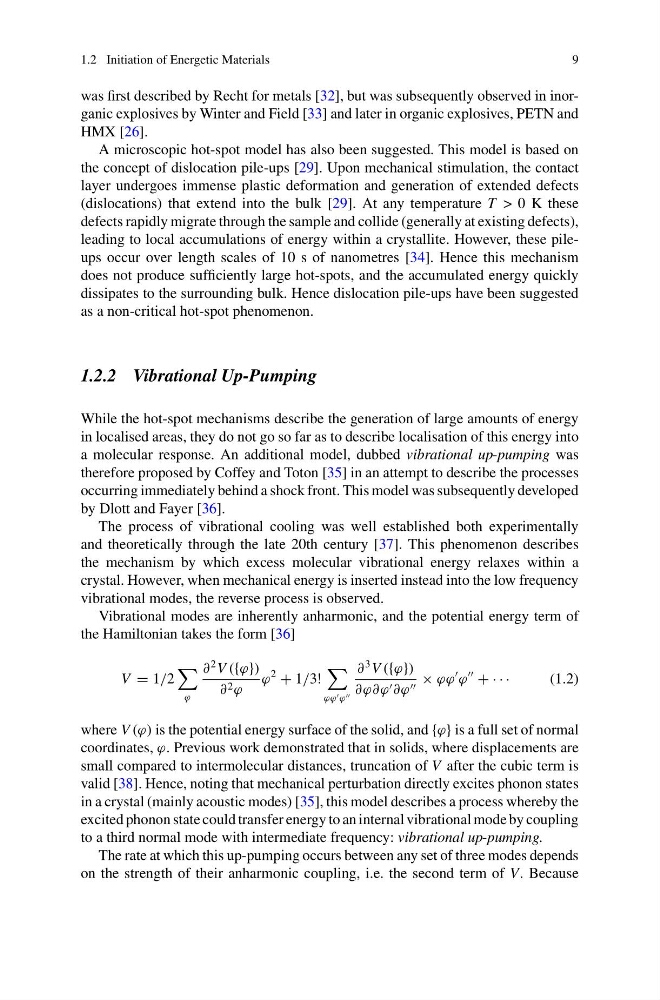
Vibrational modes are inherently anharmonic, and the potential energy term of
the Hamiltonian takes the form [36]
V = 1/2
ϕ
∂
2 V ({ϕ})
∂ 2 ϕ
ϕ
2
+ 1/3!
ϕϕ ϕ
∂
3 V ({ϕ})
∂ϕ∂ϕ ∂ϕ × ϕϕ
ϕ
+ · · ·
(1.2)
where V (ϕ) is the potential energy surface of the solid, and {ϕ} is a full set of normal
coordinates, ϕ. Previous work demonstrated that in solids, where displacements are
small compared to intermolecular distances, truncation of V after the cubic term is
valid [38]. Hence, noting that mechanical perturbation directly excites phonon states
in a crystal (mainly acoustic modes) [35], this model describes a process whereby the
excited phonon state could transfer energy to an internal vibrational mode by coupling
to a third normal mode with intermediate frequency: vibrational up-pumping.
The rate at which this up-pumping occurs between any set of three modes depends
on the strength of their anharmonic coupling, i.e. the second term of V. Because
9
was first described by Recht for metals [32], but was subsequently observed in inorganic explosives by Winter and Field [33] and later in organic explosives, PETN and
HMX [26].
A microscopic hot-spot model has also been suggested. This model is based on
the concept of dislocation pile-ups [29]. Upon mechanical stimulation, the contact
layer undergoes immense plastic deformation and generation of extended defects
(dislocations) that extend into the bulk [29]. At any temperature T > 0 K these
defects rapidly migrate through the sample and collide (generally at existing defects),
leading to local accumulations of energy within a crystallite. However, these pileups occur over length scales of 10 s of nanometres [34]. Hence this mechanism
does not produce sufficiently large hot-spots, and the accumulated energy quickly
dissipates to the surrounding bulk. Hence dislocation pile-ups have been suggested
as a non-critical hot-spot phenomenon.
1.2.2 Vibrational Up-Pumping
While the hot-spot mechanisms describe the generation of large amounts of energy
in localised areas, they do not go so far as to describe localisation of this energy into
a molecular response. An additional model, dubbed vibrational up-pumping was
therefore proposed by Coffey and Toton [35] in an attempt to describe the processes
occurring immediately behind a shock front. This model was subsequently developed
by Dlott and Fayer [36].
The process of vibrational cooling was well established both experimentally
and theoretically through the late 20th century [37]. This phenomenon describes
the mechanism by which excess molecular vibrational energy relaxes within a
crystal. However, when mechanical energy is inserted instead into the low frequency
vibrational modes, the reverse process is observed.
Vibrational modes are inherently anharmonic, and the potential energy term of
the Hamiltonian takes the form [36]
V = 1/2
ϕ
∂
2 V ({ϕ})
∂ 2 ϕ
ϕ
2
+ 1/3!
ϕϕ ϕ
∂
3 V ({ϕ})
∂ϕ∂ϕ ∂ϕ × ϕϕ
ϕ
+ · · ·
(1.2)
where V (ϕ) is the potential energy surface of the solid, and {ϕ} is a full set of normal
coordinates, ϕ. Previous work demonstrated that in solids, where displacements are
small compared to intermolecular distances, truncation of V after the cubic term is
valid [38]. Hence, noting that mechanical perturbation directly excites phonon states
in a crystal (mainly acoustic modes) [35], this model describes a process whereby the
excited phonon state could transfer energy to an internal vibrational mode by coupling
to a third normal mode with intermediate frequency: vibrational up-pumping.
The rate at which this up-pumping occurs between any set of three modes depends
on the strength of their anharmonic coupling, i.e. the second term of V. Because