

1.1 Energetic Materials
5
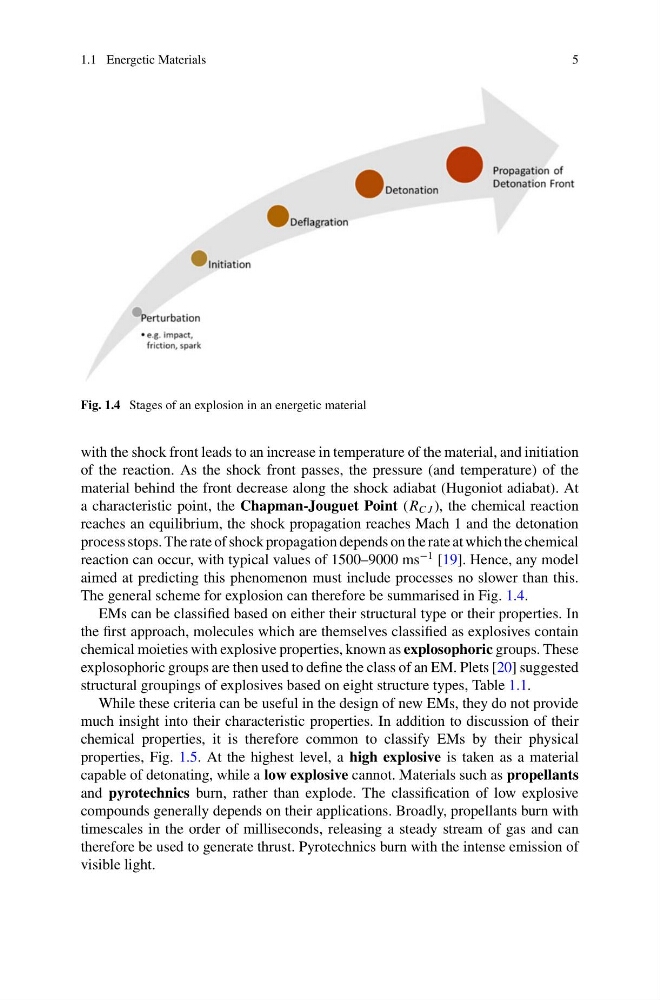
Fig. 1.4 Stages of an explosion in an energetic material
with the shock front leads to an increase in temperature of the material, and initiation
of the reaction. As the shock front passes, the pressure (and temperature) of the
material behind the front decrease along the shock adiabat (Hugoniot adiabat). At
a characteristic point, the Chapman-Jouguet Point (R C J ), the chemical reaction
reaches an equilibrium, the shock propagation reaches Mach 1 and the detonation
process stops. The rate of shock propagation depends on the rate at which the chemical
reaction can occur, with typical values of 1500–9000 ms
−1 [19]. Hence, any model
aimed at predicting this phenomenon must include processes no slower than this.
The general scheme for explosion can therefore be summarised in Fig. 1.4.
EMs can be classified based on either their structural type or their properties. In
the first approach, molecules which are themselves classified as explosives contain
chemical moieties with explosive properties, known as explosophoric groups. These
explosophoric groups are then used to define the class of an EM. Plets [20] suggested
structural groupings of explosives based on eight structure types, Table 1.1.
While these criteria can be useful in the design of new EMs, they do not provide
much insight into their characteristic properties. In addition to discussion of their
chemical properties, it is therefore common to classify EMs by their physical
properties, Fig. 1.5. At the highest level, a high explosive is taken as a material
capable of detonating, while a low explosive cannot. Materials such as propellants
and pyrotechnics burn, rather than explode. The classification of low explosive
compounds generally depends on their applications. Broadly, propellants burn with
timescales in the order of milliseconds, releasing a steady stream of gas and can
therefore be used to generate thrust. Pyrotechnics burn with the intense emission of
visible light.
5
Fig. 1.4 Stages of an explosion in an energetic material
with the shock front leads to an increase in temperature of the material, and initiation
of the reaction. As the shock front passes, the pressure (and temperature) of the
material behind the front decrease along the shock adiabat (Hugoniot adiabat). At
a characteristic point, the Chapman-Jouguet Point (R C J ), the chemical reaction
reaches an equilibrium, the shock propagation reaches Mach 1 and the detonation
process stops. The rate of shock propagation depends on the rate at which the chemical
reaction can occur, with typical values of 1500–9000 ms
−1 [19]. Hence, any model
aimed at predicting this phenomenon must include processes no slower than this.
The general scheme for explosion can therefore be summarised in Fig. 1.4.
EMs can be classified based on either their structural type or their properties. In
the first approach, molecules which are themselves classified as explosives contain
chemical moieties with explosive properties, known as explosophoric groups. These
explosophoric groups are then used to define the class of an EM. Plets [20] suggested
structural groupings of explosives based on eight structure types, Table 1.1.
While these criteria can be useful in the design of new EMs, they do not provide
much insight into their characteristic properties. In addition to discussion of their
chemical properties, it is therefore common to classify EMs by their physical
properties, Fig. 1.5. At the highest level, a high explosive is taken as a material
capable of detonating, while a low explosive cannot. Materials such as propellants
and pyrotechnics burn, rather than explode. The classification of low explosive
compounds generally depends on their applications. Broadly, propellants burn with
timescales in the order of milliseconds, releasing a steady stream of gas and can
therefore be used to generate thrust. Pyrotechnics burn with the intense emission of
visible light.