

4
1 Introduction
1.1.3 Energetic Materials: Definitions and Classifications
Explosions caused by EMs are chemical explosions and are the result of a rapid
chemical reaction that releases large amounts of energy and gas. The chemical transformation occurs so rapidly that gas products do not instantly expand out of the reaction zone. This leads to immense pressurisation within the material and formation of
a shock wave [17].
An EM can be any material that contains both a fuel and an oxidiser. These can
be single component (e.g. TNT or HMX), or multi-component (e.g. black powder)
systems. When the material ignites and reacts without the formation of additional
pressure (i.e. a slow burn), it is said to combust. If, however, pressure is generated in
the material, the material is instead said to deflagrate. A deflagration is characterised
by a sub-sonic burn rate. Under very particular circumstances—pressure build-up,
confinement or very rapid reaction—deflagration can instead change to a detonation. This transition, known as the deflagration-to-detonation (DDT) transition,
results from adiabatic heating, i.e. that temperature increases with pressure. Hence,
if sufficient pressure is accumulated within the material during its burn, or an intense
shock is applied to the material, the propagation of the chemical reaction front accelerates due to increased temperature. In a detonation, the reaction front propagates at
supersonic speeds, and is associated with the propagation of a shock front.
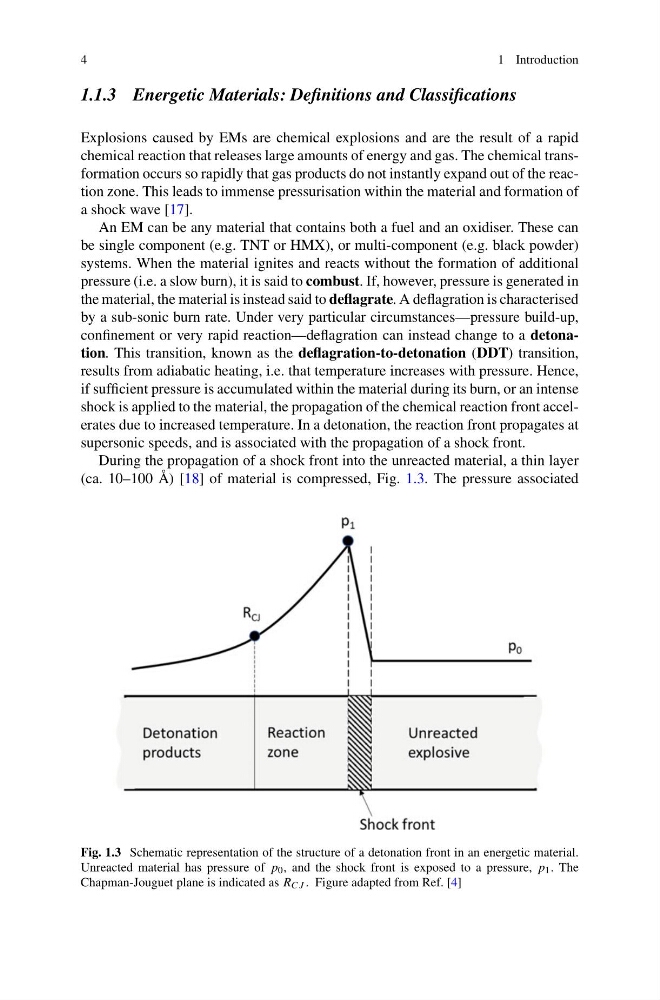
During the propagation of a shock front into the unreacted material, a thin layer
(ca. 10–100 Å) [18] of material is compressed, Fig. 1.3. The pressure associated
Fig. 1.3 Schematic representation of the structure of a detonation front in an energetic material.
Unreacted material has pressure of p 0 , and the shock front is exposed to a pressure, p 1 . The
Chapman-Jouguet plane is indicated as R C J . Figure adapted from Ref. [4]
1 Introduction
1.1.3 Energetic Materials: Definitions and Classifications
Explosions caused by EMs are chemical explosions and are the result of a rapid
chemical reaction that releases large amounts of energy and gas. The chemical transformation occurs so rapidly that gas products do not instantly expand out of the reaction zone. This leads to immense pressurisation within the material and formation of
a shock wave [17].
An EM can be any material that contains both a fuel and an oxidiser. These can
be single component (e.g. TNT or HMX), or multi-component (e.g. black powder)
systems. When the material ignites and reacts without the formation of additional
pressure (i.e. a slow burn), it is said to combust. If, however, pressure is generated in
the material, the material is instead said to deflagrate. A deflagration is characterised
by a sub-sonic burn rate. Under very particular circumstances—pressure build-up,
confinement or very rapid reaction—deflagration can instead change to a detonation. This transition, known as the deflagration-to-detonation (DDT) transition,
results from adiabatic heating, i.e. that temperature increases with pressure. Hence,
if sufficient pressure is accumulated within the material during its burn, or an intense
shock is applied to the material, the propagation of the chemical reaction front accelerates due to increased temperature. In a detonation, the reaction front propagates at
supersonic speeds, and is associated with the propagation of a shock front.
During the propagation of a shock front into the unreacted material, a thin layer
(ca. 10–100 Å) [18] of material is compressed, Fig. 1.3. The pressure associated
Fig. 1.3 Schematic representation of the structure of a detonation front in an energetic material.
Unreacted material has pressure of p 0 , and the shock front is exposed to a pressure, p 1 . The
Chapman-Jouguet plane is indicated as R C J . Figure adapted from Ref. [4]