

1.1 Energetic Materials
3
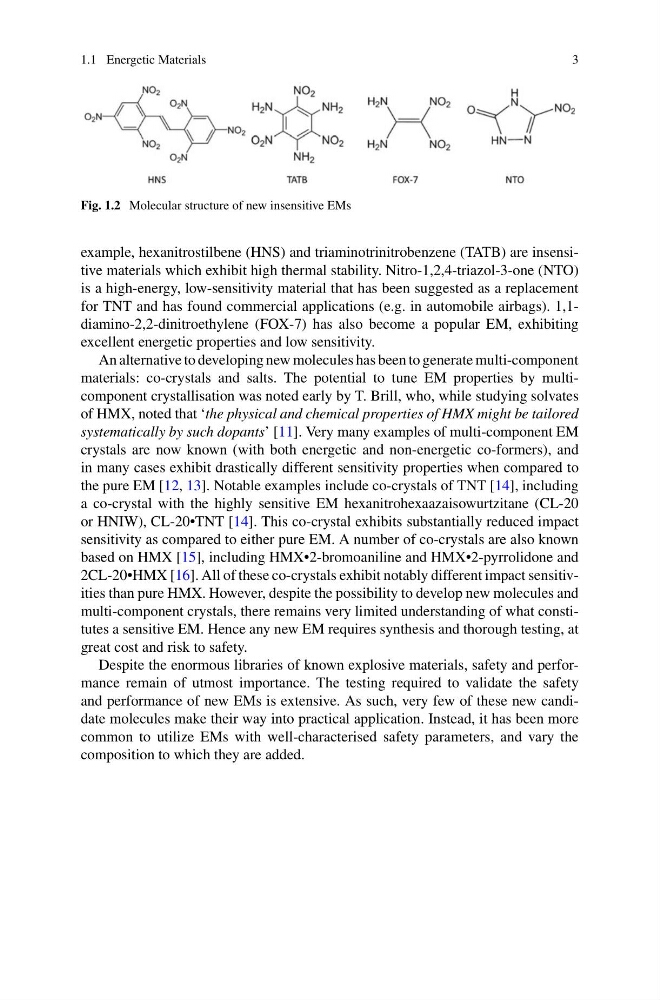
Fig. 1.2 Molecular structure of new insensitive EMs
example, hexanitrostilbene (HNS) and triaminotrinitrobenzene (TATB) are insensitive materials which exhibit high thermal stability. Nitro-1,2,4-triazol-3-one (NTO)
is a high-energy, low-sensitivity material that has been suggested as a replacement
for TNT and has found commercial applications (e.g. in automobile airbags). 1,1diamino-2,2-dinitroethylene (FOX-7) has also become a popular EM, exhibiting
excellent energetic properties and low sensitivity.
An alternative to developing new molecules has been to generate multi-component
materials: co-crystals and salts. The potential to tune EM properties by multicomponent crystallisation was noted early by T. Brill, who, while studying solvates
of HMX, noted that ‘the physical and chemical properties of HMX might be tailored
systematically by such dopants’ [11]. Very many examples of multi-component EM
crystals are now known (with both energetic and non-energetic co-formers), and
in many cases exhibit drastically different sensitivity properties when compared to
the pure EM [12, 13]. Notable examples include co-crystals of TNT [14], including
a co-crystal with the highly sensitive EM hexanitrohexaazaisowurtzitane (CL-20
or HNIW), CL-20•TNT [14]. This co-crystal exhibits substantially reduced impact
sensitivity as compared to either pure EM. A number of co-crystals are also known
based on HMX [15], including HMX•2-bromoaniline and HMX•2-pyrrolidone and
2CL-20•HMX [16]. All of these co-crystals exhibit notably different impact sensitivities than pure HMX. However, despite the possibility to develop new molecules and
multi-component crystals, there remains very limited understanding of what constitutes a sensitive EM. Hence any new EM requires synthesis and thorough testing, at
great cost and risk to safety.
Despite the enormous libraries of known explosive materials, safety and performance remain of utmost importance. The testing required to validate the safety
and performance of new EMs is extensive. As such, very few of these new candidate molecules make their way into practical application. Instead, it has been more
common to utilize EMs with well-characterised safety parameters, and vary the
composition to which they are added.
3
Fig. 1.2 Molecular structure of new insensitive EMs
example, hexanitrostilbene (HNS) and triaminotrinitrobenzene (TATB) are insensitive materials which exhibit high thermal stability. Nitro-1,2,4-triazol-3-one (NTO)
is a high-energy, low-sensitivity material that has been suggested as a replacement
for TNT and has found commercial applications (e.g. in automobile airbags). 1,1diamino-2,2-dinitroethylene (FOX-7) has also become a popular EM, exhibiting
excellent energetic properties and low sensitivity.
An alternative to developing new molecules has been to generate multi-component
materials: co-crystals and salts. The potential to tune EM properties by multicomponent crystallisation was noted early by T. Brill, who, while studying solvates
of HMX, noted that ‘the physical and chemical properties of HMX might be tailored
systematically by such dopants’ [11]. Very many examples of multi-component EM
crystals are now known (with both energetic and non-energetic co-formers), and
in many cases exhibit drastically different sensitivity properties when compared to
the pure EM [12, 13]. Notable examples include co-crystals of TNT [14], including
a co-crystal with the highly sensitive EM hexanitrohexaazaisowurtzitane (CL-20
or HNIW), CL-20•TNT [14]. This co-crystal exhibits substantially reduced impact
sensitivity as compared to either pure EM. A number of co-crystals are also known
based on HMX [15], including HMX•2-bromoaniline and HMX•2-pyrrolidone and
2CL-20•HMX [16]. All of these co-crystals exhibit notably different impact sensitivities than pure HMX. However, despite the possibility to develop new molecules and
multi-component crystals, there remains very limited understanding of what constitutes a sensitive EM. Hence any new EM requires synthesis and thorough testing, at
great cost and risk to safety.
Despite the enormous libraries of known explosive materials, safety and performance remain of utmost importance. The testing required to validate the safety
and performance of new EMs is extensive. As such, very few of these new candidate molecules make their way into practical application. Instead, it has been more
common to utilize EMs with well-characterised safety parameters, and vary the
composition to which they are added.