

2
1 Introduction
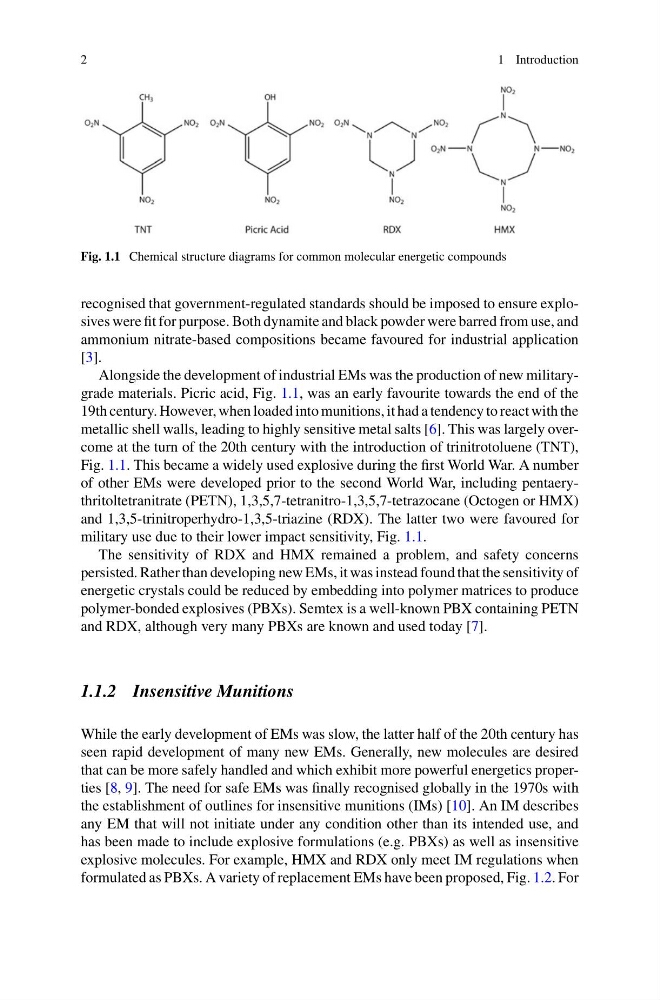
Fig. 1.1 Chemical structure diagrams for common molecular energetic compounds
recognised that government-regulated standards should be imposed to ensure explosives were fit for purpose. Both dynamite and black powder were barred from use, and
ammonium nitrate-based compositions became favoured for industrial application
[3].
Alongside the development of industrial EMs was the production of new militarygrade materials. Picric acid, Fig. 1.1, was an early favourite towards the end of the
19th century. However, when loaded into munitions, it had a tendency to react with the
metallic shell walls, leading to highly sensitive metal salts [6]. This was largely overcome at the turn of the 20th century with the introduction of trinitrotoluene (TNT),
Fig. 1.1. This became a widely used explosive during the first World War. A number
of other EMs were developed prior to the second World War, including pentaerythritoltetranitrate (PETN), 1,3,5,7-tetranitro-1,3,5,7-tetrazocane (Octogen or HMX)
and 1,3,5-trinitroperhydro-1,3,5-triazine (RDX). The latter two were favoured for
military use due to their lower impact sensitivity, Fig. 1.1.
The sensitivity of RDX and HMX remained a problem, and safety concerns
persisted. Rather than developing new EMs, it was instead found that the sensitivity of
energetic crystals could be reduced by embedding into polymer matrices to produce
polymer-bonded explosives (PBXs). Semtex is a well-known PBX containing PETN
and RDX, although very many PBXs are known and used today [7].
1.1.2 Insensitive Munitions
While the early development of EMs was slow, the latter half of the 20th century has
seen rapid development of many new EMs. Generally, new molecules are desired
that can be more safely handled and which exhibit more powerful energetics properties [8, 9]. The need for safe EMs was finally recognised globally in the 1970s with
the establishment of outlines for insensitive munitions (IMs) [10]. An IM describes
any EM that will not initiate under any condition other than its intended use, and
has been made to include explosive formulations (e.g. PBXs) as well as insensitive
explosive molecules. For example, HMX and RDX only meet IM regulations when
formulated as PBXs. A variety of replacement EMs have been proposed, Fig. 1.2. For
1 Introduction
Fig. 1.1 Chemical structure diagrams for common molecular energetic compounds
recognised that government-regulated standards should be imposed to ensure explosives were fit for purpose. Both dynamite and black powder were barred from use, and
ammonium nitrate-based compositions became favoured for industrial application
[3].
Alongside the development of industrial EMs was the production of new militarygrade materials. Picric acid, Fig. 1.1, was an early favourite towards the end of the
19th century. However, when loaded into munitions, it had a tendency to react with the
metallic shell walls, leading to highly sensitive metal salts [6]. This was largely overcome at the turn of the 20th century with the introduction of trinitrotoluene (TNT),
Fig. 1.1. This became a widely used explosive during the first World War. A number
of other EMs were developed prior to the second World War, including pentaerythritoltetranitrate (PETN), 1,3,5,7-tetranitro-1,3,5,7-tetrazocane (Octogen or HMX)
and 1,3,5-trinitroperhydro-1,3,5-triazine (RDX). The latter two were favoured for
military use due to their lower impact sensitivity, Fig. 1.1.
The sensitivity of RDX and HMX remained a problem, and safety concerns
persisted. Rather than developing new EMs, it was instead found that the sensitivity of
energetic crystals could be reduced by embedding into polymer matrices to produce
polymer-bonded explosives (PBXs). Semtex is a well-known PBX containing PETN
and RDX, although very many PBXs are known and used today [7].
1.1.2 Insensitive Munitions
While the early development of EMs was slow, the latter half of the 20th century has
seen rapid development of many new EMs. Generally, new molecules are desired
that can be more safely handled and which exhibit more powerful energetics properties [8, 9]. The need for safe EMs was finally recognised globally in the 1970s with
the establishment of outlines for insensitive munitions (IMs) [10]. An IM describes
any EM that will not initiate under any condition other than its intended use, and
has been made to include explosive formulations (e.g. PBXs) as well as insensitive
explosive molecules. For example, HMX and RDX only meet IM regulations when
formulated as PBXs. A variety of replacement EMs have been proposed, Fig. 1.2. For