

168
5 Vibrational Up-Pumping in Polymorphic Materials
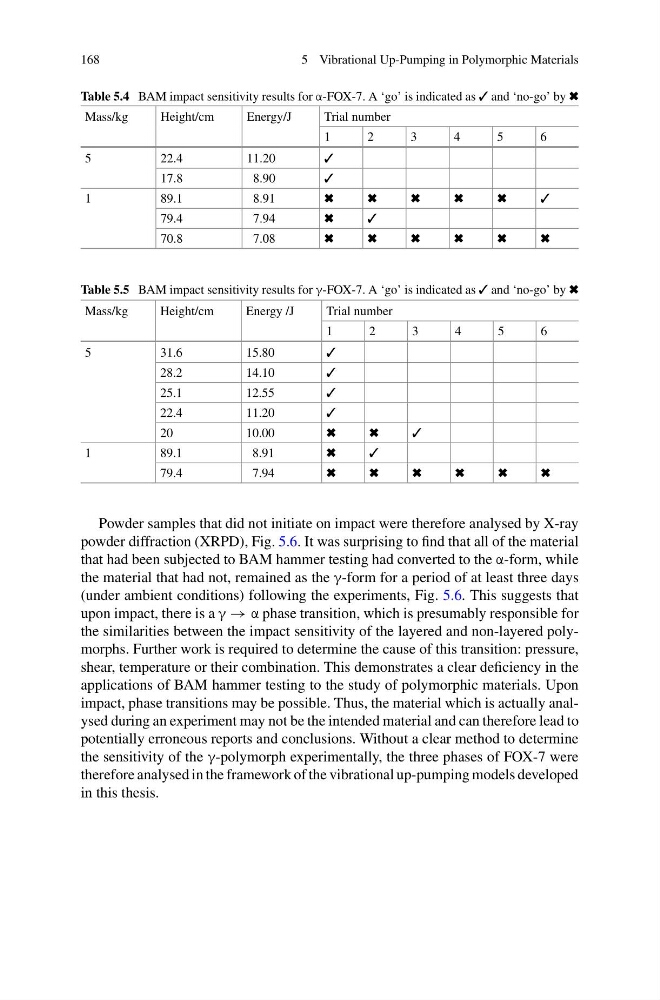
Table 5.4 BAM impact sensitivity results for α-FOX-7. A ‘go’ is indicated as ✓ and ‘no-go’ by ✖
Mass/kg
Height/cm
Energy/J
Trial number
1
2
3
4
5
6
5
22.4
11.20
✓
17.8
8.90
✓
1
89.1
8.91
✖
✖
✖
✖
✖
✓
79.4
7.94
✖
✓
70.8
7.08
✖
✖
✖
✖
✖
✖
Table 5.5 BAM impact sensitivity results for γ-FOX-7. A ‘go’ is indicated as ✓ and ‘no-go’ by ✖
Mass/kg
Height/cm
Energy /J
Trial number
1
2
3
4
5
6
5
31.6
15.80
✓
28.2
14.10
✓
25.1
12.55
✓
22.4
11.20
✓
20
10.00
✖
✖
✓
1
89.1
8.91
✖
✓
79.4
7.94
✖
✖
✖
✖
✖
✖
Powder samples that did not initiate on impact were therefore analysed by X-ray
powder diffraction (XRPD), Fig. 5.6. It was surprising to find that all of the material
that had been subjected to BAM hammer testing had converted to the α-form, while
the material that had not, remained as the γ-form for a period of at least three days
(under ambient conditions) following the experiments, Fig. 5.6. This suggests that
upon impact, there is a γ → α phase transition, which is presumably responsible for
the similarities between the impact sensitivity of the layered and non-layered polymorphs. Further work is required to determine the cause of this transition: pressure,
shear, temperature or their combination. This demonstrates a clear deficiency in the
applications of BAM hammer testing to the study of polymorphic materials. Upon
impact, phase transitions may be possible. Thus, the material which is actually analysed during an experiment may not be the intended material and can therefore lead to
potentially erroneous reports and conclusions. Without a clear method to determine
the sensitivity of the γ-polymorph experimentally, the three phases of FOX-7 were
therefore analysed in the framework of the vibrational up-pumping models developed
in this thesis.
5 Vibrational Up-Pumping in Polymorphic Materials
Table 5.4 BAM impact sensitivity results for α-FOX-7. A ‘go’ is indicated as ✓ and ‘no-go’ by ✖
Mass/kg
Height/cm
Energy/J
Trial number
1
2
3
4
5
6
5
22.4
11.20
✓
17.8
8.90
✓
1
89.1
8.91
✖
✖
✖
✖
✖
✓
79.4
7.94
✖
✓
70.8
7.08
✖
✖
✖
✖
✖
✖
Table 5.5 BAM impact sensitivity results for γ-FOX-7. A ‘go’ is indicated as ✓ and ‘no-go’ by ✖
Mass/kg
Height/cm
Energy /J
Trial number
1
2
3
4
5
6
5
31.6
15.80
✓
28.2
14.10
✓
25.1
12.55
✓
22.4
11.20
✓
20
10.00
✖
✖
✓
1
89.1
8.91
✖
✓
79.4
7.94
✖
✖
✖
✖
✖
✖
Powder samples that did not initiate on impact were therefore analysed by X-ray
powder diffraction (XRPD), Fig. 5.6. It was surprising to find that all of the material
that had been subjected to BAM hammer testing had converted to the α-form, while
the material that had not, remained as the γ-form for a period of at least three days
(under ambient conditions) following the experiments, Fig. 5.6. This suggests that
upon impact, there is a γ → α phase transition, which is presumably responsible for
the similarities between the impact sensitivity of the layered and non-layered polymorphs. Further work is required to determine the cause of this transition: pressure,
shear, temperature or their combination. This demonstrates a clear deficiency in the
applications of BAM hammer testing to the study of polymorphic materials. Upon
impact, phase transitions may be possible. Thus, the material which is actually analysed during an experiment may not be the intended material and can therefore lead to
potentially erroneous reports and conclusions. Without a clear method to determine
the sensitivity of the γ-polymorph experimentally, the three phases of FOX-7 were
therefore analysed in the framework of the vibrational up-pumping models developed
in this thesis.