

5.4 Results and Discussion
167
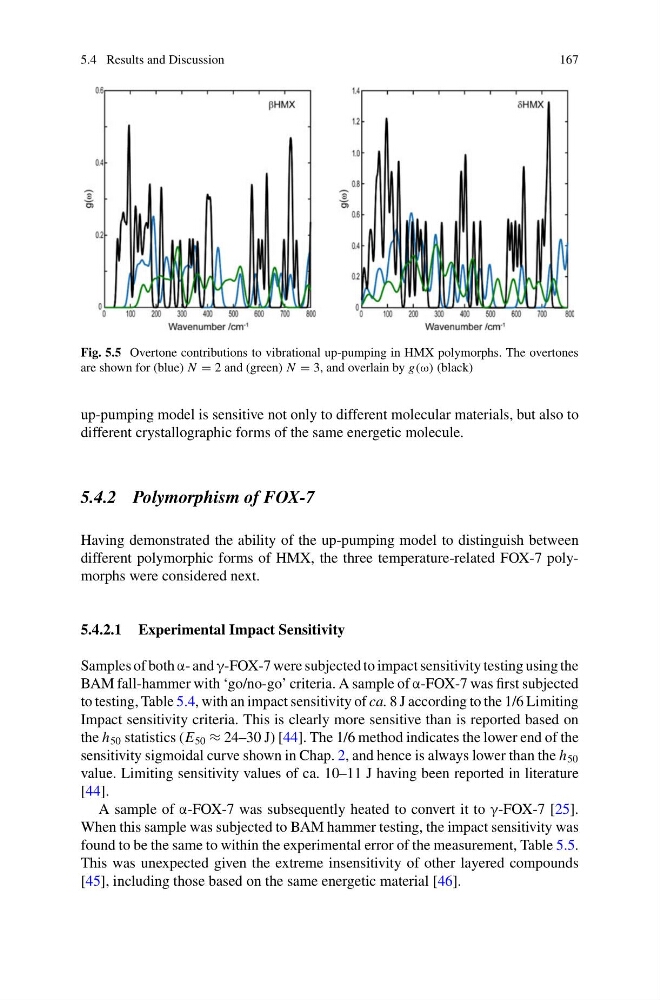
Fig. 5.5 Overtone contributions to vibrational up-pumping in HMX polymorphs. The overtones
are shown for (blue) N = 2 and (green) N = 3, and overlain by g(ω) (black)
up-pumping model is sensitive not only to different molecular materials, but also to
different crystallographic forms of the same energetic molecule.
5.4.2 Polymorphism of FOX-7
Having demonstrated the ability of the up-pumping model to distinguish between
different polymorphic forms of HMX, the three temperature-related FOX-7 polymorphs were considered next.
5.4.2.1 Experimental Impact Sensitivity
Samples of both α- and γ-FOX-7 were subjected to impact sensitivity testing using the
BAM fall-hammer with ‘go/no-go’ criteria. A sample of α-FOX-7 was first subjected
to testing, Table 5.4, with an impact sensitivity of ca. 8 J according to the 1/6 Limiting
Impact sensitivity criteria. This is clearly more sensitive than is reported based on
the h 50 statistics (E 50 ≈ 24–30 J) [44]. The 1/6 method indicates the lower end of the
sensitivity sigmoidal curve shown in Chap. 2, and hence is always lower than the h 50
value. Limiting sensitivity values of ca. 10–11 J having been reported in literature
[44].
A sample of α-FOX-7 was subsequently heated to convert it to γ-FOX-7 [25].
When this sample was subjected to BAM hammer testing, the impact sensitivity was
found to be the same to within the experimental error of the measurement, Table 5.5.
This was unexpected given the extreme insensitivity of other layered compounds
[45], including those based on the same energetic material [46].
167
Fig. 5.5 Overtone contributions to vibrational up-pumping in HMX polymorphs. The overtones
are shown for (blue) N = 2 and (green) N = 3, and overlain by g(ω) (black)
up-pumping model is sensitive not only to different molecular materials, but also to
different crystallographic forms of the same energetic molecule.
5.4.2 Polymorphism of FOX-7
Having demonstrated the ability of the up-pumping model to distinguish between
different polymorphic forms of HMX, the three temperature-related FOX-7 polymorphs were considered next.
5.4.2.1 Experimental Impact Sensitivity
Samples of both α- and γ-FOX-7 were subjected to impact sensitivity testing using the
BAM fall-hammer with ‘go/no-go’ criteria. A sample of α-FOX-7 was first subjected
to testing, Table 5.4, with an impact sensitivity of ca. 8 J according to the 1/6 Limiting
Impact sensitivity criteria. This is clearly more sensitive than is reported based on
the h 50 statistics (E 50 ≈ 24–30 J) [44]. The 1/6 method indicates the lower end of the
sensitivity sigmoidal curve shown in Chap. 2, and hence is always lower than the h 50
value. Limiting sensitivity values of ca. 10–11 J having been reported in literature
[44].
A sample of α-FOX-7 was subsequently heated to convert it to γ-FOX-7 [25].
When this sample was subjected to BAM hammer testing, the impact sensitivity was
found to be the same to within the experimental error of the measurement, Table 5.5.
This was unexpected given the extreme insensitivity of other layered compounds
[45], including those based on the same energetic material [46].