

166
5 Vibrational Up-Pumping in Polymorphic Materials
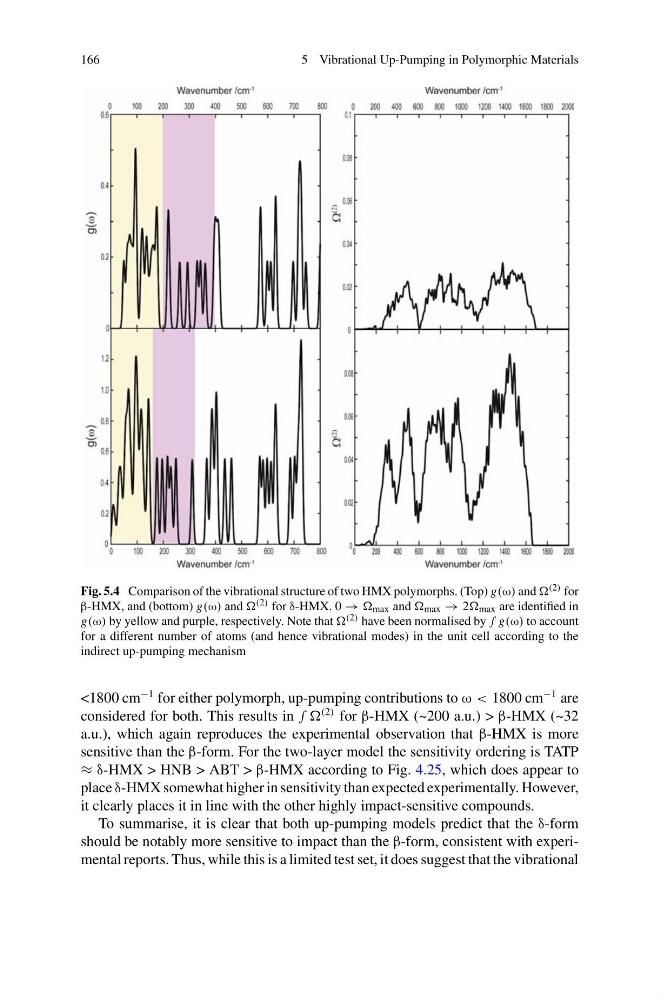
Fig. 5.4 Comparison of the vibrational structure of two HMX polymorphs. (Top) g(ω) and (2) for
β-HMX, and (bottom) g(ω) and (2) for δ-HMX. 0 → max and max → 2 max are identified in
g(ω) by yellow and purple, respectively. Note that (2) have been normalised by ∫ g(ω) to account
for a different number of atoms (and hence vibrational modes) in the unit cell according to the
indirect up-pumping mechanism
<1800 cm
−1 for either polymorph, up-pumping contributions to ω < 1800 cm
−1 are
considered for both. This results in ∫
(2) for β-HMX (~200 a.u.) > β-HMX (~32
a.u.), which again reproduces the experimental observation that β-HMX is more
sensitive than the β-form. For the two-layer model the sensitivity ordering is TATP
≈ δ-HMX > HNB > ABT > β-HMX according to Fig. 4.25, which does appear to
place δ-HMX somewhat higher in sensitivity than expected experimentally. However,
it clearly places it in line with the other highly impact-sensitive compounds.
To summarise, it is clear that both up-pumping models predict that the δ-form
should be notably more sensitive to impact than the β-form, consistent with experimental reports. Thus, while this is a limited test set, it does suggest that the vibrational
5 Vibrational Up-Pumping in Polymorphic Materials
Fig. 5.4 Comparison of the vibrational structure of two HMX polymorphs. (Top) g(ω) and (2) for
β-HMX, and (bottom) g(ω) and (2) for δ-HMX. 0 → max and max → 2 max are identified in
g(ω) by yellow and purple, respectively. Note that (2) have been normalised by ∫ g(ω) to account
for a different number of atoms (and hence vibrational modes) in the unit cell according to the
indirect up-pumping mechanism
<1800 cm
−1 for either polymorph, up-pumping contributions to ω < 1800 cm
−1 are
considered for both. This results in ∫
(2) for β-HMX (~200 a.u.) > β-HMX (~32
a.u.), which again reproduces the experimental observation that β-HMX is more
sensitive than the β-form. For the two-layer model the sensitivity ordering is TATP
≈ δ-HMX > HNB > ABT > β-HMX according to Fig. 4.25, which does appear to
place δ-HMX somewhat higher in sensitivity than expected experimentally. However,
it clearly places it in line with the other highly impact-sensitive compounds.
To summarise, it is clear that both up-pumping models predict that the δ-form
should be notably more sensitive to impact than the β-form, consistent with experimental reports. Thus, while this is a limited test set, it does suggest that the vibrational