

4.5 Results and Discussion
149
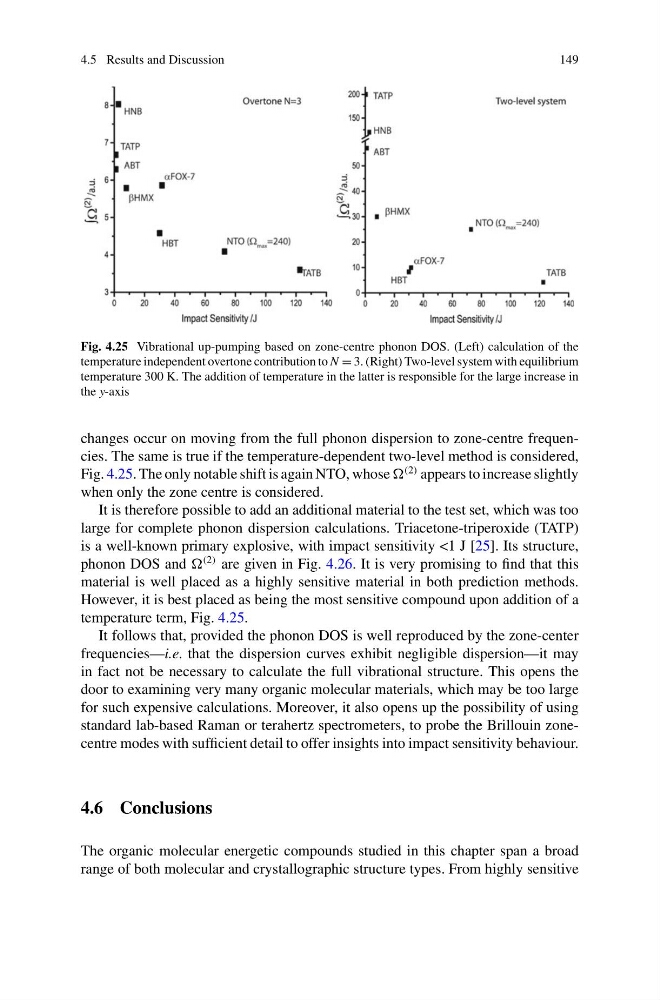
Fig. 4.25 Vibrational up-pumping based on zone-centre phonon DOS. (Left) calculation of the
temperature independent overtone contribution to N = 3. (Right) Two-level system with equilibrium
temperature 300 K. The addition of temperature in the latter is responsible for the large increase in
the y-axis
changes occur on moving from the full phonon dispersion to zone-centre frequencies. The same is true if the temperature-dependent two-level method is considered,
Fig. 4.25. The only notable shift is again NTO, whose
(2) appears to increase slightly
when only the zone centre is considered.
It is therefore possible to add an additional material to the test set, which was too
large for complete phonon dispersion calculations. Triacetone-triperoxide (TATP)
is a well-known primary explosive, with impact sensitivity <1 J [25]. Its structure,
phonon DOS and
(2) are given in Fig. 4.26. It is very promising to find that this
material is well placed as a highly sensitive material in both prediction methods.
However, it is best placed as being the most sensitive compound upon addition of a
temperature term, Fig. 4.25.
It follows that, provided the phonon DOS is well reproduced by the zone-center
frequencies—i.e. that the dispersion curves exhibit negligible dispersion—it may
in fact not be necessary to calculate the full vibrational structure. This opens the
door to examining very many organic molecular materials, which may be too large
for such expensive calculations. Moreover, it also opens up the possibility of using
standard lab-based Raman or terahertz spectrometers, to probe the Brillouin zonecentre modes with sufficient detail to offer insights into impact sensitivity behaviour.
4.6 Conclusions
The organic molecular energetic compounds studied in this chapter span a broad
range of both molecular and crystallographic structure types. From highly sensitive
149
Fig. 4.25 Vibrational up-pumping based on zone-centre phonon DOS. (Left) calculation of the
temperature independent overtone contribution to N = 3. (Right) Two-level system with equilibrium
temperature 300 K. The addition of temperature in the latter is responsible for the large increase in
the y-axis
changes occur on moving from the full phonon dispersion to zone-centre frequencies. The same is true if the temperature-dependent two-level method is considered,
Fig. 4.25. The only notable shift is again NTO, whose
(2) appears to increase slightly
when only the zone centre is considered.
It is therefore possible to add an additional material to the test set, which was too
large for complete phonon dispersion calculations. Triacetone-triperoxide (TATP)
is a well-known primary explosive, with impact sensitivity <1 J [25]. Its structure,
phonon DOS and
(2) are given in Fig. 4.26. It is very promising to find that this
material is well placed as a highly sensitive material in both prediction methods.
However, it is best placed as being the most sensitive compound upon addition of a
temperature term, Fig. 4.25.
It follows that, provided the phonon DOS is well reproduced by the zone-center
frequencies—i.e. that the dispersion curves exhibit negligible dispersion—it may
in fact not be necessary to calculate the full vibrational structure. This opens the
door to examining very many organic molecular materials, which may be too large
for such expensive calculations. Moreover, it also opens up the possibility of using
standard lab-based Raman or terahertz spectrometers, to probe the Brillouin zonecentre modes with sufficient detail to offer insights into impact sensitivity behaviour.
4.6 Conclusions
The organic molecular energetic compounds studied in this chapter span a broad
range of both molecular and crystallographic structure types. From highly sensitive