

150
4 Vibrational Up-Pumping in Some Molecular Energetic Materials
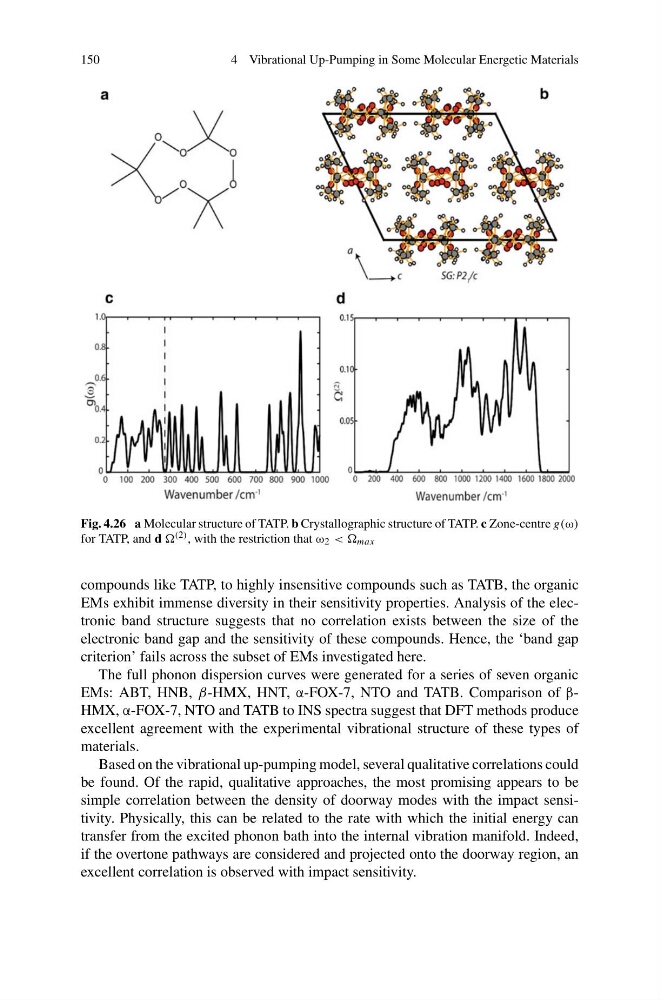
Fig. 4.26 a Molecular structure of TATP. b Crystallographic structure of TATP. c Zone-centre g(ω)
for TATP, and d (2) , with the restriction that ω 2 < < max
compounds like TATP, to highly insensitive compounds such as TATB, the organic
EMs exhibit immense diversity in their sensitivity properties. Analysis of the electronic band structure suggests that no correlation exists between the size of the
electronic band gap and the sensitivity of these compounds. Hence, the ‘band gap
criterion’ fails across the subset of EMs investigated here.
The full phonon dispersion curves were generated for a series of seven organic
EMs: ABT, HNB, β-HMX, HNT, α-FOX-7, NTO and TATB. Comparison of βHMX, α-FOX-7, NTO and TATB to INS spectra suggest that DFT methods produce
excellent agreement with the experimental vibrational structure of these types of
materials.
Based on the vibrational up-pumping model, several qualitative correlations could
be found. Of the rapid, qualitative approaches, the most promising appears to be
simple correlation between the density of doorway modes with the impact sensitivity. Physically, this can be related to the rate with which the initial energy can
transfer from the excited phonon bath into the internal vibration manifold. Indeed,
if the overtone pathways are considered and projected onto the doorway region, an
excellent correlation is observed with impact sensitivity.
4 Vibrational Up-Pumping in Some Molecular Energetic Materials
Fig. 4.26 a Molecular structure of TATP. b Crystallographic structure of TATP. c Zone-centre g(ω)
for TATP, and d (2) , with the restriction that ω 2 < < max
compounds like TATP, to highly insensitive compounds such as TATB, the organic
EMs exhibit immense diversity in their sensitivity properties. Analysis of the electronic band structure suggests that no correlation exists between the size of the
electronic band gap and the sensitivity of these compounds. Hence, the ‘band gap
criterion’ fails across the subset of EMs investigated here.
The full phonon dispersion curves were generated for a series of seven organic
EMs: ABT, HNB, β-HMX, HNT, α-FOX-7, NTO and TATB. Comparison of βHMX, α-FOX-7, NTO and TATB to INS spectra suggest that DFT methods produce
excellent agreement with the experimental vibrational structure of these types of
materials.
Based on the vibrational up-pumping model, several qualitative correlations could
be found. Of the rapid, qualitative approaches, the most promising appears to be
simple correlation between the density of doorway modes with the impact sensitivity. Physically, this can be related to the rate with which the initial energy can
transfer from the excited phonon bath into the internal vibration manifold. Indeed,
if the overtone pathways are considered and projected onto the doorway region, an
excellent correlation is observed with impact sensitivity.