

148
4 Vibrational Up-Pumping in Some Molecular Energetic Materials
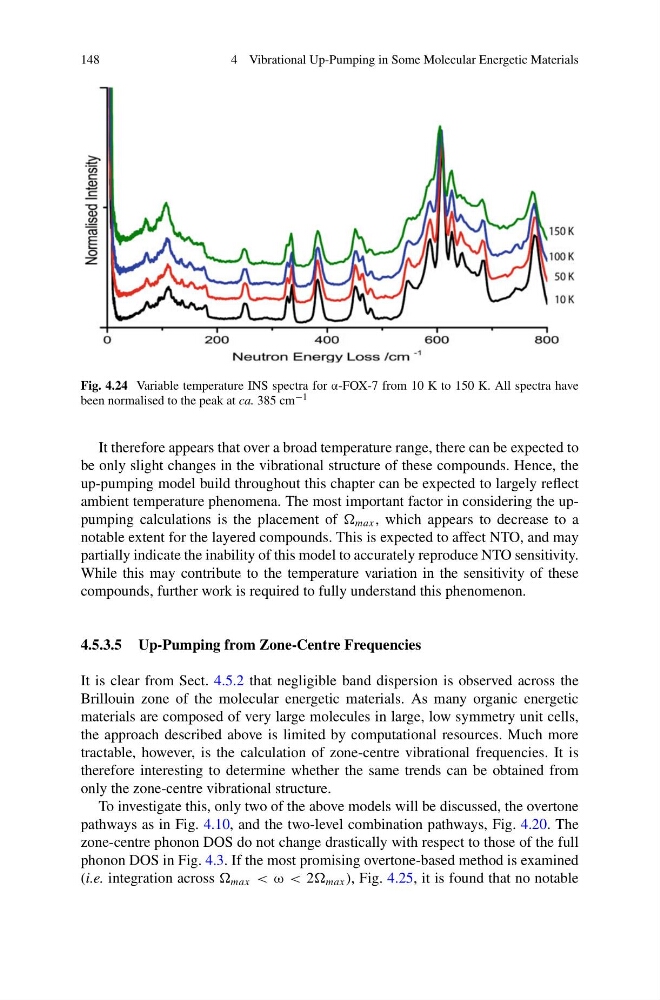
Fig. 4.24 Variable temperature INS spectra for α-FOX-7 from 10 K to 150 K. All spectra have
been normalised to the peak at ca. 385 cm −1
It therefore appears that over a broad temperature range, there can be expected to
be only slight changes in the vibrational structure of these compounds. Hence, the
up-pumping model build throughout this chapter can be expected to largely reflect
ambient temperature phenomena. The most important factor in considering the uppumping calculations is the placement of max , which appears to decrease to a
notable extent for the layered compounds. This is expected to affect NTO, and may
partially indicate the inability of this model to accurately reproduce NTO sensitivity.
While this may contribute to the temperature variation in the sensitivity of these
compounds, further work is required to fully understand this phenomenon.
4.5.3.5 Up-Pumping from Zone-Centre Frequencies
It is clear from Sect. 4.5.2 that negligible band dispersion is observed across the
Brillouin zone of the molecular energetic materials. As many organic energetic
materials are composed of very large molecules in large, low symmetry unit cells,
the approach described above is limited by computational resources. Much more
tractable, however, is the calculation of zone-centre vibrational frequencies. It is
therefore interesting to determine whether the same trends can be obtained from
only the zone-centre vibrational structure.
To investigate this, only two of the above models will be discussed, the overtone
pathways as in Fig. 4.10, and the two-level combination pathways, Fig. 4.20. The
zone-centre phonon DOS do not change drastically with respect to those of the full
phonon DOS in Fig. 4.3. If the most promising overtone-based method is examined
(i.e. integration across max < ω < 2 max ), Fig. 4.25, it is found that no notable
4 Vibrational Up-Pumping in Some Molecular Energetic Materials
Fig. 4.24 Variable temperature INS spectra for α-FOX-7 from 10 K to 150 K. All spectra have
been normalised to the peak at ca. 385 cm −1
It therefore appears that over a broad temperature range, there can be expected to
be only slight changes in the vibrational structure of these compounds. Hence, the
up-pumping model build throughout this chapter can be expected to largely reflect
ambient temperature phenomena. The most important factor in considering the uppumping calculations is the placement of max , which appears to decrease to a
notable extent for the layered compounds. This is expected to affect NTO, and may
partially indicate the inability of this model to accurately reproduce NTO sensitivity.
While this may contribute to the temperature variation in the sensitivity of these
compounds, further work is required to fully understand this phenomenon.
4.5.3.5 Up-Pumping from Zone-Centre Frequencies
It is clear from Sect. 4.5.2 that negligible band dispersion is observed across the
Brillouin zone of the molecular energetic materials. As many organic energetic
materials are composed of very large molecules in large, low symmetry unit cells,
the approach described above is limited by computational resources. Much more
tractable, however, is the calculation of zone-centre vibrational frequencies. It is
therefore interesting to determine whether the same trends can be obtained from
only the zone-centre vibrational structure.
To investigate this, only two of the above models will be discussed, the overtone
pathways as in Fig. 4.10, and the two-level combination pathways, Fig. 4.20. The
zone-centre phonon DOS do not change drastically with respect to those of the full
phonon DOS in Fig. 4.3. If the most promising overtone-based method is examined
(i.e. integration across max < ω < 2 max ), Fig. 4.25, it is found that no notable