

4.5 Results and Discussion
145
Fine-tuning of the model proposed here requires a more fundamental knowledge of
which frequencies are in fact responsible for decomposition processes.
Extending this shock model across different systems requires consideration of
the phonon heat capacities, C ph , which can be approximated by assuming within the
Einstein model that each phonon mode contributes k B to the heat capacity at and
above ambient conditions. Upon impact with the same energy, U , the total amount
of energy transferred to the material as heat depends on the compressibility of the
material, Eq. 3.1. However, without data on the compressibility of the materials used
here, it can be roughly assumed that all of the molecular materials will behave roughly
the same. This is generally a good approximation, with available ambient pressure
bulk moduli of these materials being very similar (HMX, 14.3 GPa [28]; FOX-7,
12.6 ± 1.4 GPa [29]; TATB, 14.7 ± 0.8 GPa [30]). It can therefore be assumed
that the same proportion of input energy transforms into heat for these materials.
Without knowledge of the system-dependent Grüneisen parameters, it is not possible
to estimate final bulk equilibrium temperatures. However, for the purpose of the
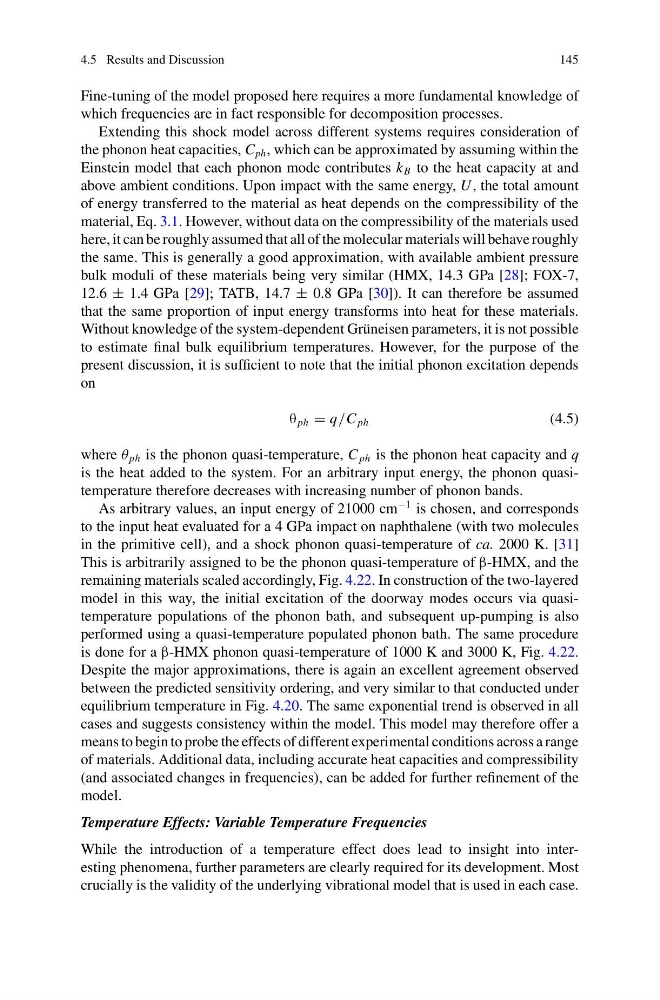
present discussion, it is sufficient to note that the initial phonon excitation depends
on
θ ph = q/C ph
(4.5)
where θ ph is the phonon quasi-temperature, C ph is the phonon heat capacity and q
is the heat added to the system. For an arbitrary input energy, the phonon quasitemperature therefore decreases with increasing number of phonon bands.
As arbitrary values, an input energy of 21000 cm
−1 is chosen, and corresponds
to the input heat evaluated for a 4 GPa impact on naphthalene (with two molecules
in the primitive cell), and a shock phonon quasi-temperature of ca. 2000 K. [31]
This is arbitrarily assigned to be the phonon quasi-temperature of β-HMX, and the
remaining materials scaled accordingly, Fig. 4.22. In construction of the two-layered
model in this way, the initial excitation of the doorway modes occurs via quasitemperature populations of the phonon bath, and subsequent up-pumping is also
performed using a quasi-temperature populated phonon bath. The same procedure
is done for a β-HMX phonon quasi-temperature of 1000 K and 3000 K, Fig. 4.22.
Despite the major approximations, there is again an excellent agreement observed
between the predicted sensitivity ordering, and very similar to that conducted under
equilibrium temperature in Fig. 4.20. The same exponential trend is observed in all
cases and suggests consistency within the model. This model may therefore offer a
means to begin to probe the effects of different experimental conditions across a range
of materials. Additional data, including accurate heat capacities and compressibility
(and associated changes in frequencies), can be added for further refinement of the
model.
Temperature Effects: Variable Temperature Frequencies
While the introduction of a temperature effect does lead to insight into interesting phenomena, further parameters are clearly required for its development. Most
crucially is the validity of the underlying vibrational model that is used in each case.
145
Fine-tuning of the model proposed here requires a more fundamental knowledge of
which frequencies are in fact responsible for decomposition processes.
Extending this shock model across different systems requires consideration of
the phonon heat capacities, C ph , which can be approximated by assuming within the
Einstein model that each phonon mode contributes k B to the heat capacity at and
above ambient conditions. Upon impact with the same energy, U , the total amount
of energy transferred to the material as heat depends on the compressibility of the
material, Eq. 3.1. However, without data on the compressibility of the materials used
here, it can be roughly assumed that all of the molecular materials will behave roughly
the same. This is generally a good approximation, with available ambient pressure
bulk moduli of these materials being very similar (HMX, 14.3 GPa [28]; FOX-7,
12.6 ± 1.4 GPa [29]; TATB, 14.7 ± 0.8 GPa [30]). It can therefore be assumed
that the same proportion of input energy transforms into heat for these materials.
Without knowledge of the system-dependent Grüneisen parameters, it is not possible
to estimate final bulk equilibrium temperatures. However, for the purpose of the
present discussion, it is sufficient to note that the initial phonon excitation depends
on
θ ph = q/C ph
(4.5)
where θ ph is the phonon quasi-temperature, C ph is the phonon heat capacity and q
is the heat added to the system. For an arbitrary input energy, the phonon quasitemperature therefore decreases with increasing number of phonon bands.
As arbitrary values, an input energy of 21000 cm
−1 is chosen, and corresponds
to the input heat evaluated for a 4 GPa impact on naphthalene (with two molecules
in the primitive cell), and a shock phonon quasi-temperature of ca. 2000 K. [31]
This is arbitrarily assigned to be the phonon quasi-temperature of β-HMX, and the
remaining materials scaled accordingly, Fig. 4.22. In construction of the two-layered
model in this way, the initial excitation of the doorway modes occurs via quasitemperature populations of the phonon bath, and subsequent up-pumping is also
performed using a quasi-temperature populated phonon bath. The same procedure
is done for a β-HMX phonon quasi-temperature of 1000 K and 3000 K, Fig. 4.22.
Despite the major approximations, there is again an excellent agreement observed
between the predicted sensitivity ordering, and very similar to that conducted under
equilibrium temperature in Fig. 4.20. The same exponential trend is observed in all
cases and suggests consistency within the model. This model may therefore offer a
means to begin to probe the effects of different experimental conditions across a range
of materials. Additional data, including accurate heat capacities and compressibility
(and associated changes in frequencies), can be added for further refinement of the
model.
Temperature Effects: Variable Temperature Frequencies
While the introduction of a temperature effect does lead to insight into interesting phenomena, further parameters are clearly required for its development. Most
crucially is the validity of the underlying vibrational model that is used in each case.