

144
4 Vibrational Up-Pumping in Some Molecular Energetic Materials
-NO 2 rocking modes are placed within the phonon bath,
(2) comes in line with other
materials in its sensitivity class. However, it falls in line with the highly sensitive
compounds if max = 200 cm
−1 is used. This once again suggests that these modes
should be included in the phonon manifold when present at such low frequencies.
For the purpose of the remaining discussion, these rocking modes will therefore be
assumed to form part of the amalgamated phonon bath.
Overall, it is remarkable that the simplifications made here reproduce the experimental sensitivity ordering to such an extent. With further investigation into the
intricate interplay of electronic factors, as well as the system dependent normalisation coefficients, A in Eqs. 4.3 and 4.4, this model seems promising for understanding
the impact sensitivity of organic EMs. As no experimental data were available against
which to compare variable temperature predictions, this will not be discussed further
here. However, the model does reflect the qualitative trend of decreasing sensitivity of
all compounds as T → 0 K, and hence convergence of intrinsic material sensitivities.
The addition of temperature effects introduces the ability to investigate which
modes can become activated upon initial excitation of the lattice. This is done by
separating the initial temperatures of the phonon bath modes, T p , to be different from
the remaining modes. In the two-stage construction, this leads to construction of the
doorway mode populations based on initial T p excitation. While limited experimental
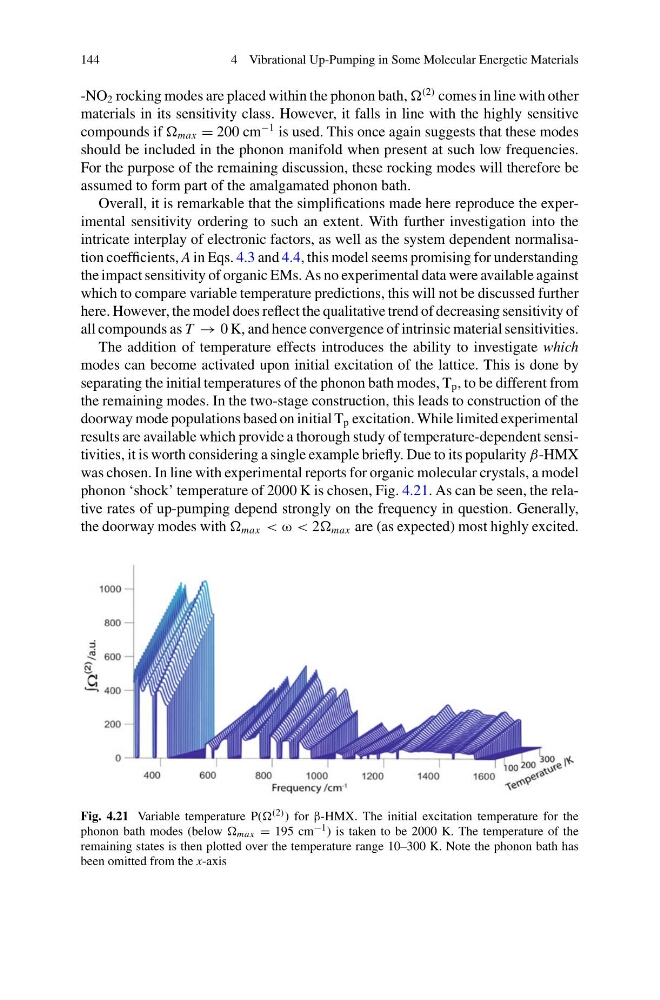
results are available which provide a thorough study of temperature-dependent sensitivities, it is worth considering a single example briefly. Due to its popularity β-HMX
was chosen. In line with experimental reports for organic molecular crystals, a model
phonon ‘shock’ temperature of 2000 K is chosen, Fig. 4.21. As can be seen, the relative rates of up-pumping depend strongly on the frequency in question. Generally,
the doorway modes with max < ω < 2 max are (as expected) most highly excited.
Fig. 4.21 Variable temperature P( (2) ) for β-HMX. The initial excitation temperature for the
phonon bath modes (below max = 195 cm −1 ) is taken to be 2000 K. The temperature of the
remaining states is then plotted over the temperature range 10–300 K. Note the phonon bath has
been omitted from the x-axis
4 Vibrational Up-Pumping in Some Molecular Energetic Materials
-NO 2 rocking modes are placed within the phonon bath,
(2) comes in line with other
materials in its sensitivity class. However, it falls in line with the highly sensitive
compounds if max = 200 cm
−1 is used. This once again suggests that these modes
should be included in the phonon manifold when present at such low frequencies.
For the purpose of the remaining discussion, these rocking modes will therefore be
assumed to form part of the amalgamated phonon bath.
Overall, it is remarkable that the simplifications made here reproduce the experimental sensitivity ordering to such an extent. With further investigation into the
intricate interplay of electronic factors, as well as the system dependent normalisation coefficients, A in Eqs. 4.3 and 4.4, this model seems promising for understanding
the impact sensitivity of organic EMs. As no experimental data were available against
which to compare variable temperature predictions, this will not be discussed further
here. However, the model does reflect the qualitative trend of decreasing sensitivity of
all compounds as T → 0 K, and hence convergence of intrinsic material sensitivities.
The addition of temperature effects introduces the ability to investigate which
modes can become activated upon initial excitation of the lattice. This is done by
separating the initial temperatures of the phonon bath modes, T p , to be different from
the remaining modes. In the two-stage construction, this leads to construction of the
doorway mode populations based on initial T p excitation. While limited experimental
results are available which provide a thorough study of temperature-dependent sensitivities, it is worth considering a single example briefly. Due to its popularity β-HMX
was chosen. In line with experimental reports for organic molecular crystals, a model
phonon ‘shock’ temperature of 2000 K is chosen, Fig. 4.21. As can be seen, the relative rates of up-pumping depend strongly on the frequency in question. Generally,
the doorway modes with max < ω < 2 max are (as expected) most highly excited.
Fig. 4.21 Variable temperature P( (2) ) for β-HMX. The initial excitation temperature for the
phonon bath modes (below max = 195 cm −1 ) is taken to be 2000 K. The temperature of the
remaining states is then plotted over the temperature range 10–300 K. Note the phonon bath has
been omitted from the x-axis