

4.5 Results and Discussion
143
Further development of the model is clearly required to resolve this situation. In
the first instance, three physical suggestions can be proposed to account for this:
1. The thermal expansion of the material leads to softening of the phonon bath
modes, and hence a decrease in max
2. The bond dissociation energy of NTO is considerably higher than for the more
sensitive compounds, and electronic effects become dominant in this compound.
3. A considerably different anharmonic constant occurs for this compound as
compared with the others in the test set.
While the two-level model may not explicitly be required, it has been observed
that up-pumping rates of overtones greatly exceed those of combination bands, by
an order of magnitude in some materials [61]. Hence it is worth re-examining the
temperature effects under the construction of the two-level model of Sect. 4.5.3.3 (i.e.
population of doorway states by the first overtone, followed by combination mode
up-pumping). This is accomplished by first thermally exciting g(ω) and projecting
the first overtone (i.e. N = 2) onto the doorway frequencies as in Fig. 4.14. The
remaining g(ω) remains thermally populated, and the combination pathways (i.e.
(2) ) are calculated, maintaining ω 2 < < max . For the purpose of this discussion, the
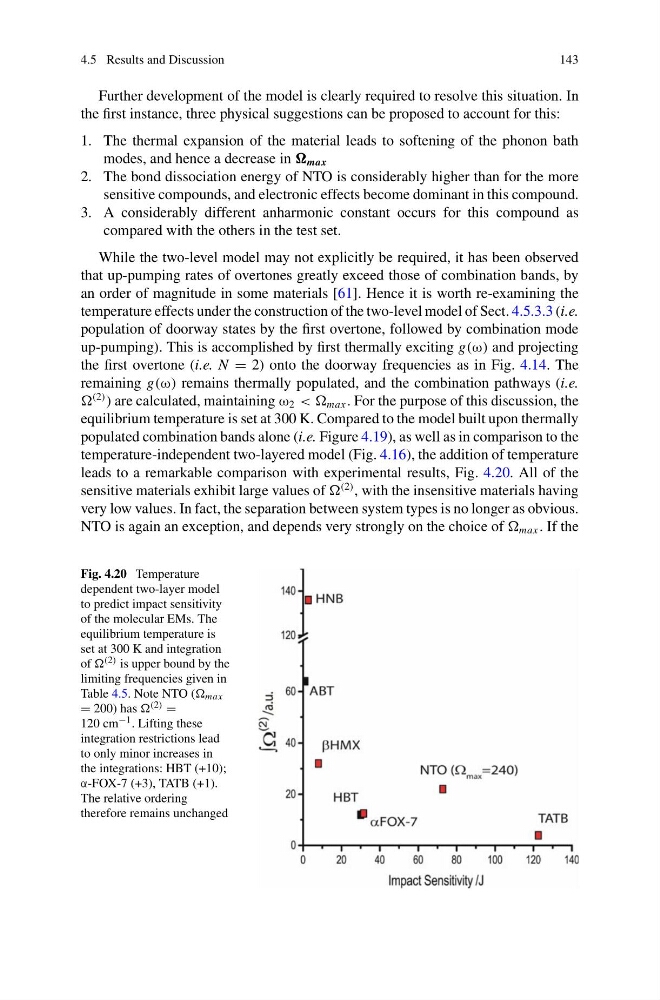
equilibrium temperature is set at 300 K. Compared to the model built upon thermally
populated combination bands alone (i.e. Figure 4.19), as well as in comparison to the
temperature-independent two-layered model (Fig. 4.16), the addition of temperature
leads to a remarkable comparison with experimental results, Fig. 4.20. All of the
sensitive materials exhibit large values of
(2) , with the insensitive materials having
very low values. In fact, the separation between system types is no longer as obvious.
NTO is again an exception, and depends very strongly on the choice of max . If the
Fig. 4.20 Temperature
dependent two-layer model
to predict impact sensitivity
of the molecular EMs. The
equilibrium temperature is
set at 300 K and integration
of (2) is upper bound by the
limiting frequencies given in
Table 4.5. Note NTO ( max
= 200) has (2) =
120 cm −1 . Lifting these
integration restrictions lead
to only minor increases in
the integrations: HBT (+10);
α-FOX-7 (+3), TATB (+1).
The relative ordering
therefore remains unchanged
143
Further development of the model is clearly required to resolve this situation. In
the first instance, three physical suggestions can be proposed to account for this:
1. The thermal expansion of the material leads to softening of the phonon bath
modes, and hence a decrease in max
2. The bond dissociation energy of NTO is considerably higher than for the more
sensitive compounds, and electronic effects become dominant in this compound.
3. A considerably different anharmonic constant occurs for this compound as
compared with the others in the test set.
While the two-level model may not explicitly be required, it has been observed
that up-pumping rates of overtones greatly exceed those of combination bands, by
an order of magnitude in some materials [61]. Hence it is worth re-examining the
temperature effects under the construction of the two-level model of Sect. 4.5.3.3 (i.e.
population of doorway states by the first overtone, followed by combination mode
up-pumping). This is accomplished by first thermally exciting g(ω) and projecting
the first overtone (i.e. N = 2) onto the doorway frequencies as in Fig. 4.14. The
remaining g(ω) remains thermally populated, and the combination pathways (i.e.
(2) ) are calculated, maintaining ω 2 < < max . For the purpose of this discussion, the
equilibrium temperature is set at 300 K. Compared to the model built upon thermally
populated combination bands alone (i.e. Figure 4.19), as well as in comparison to the
temperature-independent two-layered model (Fig. 4.16), the addition of temperature
leads to a remarkable comparison with experimental results, Fig. 4.20. All of the
sensitive materials exhibit large values of
(2) , with the insensitive materials having
very low values. In fact, the separation between system types is no longer as obvious.
NTO is again an exception, and depends very strongly on the choice of max . If the
Fig. 4.20 Temperature
dependent two-layer model
to predict impact sensitivity
of the molecular EMs. The
equilibrium temperature is
set at 300 K and integration
of (2) is upper bound by the
limiting frequencies given in
Table 4.5. Note NTO ( max
= 200) has (2) =
120 cm −1 . Lifting these
integration restrictions lead
to only minor increases in
the integrations: HBT (+10);
α-FOX-7 (+3), TATB (+1).
The relative ordering
therefore remains unchanged