

142
4 Vibrational Up-Pumping in Some Molecular Energetic Materials
Table 4.5 Limiting
frequencies for the full (2)
for the molecular energetic
materials
(2) = 0/cm −1
ABT
–
HNB
–
β-HMX
–
HBT
600
α-FOX-7
1034
NTO
–
TATB
1028
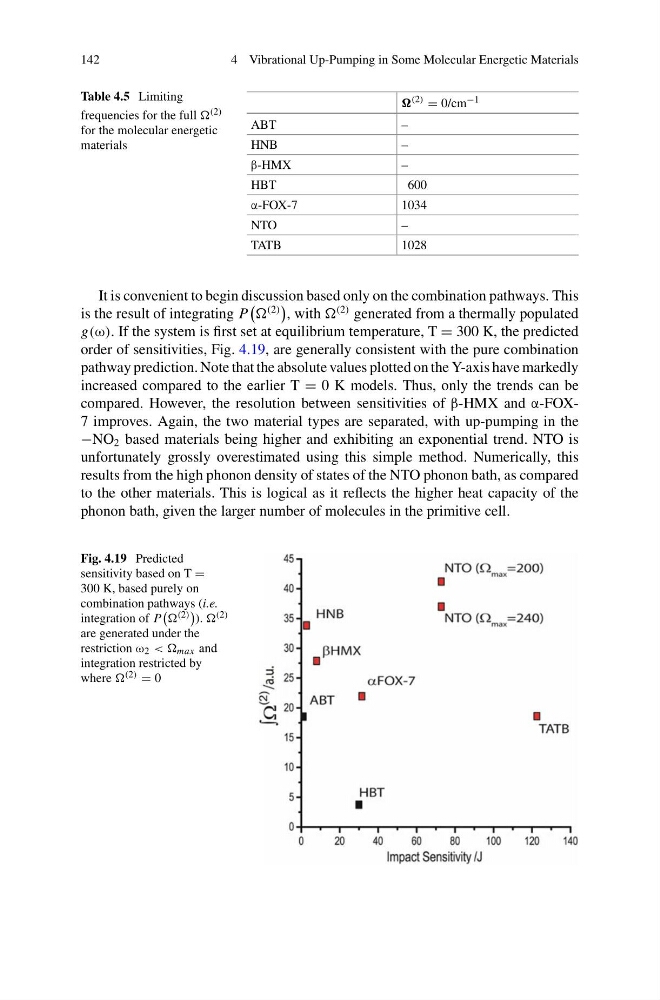
It is convenient to begin discussion based only on the combination pathways. This
is the result of integrating P
(2)
, with
(2) generated from a thermally populated
g(ω). If the system is first set at equilibrium temperature, T = 300 K, the predicted
order of sensitivities, Fig. 4.19, are generally consistent with the pure combination
pathway prediction. Note that the absolute values plotted on the Y-axis have markedly
increased compared to the earlier T = 0 K models. Thus, only the trends can be
compared. However, the resolution between sensitivities of β-HMX and α-FOX7 improves. Again, the two material types are separated, with up-pumping in the
−NO 2 based materials being higher and exhibiting an exponential trend. NTO is
unfortunately grossly overestimated using this simple method. Numerically, this
results from the high phonon density of states of the NTO phonon bath, as compared
to the other materials. This is logical as it reflects the higher heat capacity of the
phonon bath, given the larger number of molecules in the primitive cell.
Fig. 4.19 Predicted
sensitivity based on T =
300 K, based purely on
combination pathways (i.e.
integration of P
(2)
). (2)
are generated under the
restriction ω 2 < < max and
integration restricted by
where (2) = 0
4 Vibrational Up-Pumping in Some Molecular Energetic Materials
Table 4.5 Limiting
frequencies for the full (2)
for the molecular energetic
materials
(2) = 0/cm −1
ABT
–
HNB
–
β-HMX
–
HBT
600
α-FOX-7
1034
NTO
–
TATB
1028
It is convenient to begin discussion based only on the combination pathways. This
is the result of integrating P
(2)
, with
(2) generated from a thermally populated
g(ω). If the system is first set at equilibrium temperature, T = 300 K, the predicted
order of sensitivities, Fig. 4.19, are generally consistent with the pure combination
pathway prediction. Note that the absolute values plotted on the Y-axis have markedly
increased compared to the earlier T = 0 K models. Thus, only the trends can be
compared. However, the resolution between sensitivities of β-HMX and α-FOX7 improves. Again, the two material types are separated, with up-pumping in the
−NO 2 based materials being higher and exhibiting an exponential trend. NTO is
unfortunately grossly overestimated using this simple method. Numerically, this
results from the high phonon density of states of the NTO phonon bath, as compared
to the other materials. This is logical as it reflects the higher heat capacity of the
phonon bath, given the larger number of molecules in the primitive cell.
Fig. 4.19 Predicted
sensitivity based on T =
300 K, based purely on
combination pathways (i.e.
integration of P
(2)
). (2)
are generated under the
restriction ω 2 < < max and
integration restricted by
where (2) = 0